Libraries
780+ HR templates
Everything your business needs to stay compliant
Policies, contracts, letters, guidance and HR support tools for UK employers.
View full libraryPolicies, contracts, letters, guidance and HR support tools for UK employers.
View full libraryThis Reminder of Confidentiality Agreement Letter provides a formal reminder to an employee of their existing obligations to protect confidential business information. It reinforces the importance of handling company, customer, employee and commercially sensitive information appropriately, while clarifying the employee's responsibilities and the limits of confidentiality obligations.
Use this template to:

If you are managing workplace confidentiality, the toolkit brings together practical HR templates covering confidentiality requirements, communication, controls, monitoring and exit arrangements.
This template brings together the key information, sections and considerations you need to create a clear, comprehensive and professional HR document. Preview the document below.
[Sender name]
[Sender address]
[date]
[Recipient name]
[Recipient address]
Dear [Recipient first name],
Reminder of confidentiality obligations
I am writing to remind you of your existing confidentiality obligations under your [employment contract / confidentiality agreement] dated [Date of Agreement]. These obligations remain applicable in accordance with the terms of that agreement.
Protecting confidential information is important to [Company Name], our customers, suppliers, employees and business operations. All employees are expected to handle such information responsibly and in accordance with their contractual obligations and the organisation's relevant policies and procedures.
Information covered by your obligations
Depending on the terms of your agreement, confidential information may include:
You've seen 20% of how the Reminder of confidentiality agreement letter template is structured. Get the complete editable template instantly and customise it for your organisation.
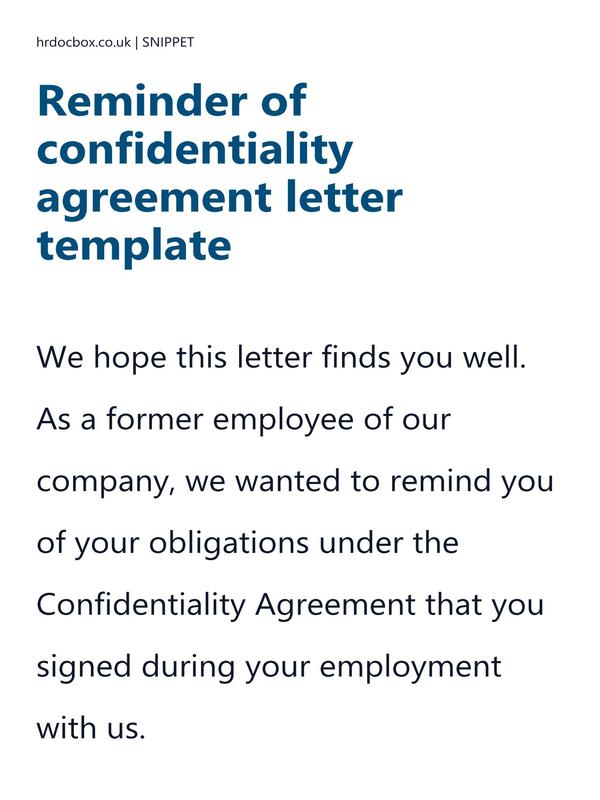
This letter provides a clear and professional way to remind an employee of confidentiality obligations already contained in their employment contract, a separate confidentiality agreement or another applicable agreement. It can be used as a general reminder or adapted to address a particular concern about how information is being handled.
The letter should identify the relevant agreement or contractual provision and explain that the employee is expected to continue complying with it. It should not be used to introduce new contractual restrictions without following an appropriate process.
Confidential information may include commercially sensitive information, pricing, customer details, supplier terms, business plans, financial information, intellectual property, internal processes and personal information. The letter should reflect the information actually covered by the existing agreement rather than assuming that every piece of workplace information is confidential.
Employees should understand that confidential information must only be accessed, used, stored and shared for legitimate authorised purposes. This includes taking care when using email, messaging applications, personal devices, cloud storage, external AI tools and conversations outside work.
Confidentiality obligations must not be presented as preventing employees from making protected disclosures, reporting suspected crimes, raising discrimination or harassment concerns, exercising employment rights or obtaining appropriate professional advice. The wording should reflect the actual agreement and applicable law.
Where a specific incident has prompted the reminder, the organisation should distinguish between a general reminder and a formal allegation of misconduct. If a potential breach requires investigation or disciplinary action, the appropriate process should be followed separately.
A written reminder helps establish that the organisation has communicated its expectations. The letter should be retained appropriately, with access limited to those who need it, and should not be treated as proof that a breach occurred or as a substitute for a properly drafted confidentiality agreement.
Related HR resources and workflow
Explore the HR resources that may be relevant before and / or after using the Reminder of confidentiality agreement letter, helping you understand the wider process, maintain appropriate documentation and follow a consistent approach.

This Confidentiality Agreement provides a clear framework for protecting confidential business, employee, customer and other sensitive information shared or accessed during employment or other working arrangements.

If you wish to notify a former employee's new employer that the employee is obliged to not share confidential information with them, send this model letter.
Use these best practice actions, recommended timescales and process stages to understand when and how the Reminder of confidentiality agreement letter should be used, helping ensure each step is handled consistently and appropriately documented.
Understand the common mistakes to avoid when using this HR template, helping you reduce risk, prevent unnecessary costs and ensure the process is handled correctly.
A reminder may be appropriate as part of a general information security exercise, when an employee changes role or gains access to more sensitive information, or when a concern arises about how confidential information is being handled. The letter should reflect the actual circumstances and the existing agreement.
Not usually. A reminder letter generally records the employer's communication of existing obligations rather than creating a new agreement. The employer can retain a copy and record when it was issued. If the organisation needs the employee to enter into a new or amended agreement, that should be dealt with separately.
Yes, if a reminder is a proportionate response to the circumstances. However, the letter should not state that a breach has been established unless the relevant facts support that conclusion. Where a potential breach requires investigation or disciplinary action, the appropriate process should be followed separately.
Some confidentiality obligations may continue after employment ends, depending on the terms of the agreement, the information concerned and the applicable law. The employer should check the relevant wording rather than assume that every contractual confidentiality restriction continues indefinitely.
Confidentiality obligations do not override legal protections for qualifying whistleblowing disclosures or other disclosures protected by law. The circumstances and applicable protections matter, so the letter should not impose a blanket ban on employees discussing workplace concerns or seeking appropriate advice.
HRDocBox provides a structured UK HR letter designed to reinforce existing confidentiality obligations without automatically treating a reminder as a new agreement or a disciplinary finding. It also prompts employers to consider lawful disclosures, employee rights and the practical handling of confidential information—areas that generic AI-generated wording may overlook.
How this content is developed and reviewed
The Reminder of confidentiality agreement letter template is developed using a practical HR methodology that considers current UK employment legislation, ACAS guidance, CIPD good practice and the real-world HR process it supports. Templates and supporting information are regularly reviewed and updated, with additional reviews triggered by significant changes to legislation, guidance or established HR practice, helping ensure each document remains practical, relevant and suitable for UK employers.
Darryl Horn, Chartered HR Director
Darryl is a Chartered HR professional with over 25 years' experience in senior HR and employee relations roles.
He has extensive practical experience of managing confidentiality HR processes and founded hrdocbox to provide businesses with practical, professionally developed HR resources grounded in UK employment law and best practice.
HRDocBox has been creating practical UK HR documents since 2009.
"Darryl provides support and advice with excellent judgement, and has a strong understanding of people, policies and UK employment legislation."
"He is someone I trust; consistent, dependable, and committed to doing things properly."



















Whether you employ 5 people or 50, hrdocbox gives you the structure, documents and expertise needed to manage employees professionally and legally.
Professionally written and fully compliant with UK employment law

Access a free contract template instantly - or save 10% on any document today.
Use this code at checkout for 10% off anything!
Includes instant download, updates, and full access to your HR templates.