Fertility leave policy template

£19.99
UK-specific Editable Instant download 12 months' updates

A fertility leave policy setting out the organisation's approach to supporting employees undergoing fertility treatment, including time off for appointments, treatment-related absence, confidentiality, flexibility and appropriate support throughout the process.

Use this template to:
  • Set out the organisation's approach to fertility-related leave and time off
  • Provide a clear framework for employees undergoing fertility treatment
  • Explain arrangements for fertility treatment appointments and related absence
  • Support managers in responding sensitively and consistently to requests
  • Protect employee confidentiality and privacy
  • Explain how fertility treatment interacts with sickness, pregnancy and other relevant policies
Fertility leave policy template
2026 Reviewed

What's included in this template?

This template brings together the key information, sections and considerations you need to create a clear, comprehensive and professional HR document. Preview the document below.

  • Purpose and scope of the policy
  • Fertility treatment and IVF appointments
  • Time off and paid or unpaid leave arrangements
  • Treatment-related sickness and absence
  • Flexible working and workplace support
  • Confidentiality and sensitive information
  • Pregnancy and discrimination protections
  • Manager responsibilities
  • Employee responsibilities
  • Review and monitoring arrangements
Specifications
Access 12 months (includes updates)
Length 3 pages • 944 words
Jurisdiction England, Wales and Scotland
Based on UK employment law, ACAS guidance
Last review 13/09/2026
Next review 13/03/2027
Delivery Instant digital delivery
Formats .doc · .txt · email

Download .doc

Copy [to paste]

Email
Template

Fertility leave policy

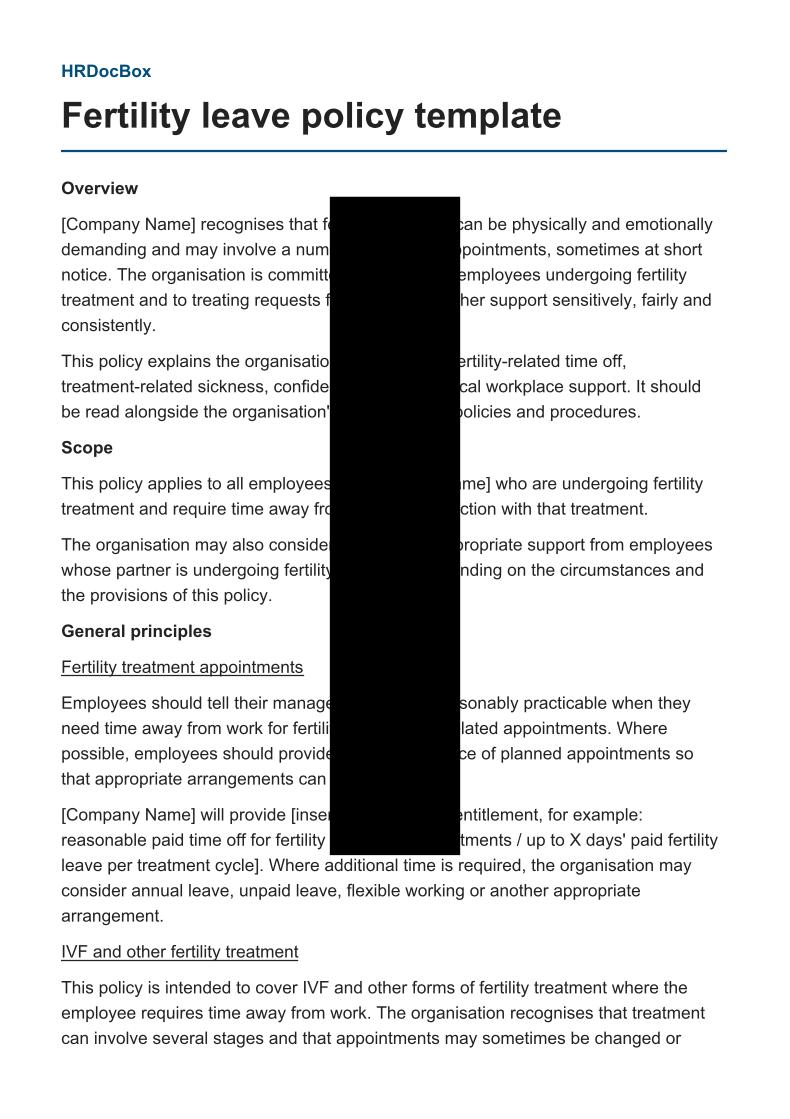
1   Overview

1.1   [Company Name] recognises that fertility treatment can be physically and emotionally demanding and may involve a number of medical appointments, sometimes at short notice. The organisation is committed to supporting employees undergoing fertility treatment and to treating requests for time off and other support sensitively, fairly and consistently.

1.2   This policy explains the organisation's approach to fertility-related time off, treatment-related sickness, confidentiality and practical workplace support. It should be read alongside the organisation's other relevant policies and procedures.

2   Scope

2.1   This policy applies to all employees of [Company Name] who are undergoing fertility treatment and require time away from work in connection with that treatment.

2.2   The organisation may also consider requests for appropriate support from employees whose partner is undergoing fertility treatment, depending on the circumstances and the provisions of this policy.

3   General principles

3.1   Fertility treatment appointments

3.1.1   Employees should tell their manager as soon as reasonably practicable when they need time away from work for fertility treatment or related appointments. Where possible, employees should provide reasonable notice of planned appointments so that appropriate arrangements can be made.

[Company Name] will provide [insert organisation's entitlement, for example: reasonable paid time off

PREVIEW ENDS HERE

This is the end of the preview

You've seen just 20% of how the Fertility leave policy template is structured. Get the complete editable template instantly and customise it for your organisation.

£19.99

Need the complete Parental process?

Explore the Parental policy templates

What is a fertility leave policy?

Fertility leave policy template preview

This policy provides a supportive and consistent framework for employees undergoing fertility treatment. It recognises that fertility treatment can involve a series of medical appointments and can be physically and emotionally demanding, while providing clear guidance on time off, absence, confidentiality and workplace support.

Supporting fertility treatment

The policy explains how employees can request time away from work for fertility treatment and related appointments. It can apply to IVF and other fertility treatment and sets out the organisation's approach to supporting employees while maintaining appropriate arrangements for the workplace.

Managing appointments and absence

Fertility treatment can involve multiple appointments over a relatively short period and may sometimes result in treatment-related sickness or the need for additional recovery time. The policy explains how these situations should be managed and how employees and managers should communicate about planned or unplanned absence.

Confidentiality and support

Fertility treatment is highly personal and employees should be able to share information about their circumstances with appropriate confidence and privacy. The policy sets expectations around confidentiality and encourages managers to take a sensitive, supportive and non-judgemental approach.

Pregnancy and equality considerations

The policy recognises that an employee's legal protections can change during fertility treatment, particularly following embryo transfer and where pregnancy occurs. It also reminds managers that decisions about treatment, absence or workplace arrangements must be handled carefully to avoid discrimination and inappropriate treatment.

Example

An employee tells their manager privately that they are undergoing IVF treatment. They explain that the treatment will involve several appointments over the coming weeks and that some appointments may be arranged at relatively short notice.

The manager discusses the situation with the employee and HR and agrees how planned appointments will be managed under the organisation's fertility leave policy. The employee is given appropriate flexibility to attend appointments and understands how to notify their manager if additional time away from work is required.

Following one stage of treatment, the employee experiences some side effects and needs additional time away from work. The absence is managed sensitively and in line with the organisation's normal sickness arrangements, without requiring the employee to provide unnecessary personal medical information.

The employee subsequently reaches the embryo transfer stage. The manager and HR recognise that specific pregnancy-related protections may now apply and ensure that the employee's circumstances are handled confidentially and appropriately while continuing to provide practical support.

Implementation guidance

Use these best practice actions, recommended timescales and process stages to understand when and how the Fertility leave policy should be used, helping ensure each step is handled consistently and appropriately documented.

Step Description Responsibility Timing
1 Discuss the employee's fertility treatment arrangements privately and establish what time off, flexibility or other workplace support may be required. Employee / Manager When support is needed
2 Agree appropriate arrangements for planned appointments, including whether time will be treated as paid leave, unpaid leave, annual leave or another agreed arrangement under the organisation's policy. Manager / HR Before appointments where possible
3 Manage any treatment-related sickness or unexpected absence sensitively and in accordance with the organisation's sickness absence arrangements. Employee / Manager As required
4 Maintain appropriate confidentiality and review whether temporary flexibility, reasonable adjustments or other practical support would help the employee manage the treatment and work effectively. Manager / HR Throughout treatment
5 Review arrangements as treatment progresses and ensure that any pregnancy, maternity, health and safety or other relevant employment rights are recognised where applicable. Manager / HR Throughout process
Premium content

To continue reading, purchase this item or a parent toolkit, library or our full library.

Common mistakes

Understand the common mistakes to avoid when using this HR template, helping you reduce risk, prevent unnecessary costs and ensure the process is handled correctly.

  • Treating fertility treatment as ordinary annual leave – recognise that treatment can involve multiple appointments, short-notice changes and treatment-related sickness.
  • Requiring unnecessary medical details – obtain only information that is genuinely needed to manage the employee's absence or workplace arrangements.
  • Discussing the treatment with colleagues – fertility treatment is sensitive personal information and should be kept confidential.
  • Applying absence procedures too rigidly – consider the circumstances and whether a supportive approach or temporary flexibility is appropriate.
  • Assuming all fertility treatment has the same legal protection – legal protections can change depending on the stage of treatment and whether pregnancy has occurred.
  • Making assumptions about an employee's ability to work – discuss the support needed with the employee rather than making assumptions about the physical or emotional impact of treatment.
Premium content

To continue reading, purchase this item or a parent toolkit, library or our full library.

HR considerations

UK employment law and best practice

This template is designed to support the process, but the document should be used alongside the relevant HR procedure and applied to the circumstances of the individual case.

No general statutory fertility leave entitlement

There is currently no general statutory entitlement to paid time off specifically for IVF or other fertility treatment appointments. Employers can, however, provide contractual or discretionary fertility leave as part of their workplace benefits and absence arrangements. Acas recommends that employers treat IVF appointments in the same way as other medical appointments and be open to requests for paid time off, unpaid time off, holiday or flexible working. https://www.acas.org.uk/pregnancy-at-work/ivf-treatment

Pregnancy protections during fertility treatment

Specific pregnancy protections can apply during IVF treatment once an embryo has been transferred. Acas states that when a worker reaches the embryo transfer stage, they have the same rights as a pregnant worker, although they do not have to tell their employer at that stage. Employers should therefore take care when making decisions affecting an employee during this period. https://www.acas.org.uk/pregnancy-at-work/ivf-treatment

Pregnancy and discrimination

Pregnancy and maternity are protected under the Equality Act 2010. Once the relevant pregnancy protections apply, an employer must not treat an employee unfavourably because they are pregnant or because of pregnancy-related illness. Employers should also consider the potential for sex discrimination when dealing with fertility treatment and associated requests for time off. https://www.acas.org.uk/pregnancy-and-maternity-discrimination

Treatment-related sickness

Fertility treatment can result in physical or emotional effects that may require an employee to take sickness absence. Acas advises that sickness related to IVF should be treated in the same way as other sickness. Employers should therefore apply their sickness arrangements fairly while taking account of the circumstances and avoiding unnecessary disclosure of sensitive medical information. https://www.acas.org.uk/pregnancy-at-work/ivf-treatment

Confidentiality and sensitive information

Information about fertility treatment is highly personal and may involve health information. Managers should handle information sensitively, limit access to those who genuinely need it and avoid sharing details with colleagues without the employee's agreement. Where pregnancy subsequently occurs, employers should also recognise the importance of confidentiality around pregnancy information. https://www.acas.org.uk/pregnancy-at-work

Flexible and supportive arrangements

Employers should consider whether temporary flexibility, paid or unpaid time off, annual leave or other practical arrangements could help an employee attend treatment while continuing to work effectively. Any enhanced fertility leave provided under this policy should be applied consistently, while allowing reasonable flexibility for individual circumstances. https://www.acas.org.uk/pregnancy-at-work/ivf-treatment

You may also need these resources

FAQs

Does the law give employees paid time off for fertility treatment?

There is currently no general statutory right to paid time off for IVF or other fertility treatment appointments. An employer can choose to provide fertility leave or enhanced paid time off through its own policy. Acas recommends that employers be open to requests for paid or unpaid time off, holiday or flexible working.

Does this policy only apply to IVF?

No. The policy can apply to IVF and other fertility treatment where the organisation chooses to provide support. The precise arrangements should be applied in accordance with the policy and the circumstances of the treatment.

How should fertility treatment sickness be recorded?

Where treatment results in sickness, it should normally be managed in accordance with the organisation's sickness arrangements. Managers should avoid requiring unnecessary details about the treatment and should consider the employee's privacy and the sensitivity of the circumstances.

When do pregnancy protections apply during IVF?

Once an embryo has been transferred, specific pregnancy-related legal protections can apply even before a pregnancy test confirms whether the treatment has been successful. Employees do not have to tell their employer at this stage, but may choose to do so so that appropriate support can be provided.

Why use HRDocBox rather than AI?

AI can generate a generic fertility policy, but HRDocBox provides structured, UK-focused HR documentation designed around practical employer processes and current UK employment considerations. This policy provides a clear framework for supporting employees through fertility treatment while helping managers handle time off, absence, confidentiality and pregnancy protections consistently.

How this content is developed and reviewed

The Fertility leave policy template is developed using a practical HR methodology that considers current UK employment legislation, ACAS guidance, CIPD good practice and the real-world HR process it supports. Templates and supporting information are regularly reviewed and updated, with additional reviews triggered by significant changes to legislation, guidance or established HR practice, helping ensure each document remains practical, relevant and suitable for UK employers.

About the author

Darryl Horn, Chartered HR Director

Darryl is a Chartered HR professional with over 25 years' experience in senior HR and employee relations roles.

He has extensive practical experience of managing parental HR processes and founded hrdocbox to provide businesses with practical, professionally developed HR resources grounded in UK employment law and best practice.

HRDocBox has been creating practical UK HR documents since 2009.

Executive recommendation

"Darryl provides support and advice with excellent judgement, and has a strong understanding of people, policies and UK employment legislation."

"He is someone I trust; consistent, dependable, and committed to doing things properly."

RB
Ruth Brock Chief Executive Officer The Hygiene Bank
Get started today

HR confidence starts here

Whether you employ 5 people or 50, hrdocbox gives you the structure, documents and expertise needed to manage employees professionally and legally.

Download your FREE UK employment contract template

Professionally written and fully compliant with UK employment law

Download FREE contract
Free UK employment contract template