Libraries
780+ HR templates
Everything your business needs to stay compliant
Policies, contracts, letters, guidance and HR support tools for UK employers.
View full libraryPolicies, contracts, letters, guidance and HR support tools for UK employers.
View full libraryThe Parental Leave Policy explains employees' statutory right to take unpaid parental leave to care for a child. It sets out who is eligible, how much leave is available, notice requirements, how requests will be managed, when leave may be postponed and the arrangements for returning to work.
Use this policy to:

If you are reviewing your family leave arrangements, these parental policy templates give you a practical set of policies covering notification, eligibility, planning, leave and return to work.
This template brings together the key information, sections and considerations you need to create a clear, comprehensive and professional HR document. Preview the document below.
1 Overview
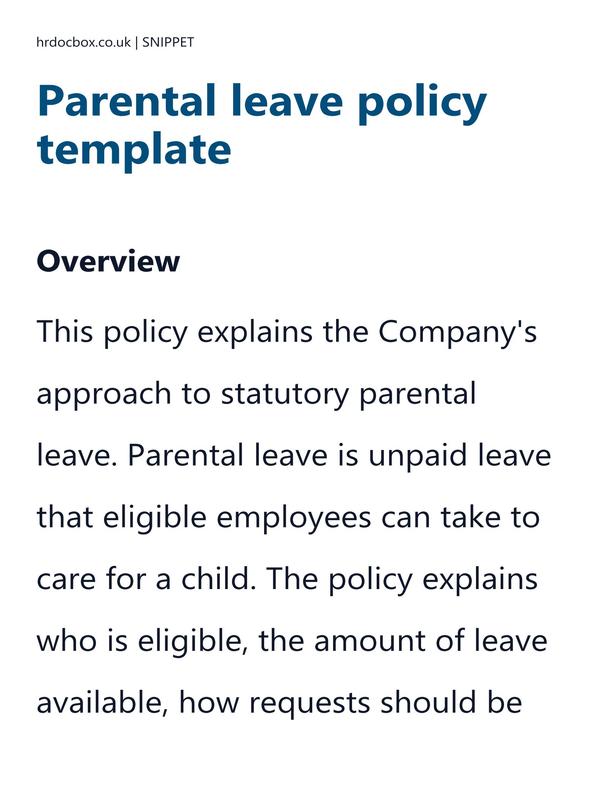
This policy explains the Company's approach to statutory parental leave. Parental leave is unpaid leave that eligible employees can take to care for a child. The policy explains who is eligible, the amount of leave available, how requests should be made and how the Company will manage parental leave fairly and consistently.
The Company recognises the importance of employees being able to balance their working responsibilities with their responsibilities as parents and will support eligible employees in exercising their statutory parental leave rights.
2 Scope
This policy applies to all employees of [Company Name] who are eligible for statutory parental leave.
The statutory right to parental leave applies to employees rather than workers or genuinely self-employed individuals. [Company Name] may choose to provide parental leave to individuals who do not have a statutory entitlement, but any such arrangement will be confirmed separately.
3 General principles
3.1 What is parental leave?
Parental leave is unpaid time off work that eligible employees can take to care for a child.
It is separate from maternity leave, paternity leave, adoption leave, shared parental leave and parental bereavement leave. Employees should speak to HR if they are unsure which type of family-related leave applies to their circumstances.
3.2 Eligibility
An employee is generally eligible for statutory parental leave where all of the following apply:
You've seen 20% of how the Parental leave policy template is structured. Get the complete editable template instantly and customise it for your organisation.
A Parental Leave Policy explains an employee's statutory right to take unpaid parental leave to care for a child. It sets out eligibility, entitlement, notice requirements, how leave can be taken, when it may be postponed and the arrangements that apply before, during and after the leave.
The policy is particularly important following the change that made statutory parental leave a day-one right from 6 April 2026. Employees no longer need one year's service before they can qualify, provided they meet the other eligibility requirements. :contentReference[oaicite:1]{index=1}
The policy provides managers and employees with a consistent framework for dealing with parental leave requests. It helps employers understand who is entitled to leave, how much leave is available and the circumstances in which a requested period can be postponed.
It also helps prevent common mistakes, such as incorrectly applying the old one-year qualifying period, confusing parental leave with other forms of family leave or failing to keep accurate records of leave taken.
The policy is suitable for employers and HR professionals who want a clear and practical framework for managing statutory parental leave in the workplace.
Employers should ensure that their policy reflects the current statutory position, particularly the day-one right introduced from 6 April 2026. The policy should also explain the eligibility criteria, 18-week entitlement, four-week annual limit, notice requirements and rules around postponement. :contentReference[oaicite:2]{index=2}
Related HR resources and workflow
Explore the HR resources that may be relevant before and / or after using the Parental leave policy, helping you understand the wider process, maintain appropriate documentation and follow a consistent approach.

The Parental Leave Confirmation Letter formally confirms an employee's request to take parental leave and sets out the agreed dates and arrangements.
Use these best practice actions, recommended timescales and process stages to understand when and how the Parental leave policy should be used, helping ensure each step is handled consistently and appropriately documented.
Understand the common mistakes to avoid when using this HR template, helping you reduce risk, prevent unnecessary costs and ensure the process is handled correctly.
Yes. From 6 April 2026, statutory parental leave became a day-one right. Eligible employees no longer need one year's service before they can take parental leave. :contentReference[oaicite:10]{index=10}
An eligible employee must generally be named on the child's birth or adoption certificate or have or expect to have parental responsibility, and the child must be under 18. The statutory right does not generally apply to workers, contractors or genuinely self-employed individuals. :contentReference[oaicite:11]{index=11}
Eligible employees can generally take up to 18 weeks of unpaid parental leave for each child, up to the child's 18th birthday. Unless the employer agrees otherwise, no more than four weeks can generally be taken for each child in any year. :contentReference[oaicite:12]{index=12}
HRDocBox combines deep HR knowledge, practical application and years of experience with real employee relations and family leave situations. The policy reflects the important 2026 change making parental leave a day-one right and provides managers and employees with a practical framework for handling requests correctly.
AI can easily produce an outdated parental leave policy, particularly because the qualifying service requirement changed in April 2026. HRDocBox combines UK employment-law knowledge, practical HR experience and regular review of employment law and guidance to provide a more reliable starting point.
In certain circumstances, yes. An employer may be able to postpone a period of parental leave where the employee's absence would cause significant disruption to the business, but the statutory requirements for postponement must be followed. https://www.gov.uk/parental-leave
How this content is developed and reviewed
The Parental leave policy template is developed using a practical HR methodology that considers current UK employment legislation, ACAS guidance, CIPD good practice and the real-world HR process it supports. Templates and supporting information are regularly reviewed and updated, with additional reviews triggered by significant changes to legislation, guidance or established HR practice, helping ensure each document remains practical, relevant and suitable for UK employers.
Darryl Horn, Chartered HR Director
Darryl is a Chartered HR professional with over 25 years' experience in senior HR and employee relations roles.
He has extensive practical experience of managing parental HR processes and founded hrdocbox to provide businesses with practical, professionally developed HR resources grounded in UK employment law and best practice.
HRDocBox has been creating practical UK HR documents since 2009.
"Darryl provides support and advice with excellent judgement, and has a strong understanding of people, policies and UK employment legislation."
"He is someone I trust; consistent, dependable, and committed to doing things properly."




















Whether you employ 5 people or 50, hrdocbox gives you the structure, documents and expertise needed to manage employees professionally and legally.
Professionally written and fully compliant with UK employment law
Access a free contract template instantly - or save 10% on any document today.
Use this code at checkout for 10% off anything!
Includes instant download, updates, and full access to your HR templates.