Protected conversation script template

£14.99

UK-specific • Editable • Instant download • 12 months' updates

The Protected Conversation Script provides a structured framework for HR professionals and managers to conduct a confidential pre-termination discussion with an employee where the employer is considering an agreed exit. It helps keep the conversation professional, voluntary and focused while giving the employee an opportunity to ask questions, consider the proposal and obtain independent advice.

Use this template to:

  • Structure a protected conversation from opening to close.
  • Explain a proposed settlement clearly and professionally.
  • Make the voluntary nature of the discussion clear.
  • Give the employee an opportunity to respond and negotiate.
  • Explain independent legal advice and next steps.
  • Reduce the risk of inappropriate pressure or poorly worded discussions.
Protected conversation script template
2026 Reviewed

What's included in this template?

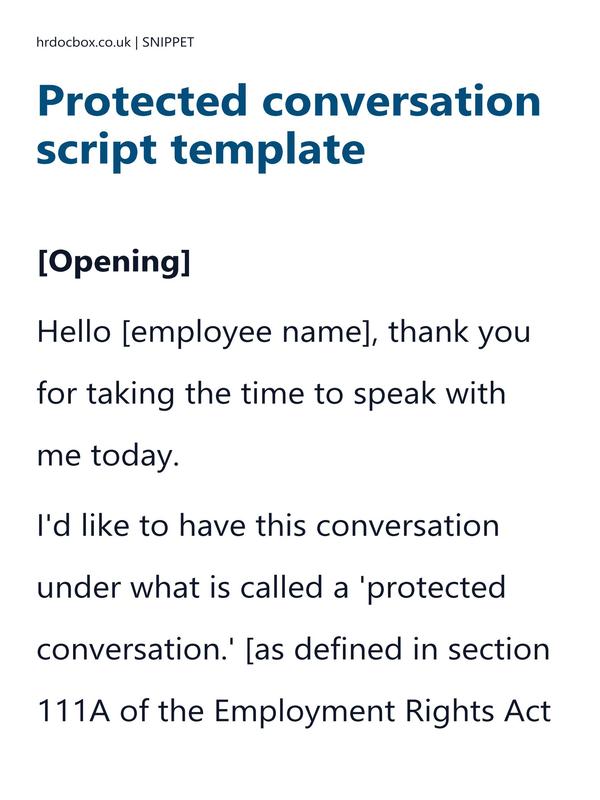
This template brings together the key information, sections and considerations you need to create a clear, comprehensive and professional HR document. Preview the document below.

  • Opening and purpose of the conversation
  • Explanation of the proposed settlement
  • Key questions and discussion prompts
  • Employee response and negotiation
  • Independent advice and timescales
  • Closing and next steps
Specifications
Access 12 months (includes updates)
Length 2 pages • 733 words
Jurisdiction England, Wales and Scotland
Based on UK employment law, ACAS guidance
Last review 24/08/2026
Next review 24/02/2027
Delivery Instant download
Formats .doc · .txt · email

Download .doc

Copy [to paste]

Email
Template

1   Before the conversation

1.1   The employer should consider whether a protected conversation is appropriate and prepare the proposed settlement terms in advance. The discussion should be conducted professionally and without pressure or inappropriate behaviour.

1.2   The employee should be given an appropriate opportunity to consider any proposal and obtain independent legal advice.

2   1. Opening the conversation

2.1   "Thank you for meeting with me today. I would like to have a confidential conversation with you about your employment and a possible agreed way of bringing your employment to an end."

2.2   "Before we discuss the detail, I want to make clear that this is a voluntary discussion. You are not required to agree to anything today, and you are free to ask questions, suggest changes or decide not to proceed."

2.3   "Any agreement would need to be formally documented in a settlement agreement and would only become binding once the appropriate requirements have been met."

3   2. Explain why the conversation is taking place

3.1   "The reason we would like to explore this option is [briefly explain the relevant circumstances]."

3.2   "We believe that an agreed separation may provide a way of resolving the current situation and bringing your employment to an end on mutually agreed terms."

"This is an opportunity to explore whether an agreement can be reached. It is not a requirement for you

PREVIEW ENDS HERE

This is the end of the preview

You've seen just 30% of how the Protected conversation script template is structured. Get the complete editable template instantly and customise it for your organisation.
£14.99

Need the complete Settlement agreement process?

Explore the Settlement agreement templates toolkit

What is a protected conversation script?

Protected conversation script template preview

A Protected Conversation Script gives HR and managers a practical structure for discussing a potential agreed termination with an employee. It provides prompts for explaining the proposal, answering questions and making sure the employee understands that participation is voluntary.

It is designed to support the conversation rather than replace professional judgement or legal advice.

What is it used for?

The script can be used where an employer wants to explore whether an employee would consider leaving under agreed terms, normally with the intention of documenting any agreement through a settlement agreement.

It helps the person leading the discussion cover the important points without turning the conversation into a rigid negotiation or pressuring the employee into an immediate decision.

Who should use it?

The script is suitable for HR professionals, business owners and managers who are responsible for conducting or supporting protected conversations.

Anyone using it should understand the limits of section 111A protection and the circumstances in which other legal principles may apply.

What happens after the conversation?

The employee should normally be given appropriate time to consider the proposal and obtain independent legal advice. If agreement is reached, the terms should be recorded in a formal settlement agreement.

If the employee does not accept the proposal, the employer should consider the appropriate next step in the underlying employment situation rather than treating the refusal itself as misconduct.

Example

An employer has concerns about an employee's ongoing performance and believes that an agreed exit may provide a practical resolution. HR decides that a protected conversation is appropriate and prepares a proposed settlement package.

The manager opens the meeting by explaining that the discussion is voluntary and that no decision is required during the meeting. The proposed leaving date, payment, reference and other terms are then explained.

The employee asks whether the settlement payment can be increased and whether the reference can be agreed in a particular format. The manager listens to the points and confirms that these can be considered as part of the negotiation.

The employee is given the proposal in writing and appropriate time to obtain independent legal advice. The parties subsequently negotiate the terms before a formal settlement agreement is prepared.

The wider HR process

Related HR resources and workflow

Explore the HR resources that may be relevant before and / or after using the Protected conversation script, helping you understand the wider process, maintain appropriate documentation and follow a consistent approach.

Previous
Guides
Managers guide to without prejudice or protected conversations

Our Guide to without prejudiice or Protected Conversations provides comprehensive insights on handling confidential discussions, ensuring legal compliance and effective communication.

This
Protected conversation script
Next
Letters
Settlement agreement proposal letter

Use this model settlement agreement proposal letter to enter discussions with an employee about ending their employment relationship.

Premium content

To continue reading, purchase this item or a parent toolkit, library or our full library.

Implementation guidance

Use these best practice actions, recommended timescales and process stages to understand when and how the Protected conversation script should be used, helping ensure each step is handled consistently and appropriately documented.

Step Description Responsibility Timing (Days from Issue)
1 Assess Whether Appropriate: Consider the circumstances, proposed outcome and underlying employment issue before deciding whether a protected conversation is an appropriate approach. HR / Management Day -14 to Day -7
2 Prepare the Conversation: Agree the proposed termination date, financial terms, notice, holiday, reference and other potential settlement terms before meeting with the employee. HR / Management Day -7 to Day -3
3 Conduct the Conversation: Use the script to explain the proposal, confirm that the discussion is voluntary and give the employee a proper opportunity to ask questions and respond. HR / Management Day 0
4 Allow Time for Advice: Give the employee reasonable time to consider the proposal, negotiate if appropriate and obtain independent legal advice. HR / Employee Day 1 to Day 10+
5 Agree or Progress: If terms are agreed, prepare and complete the formal settlement agreement. If no agreement is reached, consider the appropriate next step in the underlying employment matter. HR / Management Day 10 onwards
Premium content

To continue reading, purchase this item or a parent toolkit, library or our full library.

Common mistakes

Understand the common mistakes to avoid when using this HR template, helping you reduce risk, prevent unnecessary costs and ensure the process is handled correctly.

  • Reading the script as a rigid sales pitch rather than having a genuine discussion.
  • Pressuring the employee to accept the proposal immediately.
  • Assuming that the words "protected conversation" guarantee confidentiality.
  • Making threats or inappropriate statements about what will happen if the employee refuses.
  • Failing to give the employee reasonable time to obtain independent legal advice.
  • Forgetting that the underlying employment issue may still need to be dealt with if no settlement is reached.
Premium content

To continue reading, purchase this item or a parent toolkit, library or our full library.

HR considerations

UK employment law and best practice

This template is designed to support the process, but the document should be used alongside the relevant HR procedure and applied to the circumstances of the individual case.

Section 111A of the Employment Rights Act 1996 provides a framework for certain pre-termination negotiations. Where the statutory requirements are met, such discussions may be inadmissible as evidence in ordinary unfair dismissal proceedings. However, the protection has important limitations and should not be treated as blanket confidentiality. ACAS provides specific guidance on protected conversations and settlement agreements. (https://www.acas.org.uk/settlement-agreements/confidentiality)

Section 111A protection

The statutory protection can apply where an employer and employee are discussing the possibility of ending employment by agreement, even where there is not an existing employment dispute. This distinguishes a section 111A protected conversation from the common-law without prejudice principle, which generally requires an existing dispute. (https://www.acas.org.uk/settlement-agreements/confidentiality)

The protection is primarily concerned with ordinary unfair dismissal and constructive dismissal claims. It does not prevent all evidence from being used in every type of employment claim.

Improper behaviour

ACAS explains that section 111A protection may be lost where there has been improper behaviour. Examples can include harassment, intimidation, discrimination, threats or putting undue pressure on an employee to accept a proposal. (https://www.acas.org.uk/settlement-agreements/confidentiality)

The person conducting the conversation should therefore use neutral, professional language and allow the employee a genuine opportunity to consider the proposal.

Voluntary agreement

ACAS makes clear that settlement agreements are voluntary. An employee does not have to accept an employer's proposal and can negotiate different terms or decline to enter into an agreement. (https://www.acas.org.uk/settlement-agreements/discussing-and-negotiating-an-offer)

The script therefore avoids presenting the proposed exit as an instruction or predetermined outcome.

Independent legal advice

If the discussion leads to a settlement agreement, the agreement must meet statutory requirements. One important requirement is that the employee receives advice from an independent adviser on the terms and effect of the agreement. (https://www.acas.org.uk/acas-code-of-practice-settlement-agreements)

Employers should therefore allow appropriate time for the employee to obtain advice and should not expect an agreement to be signed immediately during or after the conversation.

Existing employment issues

A protected conversation should not be used as a substitute for every formal HR process. Depending on the circumstances, an employer may need to consider capability, disciplinary, grievance, redundancy or other procedures alongside or instead of settlement discussions.

ACAS recommends considering the circumstances carefully and ensuring that settlement discussions are handled fairly and appropriately. (https://www.acas.org.uk/acas-code-of-practice-settlement-agreements)

Legal and contractual considerations

The proposed settlement should be consistent with the employee's contractual and statutory entitlements. Any agreed termination date, notice payment, holiday payment, settlement sum, reference or other terms should be clearly documented in the eventual settlement agreement.

You may also need these resources

FAQs

What should I say at the start of a protected conversation?

Explain that you want to discuss the possibility of an agreed termination, make clear that the discussion is voluntary and confirm that the employee does not have to make an immediate decision. ACAS recommends that settlement discussions are handled appropriately and without improper pressure. (https://www.acas.org.uk/settlement-agreements/discussing-and-negotiating-an-offer)

Can I tell an employee they will be dismissed if they reject the offer?

Care is needed. You can explain the genuine employment issue that has led to the discussion, but threatening or pressuring an employee to accept a settlement can potentially amount to improper behaviour and affect the protection available under section 111A. (https://www.acas.org.uk/settlement-agreements/confidentiality)

How long should I give an employee to consider the proposal?

ACAS recommends giving the employee a reasonable period to consider the offer. The appropriate period depends on the circumstances and should allow the employee a proper opportunity to obtain independent advice and negotiate if required.

Why use HRDocBox for a Protected Conversation Script?

HRDocBox combines deep HR knowledge, practical application and years of experience with real employee relations situations. The script provides a structured framework for what can be a difficult conversation while keeping the discussion professional, voluntary and focused on a genuine opportunity to reach agreement.

Why use HRDocBox rather than asking AI to create the script?

AI can produce a convincing-looking conversation script, but protected conversations involve specific rules around section 111A, improper behaviour, employee rights and settlement agreements. HRDocBox combines UK employment-law knowledge, ACAS guidance and practical HR experience rather than relying on generic wording.

Is a protected conversation the same as a settlement agreement?

No. The conversation is the discussion about whether the parties might agree an exit. A settlement agreement is the formal legal document recording the terms once an agreement has been reached. The employee must receive appropriate independent advice before signing a qualifying settlement agreement. (https://www.acas.org.uk/settlement-agreements)

How this content is developed and reviewed

The Protected conversation script template is developed using a practical HR methodology that considers current UK employment legislation, ACAS guidance, CIPD good practice and the real-world HR process it supports. Templates are regularly reviewed and updated, with additional reviews triggered by significant changes to legislation, guidance or established HR practice, helping ensure each document remains practical, relevant and suitable for UK employers.

About the author

Darryl Horn, Chartered HR Director

Darryl is a Chartered HR professional with over 25 years' experience in senior HR and employee relations roles.

He has extensive practical experience of managing settlement agreement processes and founded hrdocbox to provide businesses with practical, professionally developed HR resources grounded in UK employment law and best practice.

HRDocBox has been creating practical UK HR documents since 2009.

Executive recommendation

"Darryl provides support and advice with excellent judgement, and has a strong understanding of people, policies and UK employment legislation."

"He is someone I trust; consistent, dependable, and committed to doing things properly."
RB
Ruth Brock Chief Executive Officer The Hygiene Bank
Get started today

HR confidence starts here

Whether you employ 5 people or 50, hrdocbox gives you the structure, documents and expertise needed to manage employees professionally and legally.

Download your FREE UK employment contract template

Professionally written and fully compliant with UK employment law
Download FREE contract
Free UK employment contract template