Employee departure communications plan template

Preview , or scroll for more content and supporting information
£2.99
UK-specific Editable Instant download 12 months' updates

This Employee Departure Communications Plan provides a structured way to plan and coordinate communications when an employee leaves the organisation. It helps ensure that the right people receive appropriate information at the right time while protecting confidentiality and maintaining a professional approach to the employee's departure.

Use this plan to:
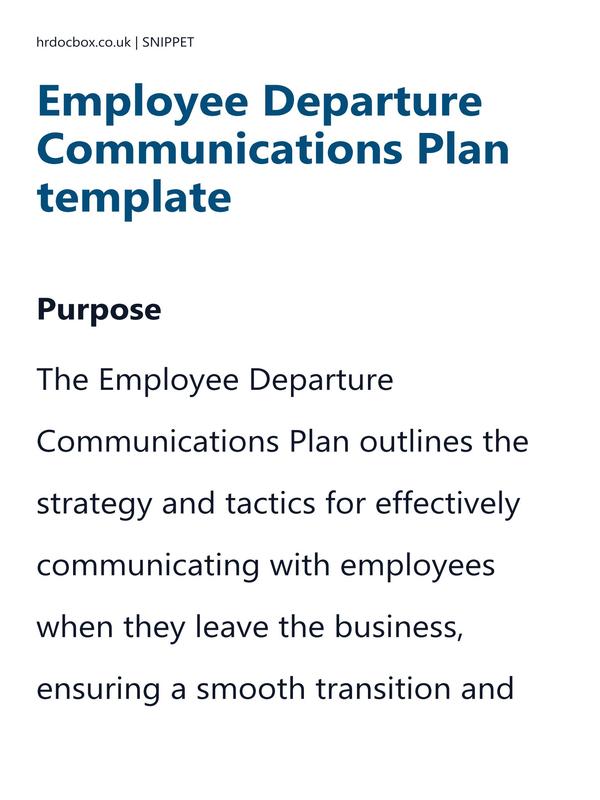
  • Plan communications before, during and after an employee's departure
  • Identify who needs to be informed and who should communicate with them
  • Agree what information can appropriately be shared
  • Coordinate internal, customer, supplier and external communications
  • Protect confidential employee and business information
  • Maintain continuity and minimise disruption when someone leaves
Employee departure communications plan template
2026 Reviewed
Get the complete resource

Don't just buy one template — get the complete Offboarding process toolkit

If you are managing employee offboarding, the toolkit brings together practical HR templates covering notice, handover, company property, access, final pay and exit arrangements.

10 templates • £19.99 • 12 months' access & updates
View the process toolkit

What's included in this template?

This template brings together the key information, sections and considerations you need to create a clear, comprehensive and professional HR document. Preview the document below.

  • Departure details and communication objectives
  • Internal audience and communication arrangements
  • Customer, supplier and external communications
  • Approved messages and information boundaries
  • Timing, responsibilities and communication channels
  • Handover, access, follow-up and completion record
Template

Download .doc

Copy [to paste]

Email

Employee departure communications plan

Departure details

Employee name  
Job title  
Department / Team  
Manager  
Reason for departure  
Final working day  
Employment end date  
Departure type Resignation / Retirement / Redundancy / Dismissal / Settlement / Other

Communication objectives

What do we need to achieve through the departure communications?


Confidentiality and communication restrictions

Are there any confidentiality requirements? Yes / No
Are there any restrictions on what can be communicated? Yes / No
Has a settlement agreement or other confidentiality arrangement been agreed? Yes / No / Not applicable
Who has approved the communication approach?  

Information that can be shared

Approved information that can be communicated:

Employee has left / is leaving Yes / No
Final working date Yes

PREVIEW ENDS HERE

This is the end of the preview

You've seen 20% of how the Employee departure communications plan template is structured. Get the complete editable template instantly and customise it for your organisation.

£2.99
Specifications
Access 12 months, with updates
Length 3 pages • 942 words
Jurisdiction England, Wales, Scotland
Based on UK law, ACAS guidance
Last update 29/09/2026
Update reason Process wording update.
Next review 29/03/2027
Delivery & Format Instant digital delivery, .doc · .txt · email

What is an employee departure communications plan?

Employee departure communications plan template preview

This plan provides a practical framework for managing communications when an employee leaves the organisation. It can be used for resignations, retirements, redundancies, dismissals and other departures, with the communication approach adapted to the circumstances and any confidentiality requirements.

Planning the communication

The plan identifies the key information that needs to be communicated, the intended audiences, who should deliver each message and when communication should take place. This helps avoid inconsistent messages or people finding out about a departure before the organisation is ready to communicate it.

Choosing what to communicate

The information shared should be appropriate to the audience and circumstances. Colleagues and external contacts will not normally need details about the employee's personal circumstances, disciplinary matters, settlement arrangements or other confidential employment information.

Managing internal communication

Internal communication may include the employee's immediate team, wider department, senior management and other employees who need to know for operational reasons. The plan can identify whether the departing employee, manager, HR or another person should communicate the news.

Managing customers and external contacts

Where the employee has regular contact with customers, suppliers or other external stakeholders, communication should focus on continuity. The organisation can explain who will take over the relevant responsibilities without unnecessarily disclosing personal information about the departing employee.

Maintaining continuity and confidentiality

Departure communications should sit alongside the practical offboarding process, including handover, system access, outstanding work, customer relationships and ownership of key responsibilities. Sensitive information should only be shared with people who have a legitimate reason to receive it.

Best in class example

A Customer Service Manager resigns after five years with the organisation and gives three months' notice. The manager has regular contact with several major customers and manages a team of eight employees.

HR and the manager agree a communication plan shortly after the resignation is confirmed. The employee is asked whether they would prefer to tell their immediate team themselves, and it is agreed that they will do so at the team's next meeting. HR will then send a short internal announcement to the wider business.

The organisation prepares separate communications for key customers. These focus on continuity and confirm that responsibility for each account will transfer to named colleagues. No information about the employee's reasons for leaving is included.

Before the final day, the manager completes a handover covering outstanding customer issues, key contacts, projects, passwords and access arrangements. On the final day, the internal communication is completed, customer contacts have been updated and responsibility for the employee's work has transferred to the relevant colleagues.

The wider HR process

Related HR resources and workflow

Explore the HR resources that may be relevant before and / or after using the Employee departure communications plan, helping you understand the wider process, maintain appropriate documentation and follow a consistent approach.

Previous
Forms
Employee Offboarding checklist form

Our Employee Offboarding Checklist Form Template ensures a thorough and organised process, covering essential steps to smoothly transition departing employees out of the organisation.

This
Employee departure communications plan
Next
Letters
Exit interview meeting invitation letter

The Exit Interview Meeting Invitation Letter formally invites an employee to an exit interview before or shortly after they leave the organisation.

Premium content

To continue reading, purchase this item or a parent toolkit, library or our full library.

Implementation guidance

Use these best practice actions, recommended timescales and process stages to understand when and how the Employee departure communications plan should be used, helping ensure each step is handled consistently and appropriately documented.

Step Description Responsibility Timing
1 Confirm the departure circumstances, final working date, communication restrictions and the people who need to be involved in planning the communication. HR / Manager As soon as the departure is confirmed
2 Identify internal, customer, supplier and other external audiences and decide what information each audience needs to receive. Manager / HR Within 5 working days of confirmation
3 Agree the messages, communication channels, timing and person responsible for each communication. Manager / HR / Employee where appropriate Before any wider announcement
4 Deliver the agreed communications and coordinate them with handover, customer contact, system access and other offboarding arrangements. Named communication owners During the notice period / before departure
5 Confirm that communications have been completed and update any outstanding customer, supplier, website, organisational chart or contact information. HR / Manager / Relevant teams By the final working day and within 5 working days afterwards
Premium content

To continue reading, purchase this item or a parent toolkit, library or our full library.

Common mistakes

Understand the common mistakes to avoid when using this HR template, helping you reduce risk, prevent unnecessary costs and ensure the process is handled correctly.

  • Announcing a departure before agreeing what can be shared with employees
  • Sharing the employee's reasons for leaving or other confidential employment information
  • Allowing different managers to give inconsistent explanations
  • Forgetting to tell customers or suppliers who will take over important relationships
  • Communicating the departure without planning the associated handover
  • Leaving outdated contact details, website information or organisational records in place
Premium content

To continue reading, purchase this item or a parent toolkit, library or our full library.

HR considerations

UK employment law and best practice

This template is designed to support the process, but the document should be used alongside the relevant HR procedure and applied to the circumstances of the individual case.

Confidentiality of the employee's departure

Employers should respect an employee's confidentiality when communicating their departure. This is particularly important where the employee has been dismissed or where the departure relates to disciplinary, grievance, settlement, health or other sensitive circumstances. Information shared with colleagues or customers should normally be limited to what they need to know. https://www.acas.org.uk/dismissals https://www.acas.org.uk/responding-to-a-grievance

Resignation and communication

When an employee resigns, it is good practice to agree how and when other people will be told about the resignation. Acas recommends discussing whether the employee or manager will communicate the departure and responding to the resignation in writing. https://www.acas.org.uk/resignation/responding-to-an-employees-resignation

Dismissals

Where employment ends through dismissal, communications should not disclose confidential details of the disciplinary, capability or other process. The organisation should communicate only information that is appropriate and necessary, such as the fact that the employee has left and who will take over their responsibilities. https://www.acas.org.uk/dismissals

Redundancy

Where the departure is the result of redundancy, communications should be coordinated with the redundancy consultation and decision-making process. Employees should be informed appropriately about proposed redundancies and kept updated throughout the process, while individual consultation and personal information should remain confidential. https://www.acas.org.uk/manage-staff-redundancies/tell-employees

Data protection

Personal information about an employee should only be shared where there is a lawful basis and the information is necessary and appropriate for the purpose. Organisations should consider carefully what information is being shared, who will receive it and whether the employee's reasonable expectations of privacy are respected. https://ico.org.uk/for-organisations/uk-gdpr-guidance-and-resources/employment/employment-practices-and-data-protection-keeping-employment-records/using-employment-records

Sharing information with customers and suppliers

When communicating an employee's departure to customers, suppliers or other external contacts, the organisation should normally focus on business continuity rather than the employee's personal circumstances. Only information that is necessary for the relevant relationship should be disclosed, and confidential employment information should not normally be shared. https://ico.org.uk/for-organisations/uk-gdpr-guidance-and-resources/employment/employment-practices-and-data-protection-keeping-employment-records/using-employment-records

Employees who are absent

Where an employee is absent when important workplace information is communicated, employers should consider whether they need to be kept appropriately informed. Certain employees have specific legal protections requiring information about workplace matters to be provided during periods of statutory leave, and employers should avoid disadvantaging employees because they are absent. https://www.acas.org.uk/keeping-in-touch-during-absence

References and future employment

Any reference or employment information provided to a prospective employer should be handled consistently with the organisation's reference procedure and data protection requirements. Managers should not provide informal information about an employee's departure without authorisation. https://ico.org.uk/for-organisations/uk-gdpr-guidance-and-resources/employment/employment-practices-and-data-protection-keeping-employment-records/using-employment-records

You may also need these resources

FAQs

Who should announce an employee's departure?

There is no single approach that applies to every departure. The employee, manager, HR or another appropriate person may communicate the departure depending on the circumstances. The approach should be agreed in advance, particularly where the employee has requested to tell colleagues themselves.

Should employees be told why someone has left?

Normally, no. Colleagues and customers generally do not need details about an employee's personal circumstances, disciplinary history, health, grievance, settlement or other confidential employment matters. A simple statement confirming the departure and any relevant arrangements is usually sufficient.

Should customers be told that an employee has left?

Where the employee has an important customer or supplier relationship, it may be appropriate to communicate the departure and identify who will take over the relationship. The communication should focus on continuity and should not disclose unnecessary personal information.

Can the employee announce their own departure?

Yes, where appropriate. The employee and manager can agree how and when colleagues or customers are informed. The organisation should still ensure that the information shared is appropriate and does not disclose confidential information.

Should the plan be used for dismissals as well as resignations?

Yes, although the communication approach may be significantly different. For a dismissal, redundancy or other sensitive departure, HR should normally control or closely coordinate the communication to protect confidentiality and ensure that the message does not disclose inappropriate details.

Why use HRDocBox rather than AI?

HRDocBox templates provide a structured starting point designed for UK employers, combining practical HR wording with relevant employment law, data protection considerations and workplace best practice. AI can generate wording, but a structured plan helps ensure the operational and confidentiality aspects of an employee departure are not overlooked.

How this content is developed and reviewed

The Employee departure communications plan template is developed using a practical HR methodology that considers current UK employment legislation, ACAS guidance, CIPD good practice and the real-world HR process it supports. Templates and supporting information are regularly reviewed and updated, with additional reviews triggered by significant changes to legislation, guidance or established HR practice, helping ensure each document remains practical, relevant and suitable for UK employers.

About the author

Darryl Horn, Chartered HR Director

Darryl is a Chartered HR professional with over 25 years' experience in senior HR and employee relations roles.

He has extensive practical experience of managing offboarding HR processes and founded hrdocbox to provide businesses with practical, professionally developed HR resources grounded in UK employment law and best practice.

HRDocBox has been creating practical UK HR documents since 2009.

Executive recommendation

"Darryl provides support and advice with excellent judgement, and has a strong understanding of people, policies and UK employment legislation."

"He is someone I trust; consistent, dependable, and committed to doing things properly."

RB
Ruth Brock Chief Executive Officer The Hygiene Bank
Get started today

HR confidence starts here

Whether you employ 5 people or 50, hrdocbox gives you the structure, documents and expertise needed to manage employees professionally and legally.

Download your FREE UK employment contract template

Professionally written and fully compliant with UK employment law
Download FREE contract
Free UK employment contract template