Stay Interview results and analysis report template

Preview , or scroll for more content and supporting information
£12.99
UK-specific Editable Instant download 12 months' updates

Use this Stay Interview Results and Analysis Report to consolidate findings from a completed round of employee stay interviews. It helps HR and management assess participation, identify recurring themes, understand what employees value, highlight potential retention risks and translate workforce feedback into prioritised organisational improvements.

Use this report to:

  • Summarise the number and proportion of employees who participated in stay interviews.
  • Identify the main factors that encourage employees to stay with the organisation.
  • Analyse recurring concerns relating to management, communication, workload, pay, recognition and development.
  • Compare findings across departments, teams or employee groups where appropriate.
  • Highlight potential retention risks and opportunities to improve the employee experience.
  • Present evidence-based recommendations, assigned actions and measures of progress to senior management.
Stay Interview results and analysis report template
2026 Reviewed
Get the complete resource

Don't just buy one template — get the complete Stay Interview process toolkit

If you are introducing stay interviews, the toolkit brings together practical HR templates covering preparation, questions, listening, actions and follow-up.

4 templates • £29.99 • 12 months' access & updates
View the process toolkit

What's included in this template?

This template brings together the key information, sections and considerations you need to create a clear, comprehensive and professional HR document. Preview the document below.

  • Executive summary, objectives and scope of the stay interview exercise.
  • Participation figures and workforce coverage.
  • Consolidated findings on reasons for staying and positive employee experiences.
  • Analysis of recurring concerns, department-level themes and potential retention risks.
  • Prioritised recommendations and a management action plan.
  • Measures of success, reporting arrangements and follow-up review dates.
Template

Download .doc

Copy [to paste]

Email

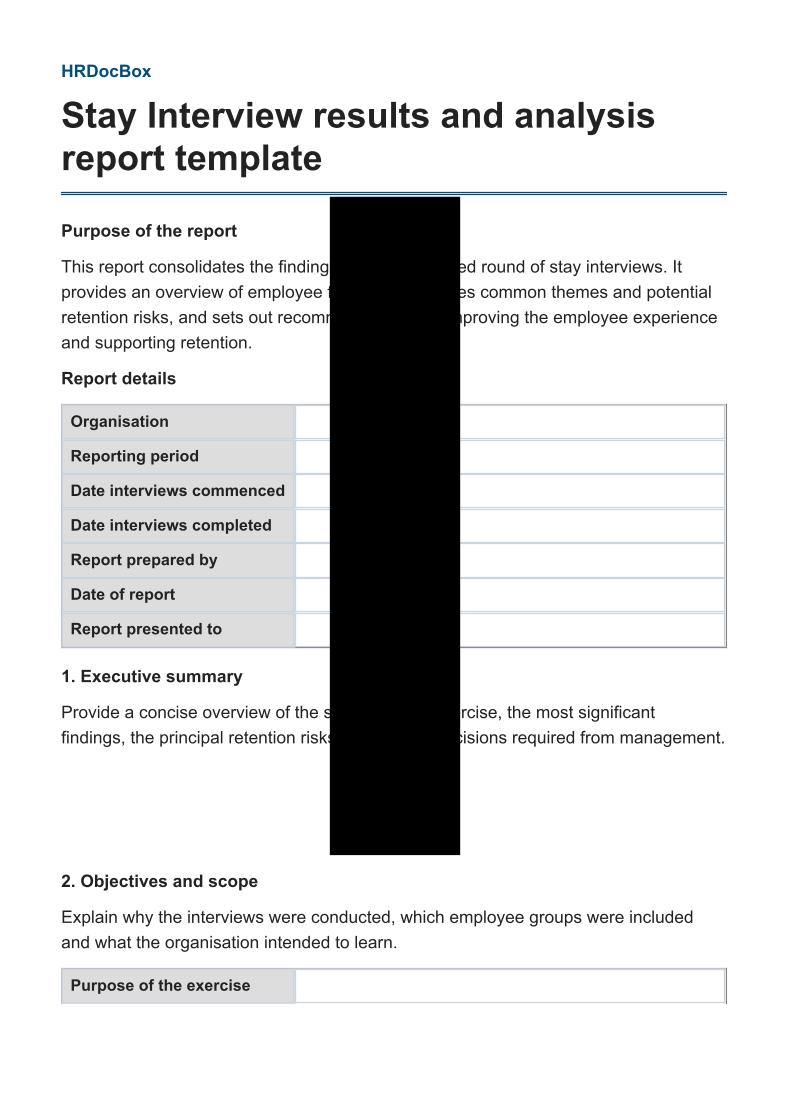
Stay Interview results and analysis report

Purpose of the report

This report consolidates the findings from a completed round of stay interviews. It provides an overview of employee feedback, identifies common themes and potential retention risks, and sets out recommendations for improving the employee experience and supporting retention.

Report details

Organisation  
Reporting period  
Date interviews commenced  
Date interviews completed  
Report prepared by  
Date of report  
Report presented to  

1. Executive summary

Provide a concise overview of the stay interview exercise, the most significant findings, the principal retention risks and the key decisions required from management.


2. Objectives and scope

Explain why the interviews were conducted, which employee groups were included and what the organisation intended to learn.

Purpose of the exercise  
Departments or employee groups included  
Interview approach used  
Main topics explored  
Limitations of the exercise  

3. Participation and workforce coverage

Summarise the number of employees invited, interviews completed and workforce coverage achieved. Identify any teams or groups that were not represented adequately.

Total workforce within scope  
Employees invited to participate  
Interviews completed  
PREVIEW ENDS HERE

This is the end of the preview

You've seen 20% of how the Stay Interview results and analysis report template is structured. Get the complete editable template instantly and customise it for your organisation.
£12.99
Specifications
Access 12 months, with updates
Length 4 pages • 1,265 words
Jurisdiction England, Wales, Scotland
Based on UK law, ACAS guidance
Last update 10/10/2026
Update reason Minor template wording changes.
Next review 10/04/2027
Delivery & Format Instant digital delivery, .doc · .txt · email

What is a stay interview results and analysis report?

Stay Interview results and analysis report template preview

A Stay Interview Results and Analysis Report provides a consolidated view of employee feedback following a planned round of stay interviews. Rather than recording individual conversations, it brings together the findings to identify common experiences, areas of strength and issues that may affect employee engagement and retention across the organisation.

Understanding participation and workforce coverage

The report begins by establishing how many employees were invited to participate, how many interviews were completed and which departments or employee groups were represented. This context helps management understand the reach of the exercise and assess whether the findings provide a sufficiently broad picture of the workforce. Participation figures should be interpreted carefully, particularly where response rates are low or some teams are underrepresented.

Identifying what employees value

Stay interviews can reveal why employees choose to remain with an organisation, including supportive colleagues, good working relationships, job security, meaningful work, flexibility, development opportunities and positive management. Consolidating these findings helps the organisation identify strengths to preserve and build upon rather than focusing exclusively on problems.

Analysing recurring themes and concerns

The report should group feedback into meaningful themes, such as leadership, communication, recognition, pay, workload, working conditions, training and career progression. It should distinguish frequently raised issues from isolated but significant concerns. Where quantitative scores or counts are used, the method should be explained and the limitations of the data acknowledged.

Comparing departments and identifying retention risks

Where participation and sample sizes allow, findings can be compared across departments, locations or job groups. Differences may reveal local management challenges, inconsistent communication or wider organisational issues. Potential retention risks should be based on the feedback and relevant evidence, not treated as a definitive prediction that employees will leave.

Turning findings into organisational action

The most valuable outcome is a practical set of recommendations. Each priority should identify the issue being addressed, the proposed intervention, the accountable owner, the target date and the measure of success. Actions may range from improving team communication and recognition to reviewing development pathways, management capability or workload allocation.

Reporting to senior management

A concise executive summary should highlight the most important findings, the implications for employee retention and the decisions required from leadership. This allows management to allocate resources, agree priorities and monitor whether actions are delivered. The report should distinguish employee feedback from HR interpretation and clearly identify where further investigation is needed.

Measuring impact and maintaining confidentiality

The report should establish how progress will be reviewed, including action completion, subsequent employee feedback, engagement measures and workforce turnover data where relevant. Findings should be presented in aggregate wherever possible, with care taken not to identify employees through comments or small departmental groups. The organisation should explain how interview information will be used and restrict access to those with a legitimate business need.

Best in class example

A manufacturing business completes a round of stay interviews across production, customer experience, administration and digital teams. The aim is to understand what employees value about working for the organisation and identify changes that could improve retention as the business grows.

HR consolidates the interview notes and identifies several positive themes, including supportive colleagues, job stability and pride in the products the business manufactures. However, employees in several departments also raise concerns about inconsistent communication, limited access to training and uncertainty about opportunities for progression.

The analysis shows that communication and development are recurring themes rather than isolated comments. Production employees highlight the need for more cross-training, while employees in customer-facing roles want clearer development pathways. HR also identifies some differences between teams that require further discussion with their managers.

HR presents the findings to the senior leadership team, recommending clearer team communication routines, a review of training opportunities and more consistent development conversations. Each recommendation is assigned an accountable owner, a target date and a measure of success.

Management agrees the priorities and schedules a review after three months. HR will assess completion of the actions, gather further employee feedback and monitor relevant retention data. The report provides a clear link between employee feedback, management decisions and measurable organisational improvements.

The wider HR process

Related HR resources and workflow

Explore the HR resources that may be relevant before and / or after using the Stay Interview results and analysis report, helping you understand the wider process, maintain appropriate documentation and follow a consistent approach.

Previous
Forms
Stay interview form

Our stay interview form template helps to identify and address employee retention issues by capturing feedback on job satisfaction and engagement.

This
Stay Interview results and analysis report
Premium content

To continue reading, purchase this item or a parent toolkit, library or our full library.

Implementation guidance

Use these best practice actions, recommended timescales and process stages to understand when and how the Stay Interview results and analysis report should be used, helping ensure each step is handled consistently and appropriately documented.

Step Description Responsibility Timing
1 Consolidate the interview data. Gather completed interview records, confirm the number of interviews completed and identify the departments or employee groups represented. Check that records are complete and suitable for analysis. HR Within 5 working days of completing the interview round
2 Analyse the findings. Group feedback into consistent themes, identify positive experiences and recurring concerns, and quantify responses where appropriate. Distinguish common themes from isolated but significant issues. HR or People Analyst Within 10 working days of completing the interview round
3 Develop recommendations. Assess the significance of the findings, consider possible causes and develop practical recommendations. Consult relevant managers where further investigation or operational context is needed. HR and department managers Within 15 working days of completing the interview round
4 Present and agree priorities. Prepare the executive summary and present the key findings to senior management. Agree which actions will proceed, allocate resources and appoint accountable owners with realistic target dates. HR and senior leadership team Within 20 working days of completing the interview round
5 Monitor delivery and impact. Track action completion, report delays, gather follow-up feedback and review relevant workforce indicators. Update management on progress and recommend further action where the original concerns remain unresolved. HR and nominated action owners Monthly action tracking, with a formal impact review after 3 months
Premium content

To continue reading, purchase this item or a parent toolkit, library or our full library.

Common mistakes

Understand the common mistakes to avoid when using this HR template, helping you reduce risk, prevent unnecessary costs and ensure the process is handled correctly.

  • Reporting comments without analysing them. Group feedback into meaningful themes and explain what the findings suggest about the employee experience.
  • Focusing only on negative feedback. Identify what employees value and recommend how the organisation can preserve those strengths.
  • Presenting opinions as proven facts. Distinguish employee feedback, quantitative findings, HR interpretation and matters requiring further investigation.
  • Making unreliable departmental comparisons. Consider participation levels and group sizes before drawing conclusions about differences between teams.
  • Producing recommendations without ownership. Assign clear responsibilities, target dates and measures of success to agreed actions.
  • Overlooking confidentiality. Avoid identifiable quotations and detailed breakdowns that could reveal individual employees, particularly in small teams.
Premium content

To continue reading, purchase this item or a parent toolkit, library or our full library.

HR considerations

UK employment law and best practice

This template is designed to support the process, but the document should be used alongside the relevant HR procedure and applied to the circumstances of the individual case.

Data protection and lawful processing

Stay interview findings may contain personal data about employees' working relationships, opinions, development needs and workplace experiences. Employers should identify an appropriate lawful basis for processing personal data, explain how information will be used, collect only relevant information and restrict access appropriately. Where special category data is disclosed, additional UK GDPR requirements may apply.

ICO guidance: https://ico.org.uk/for-organisations/uk-gdpr-guidance-and-resources/

Confidentiality and anonymised reporting

Consolidated reporting should normally focus on themes and findings rather than identifiable employee comments. Removing names alone may not prevent identification where teams are small or the circumstances described are distinctive. Consider whether quotations, departmental breakdowns or other contextual details could identify individuals before sharing the report with management.

ICO guidance: https://ico.org.uk/for-organisations/uk-gdpr-guidance-and-resources/data-protection-principles/

Equality and fair treatment

Analyse feedback fairly and avoid drawing conclusions based on protected characteristics or unsupported assumptions about particular employee groups. Where the report identifies differences between groups, investigate the underlying reasons carefully. If feedback indicates possible discrimination or harassment, follow the appropriate process rather than relying solely on aggregate reporting.

Equality Act 2010: https://www.legislation.gov.uk/ukpga/2010/15/contents

Accuracy and interpretation of findings

Ensure that the report accurately represents the interviews completed and explains how themes, percentages and ratings have been calculated. Record the number of employees included in each analysis where relevant. Do not imply that findings represent the entire workforce if participation was limited or uneven across departments.

Employee concerns requiring separate action

Stay interview feedback may reveal issues involving health and safety, discrimination, harassment, grievances, wellbeing or management conduct. These matters should be referred to the appropriate internal process where necessary. Consolidating findings should not delay action on an urgent concern or prevent an employee from raising a formal complaint.

Retention data and performance indicators

Where stay interview findings are compared with turnover, absence, engagement or other workforce measures, ensure the comparison is proportionate and the data is sufficiently accurate. Correlation does not establish that a particular issue caused employees to leave. Use findings to identify areas for further investigation and evaluate whether subsequent actions appear to improve outcomes.

Secure records and retention periods

Keep source interview records and consolidated reports in appropriate secure locations, with access restricted according to business need. Apply the organisation's retention policy and delete or anonymise information when it is no longer required, subject to any applicable legal or legitimate record-keeping requirements.

Implementation note

There is no general statutory requirement to conduct stay interviews or produce a consolidated results report. This is a good-practice management tool. Its effectiveness depends on honest analysis, appropriate confidentiality, clear management decisions and visible follow-through on the issues employees have raised.

You may also need these resources

FAQs

What is a Stay Interview Results and Analysis Report?

It is a consolidated report prepared after a round of stay interviews has been completed. It brings together the main findings, identifies recurring themes and potential retention risks, highlights positive aspects of the employee experience and recommends organisational actions. It is intended for HR and management decision-making rather than recording one employee's conversation.

What information should the report include?

The report should include the purpose and scope of the exercise, participation figures, the main reasons employees stay, positive themes, recurring concerns, relevant departmental differences, potential retention risks, recommended actions and a follow-up plan. An executive summary should identify the most important findings and decisions required from management.

How should stay interview results be analysed?

Group feedback into consistent themes, count responses where appropriate and distinguish frequently raised issues from isolated but significant concerns. Consider participation levels, department sizes and the context of individual comments. Explain how any percentages or ratings have been calculated and avoid treating subjective feedback as proof of a particular cause.

Should the report include departmental comparisons?

Yes, where the data supports meaningful comparisons and confidentiality can be maintained. Departmental analysis may identify different experiences of communication, development, workload or management support. Be cautious with small groups, as detailed findings may identify individual employees or produce misleading conclusions from limited participation.

How should management use the findings?

Management should agree a prioritised action plan based on the findings, appoint accountable owners, set realistic target dates and define measures of success. HR should track delivery and review the impact after an appropriate period, such as three months. Actions should be communicated to employees where appropriate so that they can see that their feedback has been considered.

Why use HRDocBox rather than asking AI?

HRDocBox provides structured, editable HR resources designed for practical use by UK employers. This report gives HR a consistent framework for consolidating results, analysing themes and presenting recommendations. AI can help summarise interview feedback, but it may misinterpret context, overstate patterns or expose personal information. Human review and appropriate data protection controls remain essential.

How this content is developed and reviewed

The Stay Interview results and analysis report template is developed using a practical HR methodology that considers current UK employment legislation, ACAS guidance, CIPD good practice and the real-world HR process it supports. Templates and supporting information are regularly reviewed and updated, with additional reviews triggered by significant changes to legislation, guidance or established HR practice, helping ensure each document remains practical, relevant and suitable for UK employers.

About the author

Darryl Horn, Chartered HR Director

Darryl is a Chartered HR professional with over 25 years' experience in senior HR and employee relations roles.

He has extensive practical experience of managing stay interview HR processes and founded hrdocbox to provide businesses with practical, professionally developed HR resources grounded in UK employment law and best practice.

HRDocBox has been creating practical UK HR documents since 2009.

Executive recommendation

"Darryl provides support and advice with excellent judgement, and has a strong understanding of people, policies and UK employment legislation."

"He is someone I trust; consistent, dependable, and committed to doing things properly."

RB
Ruth Brock Chief Executive Officer The Hygiene Bank
Get started today

HR confidence starts here

Whether you employ 5 people or 50, hrdocbox gives you the structure, documents and expertise needed to manage employees professionally and legally.

Download your FREE UK employment contract template

Professionally written and fully compliant with UK employment law
Download FREE contract
Free UK employment contract template