Health and Safety training matrix template

Preview , or scroll for more content and supporting information
£9.99
UK-specific Editable Instant download 12 months' updates

This Health and Safety training matrix provides a structured way to identify the health and safety training required across different roles and work activities. It helps organisations establish consistent training expectations, identify role-specific requirements and monitor when training needs to be reviewed or refreshed.

Use this matrix to:
  • Identify health and safety training requirements by role
  • Distinguish between required, optional and non-applicable training
  • Set appropriate training and refresher frequencies
  • Review training requirements when roles, risks or legislation change
Health and Safety training matrix template
2026 Reviewed
Get the complete resource

Don't just buy one template — get the complete Inspection and audit templates toolkit

If you are managing health and safety inspections or audits, the toolkit brings together practical templates covering planning, inspection, findings, corrective action and verification.

3 templates • £24.99 • 12 months' access & updates
View the complete toolkit

What's included in this template?

This template brings together the key information, sections and considerations you need to create a clear, comprehensive and professional HR document. Preview the document below.

  • Role-based health and safety training matrix
  • Required, optional and non-applicable training key
  • 20 common health and safety training topics
  • Training frequency and refresher guidance
  • Role-specific and risk-based training considerations
  • Review notes and actions for keeping requirements up to date
Template

Download .doc

Copy [to paste]

Email

Health and Safety training matrix

Use this matrix to identify the health and safety training requirements for different roles and groups of workers. Requirements should be reviewed against relevant risk assessments, work activities, individual responsibilities and applicable legal requirements.

Key:

  • R – Required
  • O – Optional (as needed for the role)
  • N/A – Not Applicable
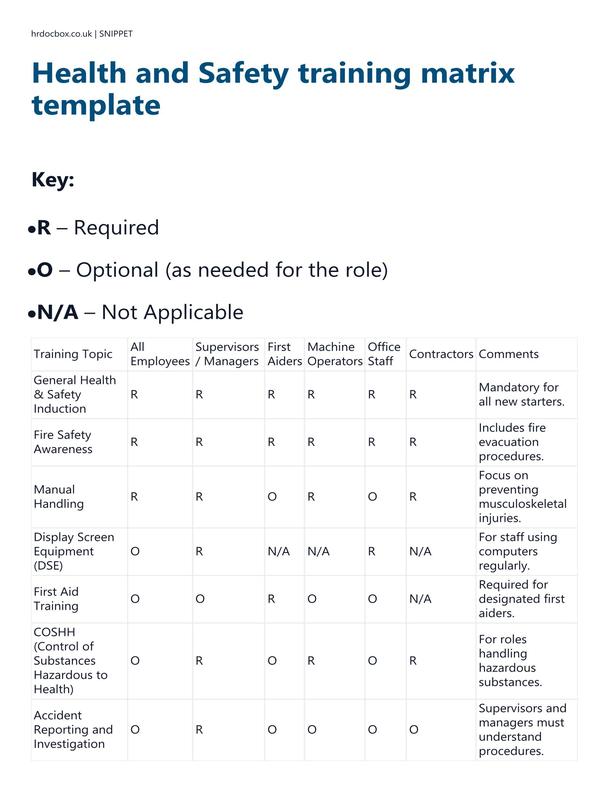
Training Topic All Employees Supervisors / Managers First Aiders Machine Operators Office Staff Contractors Comments
General Health & Safety Induction R R R R R R Mandatory for all new starters.
Fire Safety Awareness R R R R R R Includes fire evacuation procedures.
Manual Handling R R O R O R Focus on

PREVIEW ENDS HERE

This is the end of the preview

You've seen 20% of how the Health and Safety training matrix template is structured. Get the complete editable template instantly and customise it for your organisation.

£9.99
Specifications
Access 12 months, with updates
Length 2 pages • 644 words
Jurisdiction England, Wales, Scotland
Based on UK law, ACAS guidance
Last update 13/09/2026
Update reason FAQ update.
Next review 13/03/2027
Delivery & Format Instant digital delivery, .doc · .txt · email

What is a health and safety training matrix?

Health and Safety training matrix template preview

This Health and Safety training matrix provides a practical framework for identifying the training different groups of employees and workers may need. It can be adapted to reflect the organisation's own roles, activities, workplace risks and health and safety arrangements.

Identifying training requirements

The matrix brings together common health and safety training topics and shows how requirements may differ between employees, managers, first aiders, machine operators, office staff and contractors. This provides a useful starting point for considering which training is relevant to different roles.

Applying role-specific requirements

Not every training topic will apply to every person. The matrix uses a simple key to distinguish between training that is required, training that may be appropriate depending on the role and training that is not applicable. This helps organisations avoid treating health and safety training as a one-size-fits-all exercise.

Considering training frequency

The matrix includes suggested frequencies for key areas of training, while recognising that refresher requirements can depend on the nature of the work, the risks involved, changes to legislation and the organisation's own arrangements. Training should be reviewed whenever there is a reason to believe that existing knowledge or competence may no longer be sufficient.

Keeping the matrix up to date

The training requirements should be reviewed when roles, equipment, processes or workplace risks change and when new legal or organisational requirements are introduced. The matrix can then be used as a central reference point when planning training and reviewing health and safety arrangements.

Best in class example

A manufacturing business reviews its health and safety training requirements across its production, management and office teams. Rather than requiring every employee to complete identical training, it uses a role-based matrix to identify which subjects are relevant to each group.

General health and safety induction and fire safety awareness are identified as required for all employees and contractors. Machine operators have additional requirements covering machinery and equipment safety, manual handling and other risks associated with their work, while office staff have specific requirements relating to display screen equipment.

The organisation also uses the matrix to identify training that may only be relevant in particular circumstances. For example, working at height is considered for roles undertaking elevated work, COSHH training is considered for people handling hazardous substances and driving safety is considered for those who use company vehicles.

The matrix is reviewed when working practices or equipment change and as part of the organisation's regular health and safety review. This ensures that training requirements remain appropriate to the risks and responsibilities associated with each role rather than becoming a static list that is not updated.

Implementation guidance

Use these best practice actions, recommended timescales and process stages to understand when and how the Health and Safety training matrix should be used, helping ensure each step is handled consistently and appropriately documented.

Step Description Responsibility Timing
1 Identify the roles, activities and workplace risks that need to be considered when establishing health and safety training requirements. Manager / H&S When establishing the matrix
2 Review each training topic against the relevant roles and classify it as required, optional or not applicable. Manager / H&S During initial review
3 Establish appropriate initial and refresher training arrangements, taking account of risk assessments, legal requirements and the nature of the work. H&S / Manager Before training is arranged
4 Review the matrix when there are changes to roles, equipment, processes, workplace risks or relevant legal requirements. Manager / H&S / HR As changes occur and at least annually
5 Record any changes or actions arising from the review and ensure identified training requirements are communicated and addressed. Manager / H&S Promptly following review
Premium content

To continue reading, purchase this item or a parent toolkit, library or our full library.

Common mistakes

Understand the common mistakes to avoid when using this HR template, helping you reduce risk, prevent unnecessary costs and ensure the process is handled correctly.

  • Making every training topic mandatory for everyone – training requirements should reflect the employee's role, activities and actual workplace risks.
  • Ignoring role-specific risks – consider whether particular roles require additional training because of machinery, substances, driving, working at height or other activities.
  • Treating refresher periods as universal – frequency should reflect the relevant training, risk, qualification and organisational arrangements rather than applying the same period to everything.
  • Failing to review the matrix – requirements can change when roles, equipment, processes, risks or legislation change.
  • Using the matrix instead of risk assessment – the matrix should be informed by suitable and sufficient risk assessments and should not replace them.
  • Assuming training automatically demonstrates competence – depending on the activity, employees may also need practical instruction, assessment, supervision or experience.
Premium content

To continue reading, purchase this item or a parent toolkit, library or our full library.

HR considerations

UK employment law and best practice

This template is designed to support the process, but the document should be used alongside the relevant HR procedure and applied to the circumstances of the individual case.

Health and Safety at Work etc. Act 1974

The Health and Safety at Work etc. Act 1974 places duties on employers to protect the health, safety and welfare of employees and others affected by their activities. Employers must provide appropriate information, instruction, training and supervision where necessary to support safe working arrangements. A structured training matrix can help organisations identify and monitor the training arrangements supporting these duties. https://www.legislation.gov.uk/ukpga/1974/37/section/2

Management of Health and Safety at Work Regulations 1999

The Management of Health and Safety at Work Regulations 1999 require employers to make suitable and sufficient assessments of risks to employees and others affected by their undertaking. Training requirements should therefore be informed by the risks identified through the organisation's risk assessment process and reviewed when circumstances change. https://www.legislation.gov.uk/uksi/1999/3242/contents

Information, instruction and training

Health and safety training should be appropriate to the work being undertaken and the risks involved. The Health and Safety Executive emphasises the importance of providing workers with suitable information, instruction and training so that they can work safely and understand the hazards associated with their work. https://www.hse.gov.uk/pubns/indg275.htm

Training for specific risks and activities

Some activities may require specific training because of the hazards involved, including work involving machinery, hazardous substances, manual handling, work at height or other higher-risk activities. The appropriate requirements should be established by considering the actual work, relevant risk assessments and applicable health and safety requirements rather than relying solely on a generic training list. https://www.hse.gov.uk/workers/employers.htm

Reviewing training requirements

Training arrangements should be reviewed where there are significant changes to work, equipment, processes or risks and where monitoring indicates that existing arrangements may no longer be adequate. A training matrix provides a useful mechanism for documenting these requirements and identifying where further training or refresher training may be needed. https://www.hse.gov.uk/legislation/index.htm

Competence and supervision

Training is an important part of establishing competence but completing a training course does not necessarily mean that an employee can undertake a task without further support. Employers should consider knowledge, skills, experience and practical ability and provide suitable supervision or additional instruction where appropriate. https://www.hse.gov.uk/pubns/indg275.htm

You may also need these resources

FAQs

What is a Health and Safety training matrix?

A Health and Safety training matrix is a structured record used to identify which health and safety training is required for different roles or groups of workers. It can also be used to identify optional training and subjects that are not relevant to particular roles.

Does everyone need to complete the same health and safety training?

No. Some training may be appropriate for everyone, while other subjects will depend on the employee's role, activities and exposure to particular risks. The matrix helps distinguish between these different requirements.

How often should the training matrix be reviewed?

It should be reviewed regularly and whenever there are significant changes to roles, equipment, processes or workplace risks. An annual review can provide a useful minimum check, although higher-risk activities may require more frequent review.

Should contractors be included?

Where contractors are working within the organisation's workplace or undertaking activities that expose them or others to relevant risks, their health and safety training requirements should be considered. The organisation should establish appropriate arrangements based on the work being undertaken.

Why use HRDocBox rather than AI?

AI can generate a generic training matrix, but HRDocBox provides structured, UK-focused HR and workplace documentation designed around practical employer processes. This matrix provides a useful framework for considering training requirements by role, reviewing refresher needs and keeping health and safety training arrangements organised.

How this content is developed and reviewed

The Health and Safety training matrix template is developed using a practical HR methodology that considers current UK employment legislation, ACAS guidance, CIPD good practice and the real-world HR process it supports. Templates and supporting information are regularly reviewed and updated, with additional reviews triggered by significant changes to legislation, guidance or established HR practice, helping ensure each document remains practical, relevant and suitable for UK employers.

About the author

Darryl Horn, Chartered HR Director

Darryl is a Chartered HR professional with over 25 years' experience in senior HR and employee relations roles.

He has extensive practical experience of managing inspection and audit HR processes and founded hrdocbox to provide businesses with practical, professionally developed HR resources grounded in UK employment law and best practice.

HRDocBox has been creating practical UK HR documents since 2009.

Executive recommendation

"Darryl provides support and advice with excellent judgement, and has a strong understanding of people, policies and UK employment legislation."

"He is someone I trust; consistent, dependable, and committed to doing things properly."

RB
Ruth Brock Chief Executive Officer The Hygiene Bank
Get started today

HR confidence starts here

Whether you employ 5 people or 50, hrdocbox gives you the structure, documents and expertise needed to manage employees professionally and legally.

Download your FREE UK employment contract template

Professionally written and fully compliant with UK employment law

Download FREE contract
Free UK employment contract template