Libraries
780+ HR templates
Everything your business needs to stay compliant
Policies, contracts, letters, guidance and HR support tools for UK employers.
View full libraryPolicies, contracts, letters, guidance and HR support tools for UK employers.
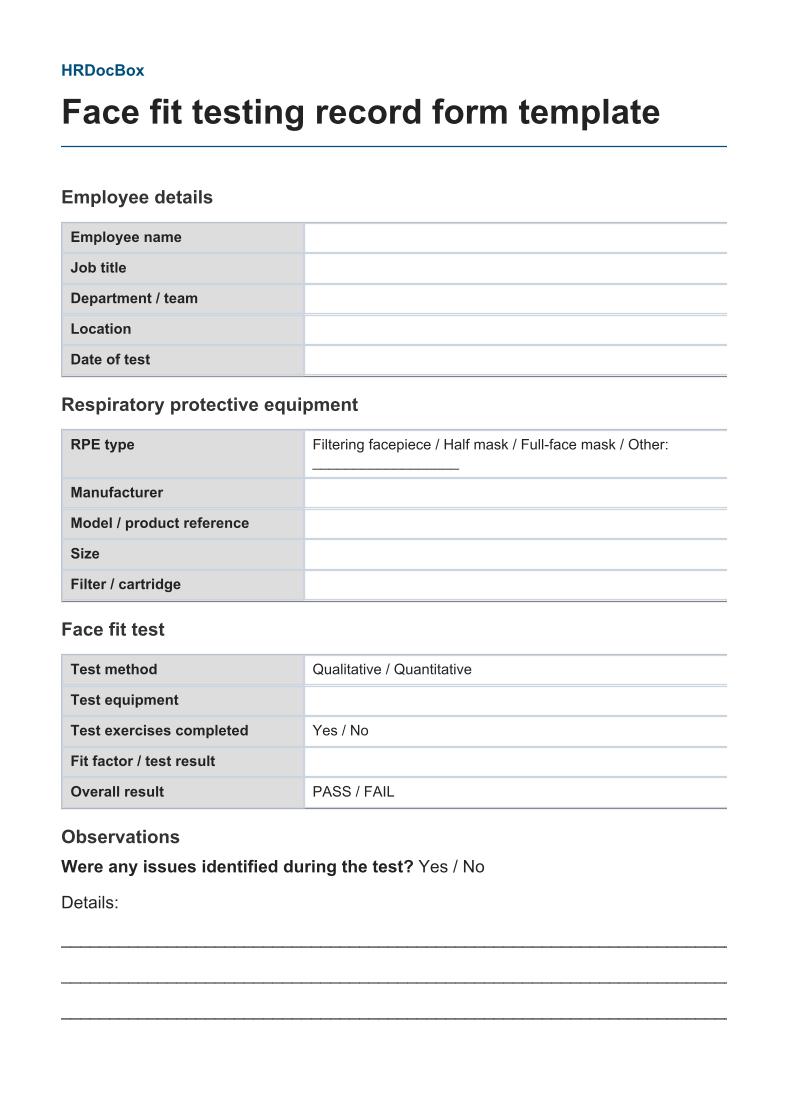
View full libraryA face fit testing record form for recording the outcome of a qualitative or quantitative face fit test, including the employee, respirator, test method, result and any actions required.
Use this template to:
Plan workplace safety inspections and audits with templates for findings, corrective actions and follow-up. Track issues and document improvements.
| Employee name | |
| Job title | |
| Department / team | |
| Location | |
| Date of test |
You've seen 20% of how the Face fit testing record form template is structured. Get the complete editable template instantly and customise it for your organisation.

This face fit testing record form provides a clear record of testing carried out to establish whether a particular tight-fitting respirator provides an adequate seal for an individual employee. It can be used to record the equipment tested, method used, result and any follow-up action required.
The form records the employee's details, the type of respiratory protective equipment tested and the relevant test method. It can be used for different types of tight-fitting RPE, including filtering facepieces, half masks and full-face masks where face fit testing is required.
The outcome of the test can be recorded together with the relevant fit factor or other test information. Where a test is unsuccessful, the form provides a record of the issue and helps identify whether another suitable respirator should be selected and tested.
Face fit testing can also highlight problems such as poor fit, incorrect positioning, facial hair or interference from other equipment. Recording these observations provides useful information for managing the employee's ongoing use of RPE.
The completed form can be retained as part of the organisation's health and safety records and used to demonstrate that appropriate face fit testing has been carried out. A new test may be needed where the type or model of RPE changes or where circumstances affecting the fit change.
Related HR resources and workflow
Explore the HR resources that may be relevant before and / or after using the Face fit testing record form, helping you understand the wider process, maintain appropriate documentation and follow a consistent approach.

A PPE issue record form for recording the personal protective equipment provided to employees, including the equipment issued, date of issue, quantities, replacement requirements and employee acknowledgement.
Use these best practice actions, recommended timescales and process stages to understand when and how the Face fit testing record form should be used, helping ensure each step is handled consistently and appropriately documented.
Understand the common mistakes to avoid when using this HR template, helping you reduce risk, prevent unnecessary costs and ensure the process is handled correctly.
Face fit testing should be carried out by a competent person who has the appropriate knowledge, skills and equipment to perform the test correctly. The tester should use a suitable recognised method and understand the requirements for the type of respiratory protective equipment being tested.
Where tight-fitting respiratory protective equipment is required, the employer should ensure that the RPE is suitable for the individual wearer and provides an effective seal. The test is specific to the particular make, model, style and size of respirator rather than simply confirming that an employee can wear RPE generally.
The failed respirator should not be relied upon for protection. The employer should consider why the test was unsuccessful and identify a suitable alternative RPE where necessary. The alternative should then be tested to confirm that it provides an adequate fit for the individual employee.
Further testing may be required when an employee changes to a different make, model, style or size of tight-fitting RPE, or where circumstances change in a way that could affect the fit. This can include significant changes to facial features, dental work or other factors that may affect the seal.
No. The record provides evidence of the face fit testing carried out for an individual employee and specific RPE. It should be used alongside the organisation's wider risk assessments, RPE selection process, training arrangements and safe systems of work rather than as a replacement for them.
AI can generate a generic face fit testing record, but HRDocBox provides structured, UK-focused HR and workplace documentation designed to be used consistently by employers. This form prompts the employer to record the specific RPE tested, test method, result, observations and follow-up actions, helping create a clear and practical record that can be retained and reviewed.
How this content is developed and reviewed
The Face fit testing record form template is developed using a practical HR methodology that considers current UK employment legislation, ACAS guidance, CIPD good practice and the real-world HR process it supports. Templates and supporting information are regularly reviewed and updated, with additional reviews triggered by significant changes to legislation, guidance or established HR practice, helping ensure each document remains practical, relevant and suitable for UK employers.
Darryl Horn, Chartered HR Director
Darryl is a Chartered HR professional with over 25 years' experience in senior HR and employee relations roles.
He has extensive practical experience of managing inspection and audit HR processes and founded hrdocbox to provide businesses with practical, professionally developed HR resources grounded in UK employment law and best practice.
HRDocBox has been creating practical UK HR documents since 2009.
"Darryl provides support and advice with excellent judgement, and has a strong understanding of people, policies and UK employment legislation."
"He is someone I trust; consistent, dependable, and committed to doing things properly."




















Whether you employ 5 people or 50, hrdocbox gives you the structure, documents and expertise needed to manage employees professionally and legally.
Professionally written and fully compliant with UK employment law
Access a free contract template instantly - or save 10% on any document today.
Use this code at checkout for 10% off anything!
Includes instant download, updates, and full access to your HR templates.