Libraries
780+ HR templates
Everything your business needs to stay compliant
Policies, contracts, letters, guidance and HR support tools for UK employers.
View full libraryPolicies, contracts, letters, guidance and HR support tools for UK employers.
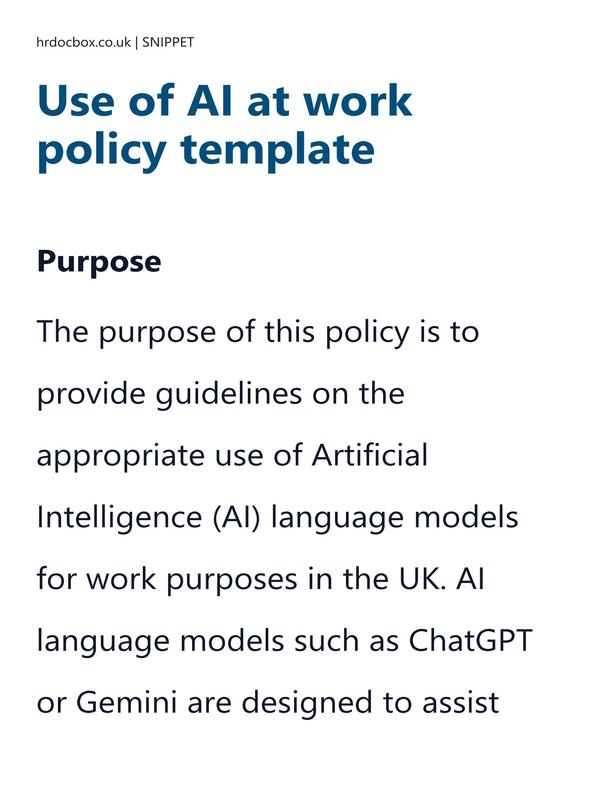
View full libraryA practical Use of AI at Work Policy setting out how employees may use artificial intelligence tools safely, responsibly and appropriately in the workplace. It establishes clear expectations around confidentiality, personal data, accuracy, intellectual property, security, human oversight and acceptable use.
Use this template to:
If you are strengthening information security, these security and information policy templates give you a practical set of policies covering information handling, access, employee responsibilities, monitoring and leavers.
1 Overview
1.1 Artificial intelligence (AI) can help employees work more efficiently, generate ideas, analyse information and complete routine tasks. However, its use can create risks relating to confidentiality, personal data, accuracy, security, intellectual property, bias and inappropriate decision-making.
1.2 This policy sets out the organisation's expectations for using AI at work. AI should be used responsibly and appropriately and should support, rather than replace, appropriate human judgement.
2 Scope
2.1 This policy applies to all employees and, where relevant, workers, contractors, agency workers, consultants and other individuals using AI in connection with the organisation's work.
2.2 It applies to AI tools accessed through company systems and, where they are used for work purposes, AI tools accessed through personal devices or accounts.
3 General principles
3.1 Use approved AI tools
3.1.1 Employees should only use AI tools that have been approved or otherwise permitted by the organisation for work purposes.
3.1.2 Employees should not download, install or use AI applications on company equipment where doing so could create a security, confidentiality or data protection risk.
3.2 Protect confidential information
Employees must not enter confidential, commercially sensitive or otherwise protected business information into an AI tool
You've seen 20% of how the Use of AI at work policy template is structured. Get the complete editable template instantly and customise it for your organisation.

AI tools are increasingly being used to create content, analyse information, automate tasks and support workplace decision-making. While these tools can provide significant benefits, they can also create risks around confidentiality, personal data, accuracy, bias, intellectual property and security. This policy provides a clear framework for using AI responsibly at work.
The policy explains how employees can use AI tools to support their work while making clear that AI should complement rather than replace appropriate human judgement. Employees remain responsible for checking AI-generated information before relying on or sharing it.
AI systems should not be treated as automatically secure or confidential. The policy establishes expectations around entering personal data, confidential information, commercially sensitive material, customer information and other protected business information into AI tools.
AI-generated information can be inaccurate, incomplete or biased. The policy therefore sets expectations for human review and highlights the need for particular care where AI is used in connection with employees, customers or other decisions that could have significant consequences.
The policy also addresses security, intellectual property, copyright, inappropriate use and the use of unapproved AI tools. It provides employees with clear expectations while allowing organisations to benefit from appropriate AI use as the technology develops.
Use these best practice actions, recommended timescales and process stages to understand when and how the Use of AI at work policy should be used, helping ensure each step is handled consistently and appropriately documented.
Understand the common mistakes to avoid when using this HR template, helping you reduce risk, prevent unnecessary costs and ensure the process is handled correctly.
This depends on the organisation's approved tools and rules. Employees should only use AI tools in accordance with this policy and any separate IT, information security or data protection requirements.
Not unless the organisation has confirmed that the particular AI tool and proposed use are appropriate. Personal, confidential and commercially sensitive information should be protected and should not be entered into an AI system simply for convenience.
AI may sometimes be used to support administrative or analytical work, but significant employment decisions require appropriate human oversight. Particular care is needed where automated processing or profiling could affect an individual.
Yes. AI can produce inaccurate, incomplete or misleading information. Employees remain responsible for checking outputs before using them in important work, communications or decisions.
AI can be useful for drafting and improving content where its use is permitted. Employees should still check the output for accuracy, tone, confidentiality, copyright and suitability before using it.
Check the organisation's approved AI guidance and speak to the appropriate manager, HR, IT or data protection contact before proceeding where there is uncertainty, particularly if personal, confidential or commercially sensitive information is involved.
AI can produce general policy wording, but HRDocBox provides structured, UK-focused HR documentation designed around practical workplace requirements. This policy gives employers a clear framework for responsible AI use, while helping employees understand the boundaries around confidentiality, data protection, accuracy, security and human judgement.
How this content is developed and reviewed
The Use of AI at work policy template is developed using a practical HR methodology that considers current UK employment legislation, ACAS guidance, CIPD good practice and the real-world HR process it supports. Templates and supporting information are regularly reviewed and updated, with additional reviews triggered by significant changes to legislation, guidance or established HR practice, helping ensure each document remains practical, relevant and suitable for UK employers.
Darryl Horn, Chartered HR Director
Darryl is a Chartered HR professional with over 25 years' experience in senior HR and employee relations roles.
He has extensive practical experience of managing security and information HR processes and founded hrdocbox to provide businesses with practical, professionally developed HR resources grounded in UK employment law and best practice.
HRDocBox has been creating practical UK HR documents since 2009.
"Darryl provides support and advice with excellent judgement, and has a strong understanding of people, policies and UK employment legislation."
"He is someone I trust; consistent, dependable, and committed to doing things properly."













Whether you employ 5 people or 50, hrdocbox gives you the structure, documents and expertise needed to manage employees professionally and legally.
Professionally written and fully compliant with UK employment law
Access a free contract template instantly - or save 10% on any document today.
Use this code at checkout for 10% off anything!
Includes instant download, updates, and full access to your HR templates.