Criminal records check consent letter template

Preview , or scroll for more content and supporting information
£12.99
UK-specific Editable Instant download 12 months' updates

This Criminal Records Check Consent Letter provides a clear way for an employer to request an individual's consent to a criminal records check as part of recruitment, employment or suitability checks. It explains the purpose and level of check, how the information will be handled and what the individual needs to do next.

Use this template to:

  • Explain why a criminal records check is being requested
  • Confirm the type and purpose of the check being undertaken
  • Explain how information obtained from the check will be handled
  • Give the individual an opportunity to provide the required consent or information
  • Set out what happens after the check is completed
  • Create a clear written record of the request and consent process
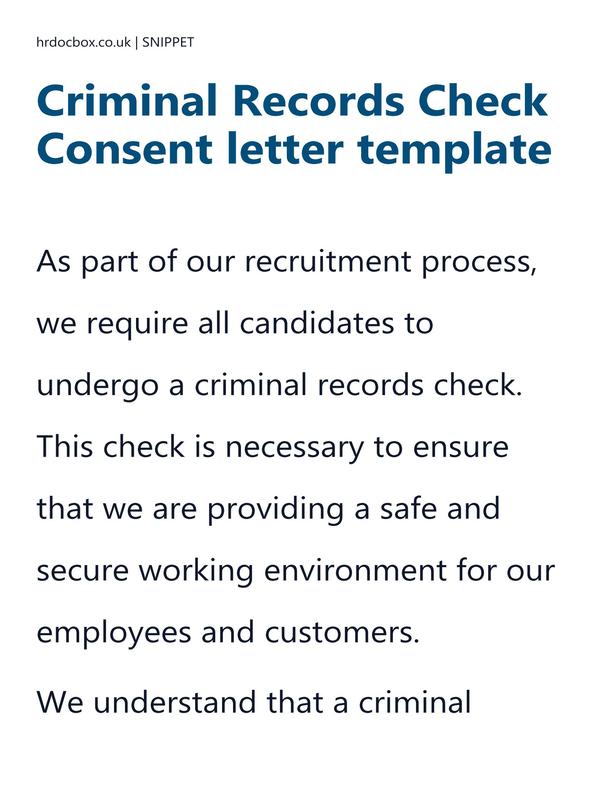
Criminal records check consent letter template
2026 Reviewed
Get the complete resource

Don't just buy one template — get the complete Employee vetting process toolkit

If you are managing pre-employment checks, the toolkit brings together practical HR templates covering right to work, references, screening, verification and records.

12 templates • £29.99 • 12 months' access & updates
View the process toolkit

What's included in this template?

This template brings together the key information, sections and considerations you need to create a clear, comprehensive and professional HR document. Preview the document below.

  • Reason for requesting the criminal records check
  • Type and level of DBS or criminal records check required
  • Information about the role and suitability assessment
  • Explanation of how criminal offence information will be handled
  • Consent and application arrangements
  • Confidentiality, data protection and next steps
Template

Download .doc

Copy [to paste]

Email

[Sender name]

[Sender address]

[date]

[Recipient name]

[Recipient address]


Dear [Recipient first name],

Criminal Records Check Consent

Purpose of the check

As part of the [recruitment / onboarding / employment / suitability] process for the role of [Job Title], we require a criminal records check to be completed.

The purpose of the check is to [explain the specific reason, such as meeting safeguarding requirements, assessing suitability for the role, complying with a legal or regulatory requirement, or applying the organisation's recruitment requirements].

Type of check

The check required for this role is:

[Basic DBS check / Standard DBS check / Enhanced DBS check / Enhanced DBS check with [Children's / Adults'] Barred List check / Other applicable criminal records check].

The organisation has assessed the role and considers this level of check to be appropriate for the duties and requirements of

PREVIEW ENDS HERE

This is the end of the preview

You've seen 20% of how the Criminal records check consent letter template is structured. Get the complete editable template instantly and customise it for your organisation.
£12.99
Specifications
Access 12 months, with updates
Length 2 pages • 623 words
Jurisdiction England, Wales, Scotland
Based on UK law, ACAS guidance
Last update 30/09/2026
Update reason Updated supporting information.
Next review 30/03/2027
Delivery & Format Instant digital delivery, .doc · .txt · email

What is a criminal records check consent letter?

Criminal records check consent letter template preview

This letter provides a structured way for an employer to explain a proposed criminal records check and obtain the individual's consent where consent is being relied upon for the relevant processing or application process. It is suitable for recruitment and, where appropriate, existing employees whose roles require a criminal records check.

Explaining why the check is required

The letter explains why the organisation requires a criminal records check and how it relates to the individual's role. This helps avoid requesting checks without a clear and legitimate purpose.

Confirming the appropriate level of check

The employer can identify whether a Basic, Standard, Enhanced or Enhanced with Barred List check is being requested. The level should be determined by the legal eligibility requirements for the role rather than simply by organisational preference.

Explaining how information will be used

The letter explains that information obtained will be handled confidentially and used for the stated recruitment, employment or suitability purpose. It also provides an opportunity to explain relevant data protection arrangements.

Recording consent and the application process

The individual can confirm whether they consent to the proposed check where consent is the appropriate basis for obtaining and processing the information. The letter also explains any further application, identification or verification steps required.

Considering criminal records fairly

A criminal record should not automatically be treated as a reason to reject an applicant or employee. Where relevant information is disclosed, the organisation should consider its relevance to the role and apply its recruitment of ex-offenders or criminal record policy consistently.

Best in class example

An organisation was recruiting for a role involving regular contact with vulnerable adults. As part of its recruitment process, HR reviewed the role against the current DBS eligibility guidance and determined that an Enhanced DBS check with the appropriate barred list check was required.

The preferred candidate was offered the role subject to satisfactory pre-employment checks. HR sent the candidate a criminal records check consent letter explaining why the check was required, the level of check being requested and how information obtained would be handled.

The candidate completed the required application and identity verification process. The DBS certificate subsequently contained information that required further consideration. The organisation did not automatically reject the candidate but reviewed the information against the requirements and risks of the particular role.

HR recorded the decision-making process and restricted access to the criminal record information to those who needed it for the relevant recruitment decision. The information was handled in accordance with the organisation's data protection and criminal records policies.

The wider HR process

Related HR resources and workflow

Explore the HR resources that may be relevant before and / or after using the Criminal records check consent letter, helping you understand the wider process, maintain appropriate documentation and follow a consistent approach.

Previous
Policies
Criminal record checks policy

If you are undertaking criminal record checks as part of your onboarding process, this model policy provides you with a legal, effective framework.

This
Criminal records check consent letter
Next
Forms
Criminal Records Check Consent form

Our Criminal Records Check Consent form template ensures seamless and compliant processing of applicant background checks.

Premium content

To continue reading, purchase this item or a parent toolkit, library or our full library.

Implementation guidance

Use these best practice actions, recommended timescales and process stages to understand when and how the Criminal records check consent letter should be used, helping ensure each step is handled consistently and appropriately documented.

Step Description Responsibility Timing
1 Assess the role and confirm whether a criminal records check is required and what level of check the role is legally eligible for. HR / Recruiting Manager Before requesting the check
2 Explain the reason for the check, the level requested and how the information will be used and protected. HR / Recruiting Manager Before application
3 Obtain consent where appropriate and complete the required DBS or criminal records application and identity verification process. HR / Applicant or Employee As soon as reasonably practicable
4 Review any information disclosed against the requirements and risks of the particular role, applying the organisation's relevant policy consistently. HR / Appropriate Decision-maker Promptly after result received
5 Record the outcome and retain only the information required for legitimate purposes in accordance with the organisation's retention and data protection arrangements. HR / Data Protection Lead After decision / ongoing
Premium content

To continue reading, purchase this item or a parent toolkit, library or our full library.

Common mistakes

Understand the common mistakes to avoid when using this HR template, helping you reduce risk, prevent unnecessary costs and ensure the process is handled correctly.

  • Requesting a Standard or Enhanced DBS check when the role is not legally eligible for that level of check
  • Failing to explain why the criminal records check is required
  • Treating consent as automatically providing the employer with a lawful basis to process criminal offence data
  • Assuming that any criminal record automatically makes someone unsuitable for employment
  • Sharing criminal record information more widely than necessary
  • Keeping DBS or criminal record information indefinitely without a clear retention justification
Premium content

To continue reading, purchase this item or a parent toolkit, library or our full library.

HR considerations

UK employment law and best practice

This template is designed to support the process, but the document should be used alongside the relevant HR procedure and applied to the circumstances of the individual case.

Choosing the correct level of check

Employers are responsible for determining whether a role is eligible for a Basic, Standard, Enhanced or Enhanced with Barred List DBS check. Standard and Enhanced checks can only be requested where the role or activities meet the relevant statutory eligibility requirements. A Basic DBS check does not have the same role-specific eligibility requirements. https://www.gov.uk/government/collections/dbs-eligibility-guidance

Basic DBS checks

A Basic DBS check is available for any position or purpose and discloses convictions and conditional cautions that are considered unspent under the Rehabilitation of Offenders Act 1974. An employer can apply for a Basic check on an individual's behalf through a Responsible Organisation where the individual has provided consent. https://www.gov.uk/government/publications/basic-dbs-checks-key-benefits-for-employers/guide-to-basic-dbs-checks

Standard and Enhanced checks

Standard and Enhanced DBS checks are restricted to roles that meet the relevant legal eligibility requirements. An organisation must assess the role before requesting the appropriate level of check and must not knowingly submit an application for an ineligible Standard or Enhanced check. https://www.gov.uk/government/collections/dbs-eligibility-guidance

Consent and criminal offence data

Criminal convictions and offences are subject to additional data protection requirements. An organisation processing this information needs both an Article 6 lawful basis and either official authority or an appropriate condition under Article 10 and Schedule 1 of the Data Protection Act 2018. Consent can sometimes be relevant, but employers should consider carefully whether consent is genuinely freely given because of the employer's position of power. https://ico.org.uk/for-organisations/uk-gdpr-guidance-and-resources/lawful-basis/criminal-offence-data/what-are-the-rules-on-criminal-offence-data/

Using criminal record information fairly

Information revealed by a DBS certificate should be used fairly and only for the purpose for which it was obtained. Employers should have an appropriate approach to the recruitment of people with criminal records and should consider the relevance of disclosed information to the particular role rather than automatically treating a criminal record as a reason for rejection. https://www.gov.uk/guidance/dbs-check-requests-guidance-for-employers

Spent convictions and cautions

Under the Rehabilitation of Offenders Act 1974, most convictions and cautions become spent after specified rehabilitation periods. In most employment situations, an employer cannot require an individual to disclose a spent conviction. Exceptions apply to certain roles and activities covered by the Rehabilitation of Offenders Act 1974 (Exceptions) Order 1975. https://www.gov.uk/government/publications/new-guidance-on-the-rehabilitation-of-offenders-act-1974/guidance-on-the-rehabilitation-of-offenders-act-1974-and-the-exceptions-order-1975

Protected convictions and cautions

Where a Standard or Enhanced DBS check applies, employers must also take account of the filtering rules that determine which convictions and cautions are disclosed. Employers should not ask applicants to disclose information that they are legally protected from having to disclose. https://www.gov.uk/government/publications/dbs-filtering-guidance/dbs-filtering-guide

Confidentiality and access

Criminal record information should be treated as confidential and access should be restricted to people who genuinely need the information for the relevant recruitment, employment or suitability decision. Employers should avoid sharing criminal record information with unrelated third parties unless there is a lawful reason to do so. https://ico.org.uk/for-organisations/uk-gdpr-guidance-and-resources/employment/recruitment-and-selection/pre-employment-vetting-of-candidates/

Retention and data protection

The organisation should determine how long information obtained through criminal records checks needs to be retained and should not keep personal information for longer than necessary. DBS certificate information should be handled in accordance with applicable data protection requirements and the organisation's retention arrangements. https://www.gov.uk/guidance/dbs-check-requests-guidance-for-employers

You may also need these resources

FAQs

Does an employer need consent to carry out a DBS check?

The requirements depend on the type of check and the application route. For example, an employer can apply for a Basic DBS check on an individual's behalf through a Responsible Organisation where the individual has consented. Standard and Enhanced checks have their own application requirements. Consent to a check should also be distinguished from the employer's separate lawful basis and condition for processing criminal offence data.

Can an employer request any level of DBS check?

No. Basic checks are broadly available, but Standard and Enhanced checks are restricted to roles that meet the relevant legal eligibility requirements. Employers are responsible for checking that the role qualifies before making the application.

Does a criminal record automatically prevent someone from being employed?

No. A criminal record does not automatically mean that an individual is unsuitable. Where information is disclosed, the employer should consider its relevance to the particular role and apply its recruitment and criminal record procedures fairly and consistently.

Can an employer ask about spent convictions?

For most jobs, an employer cannot require an individual to disclose a spent conviction. Certain roles are exempt from the normal rehabilitation rules and may permit questions about specified spent convictions and cautions. The employer should establish whether an exception applies before asking for this information.

How should DBS information be stored?

Criminal record information should be kept securely, with access restricted to people who need it for a legitimate purpose. The organisation should also have appropriate retention and deletion arrangements and should avoid retaining information longer than necessary.

Why use HRDocBox rather than AI?

HRDocBox templates are designed specifically for UK employers and structured around practical HR processes, UK employment law and current official guidance. They provide a consistent starting point while still allowing employers to adapt the document to their own recruitment, safeguarding and data protection arrangements.

How this content is developed and reviewed

The Criminal records check consent letter template is developed using a practical HR methodology that considers current UK employment legislation, ACAS guidance, CIPD good practice and the real-world HR process it supports. Templates and supporting information are regularly reviewed and updated, with additional reviews triggered by significant changes to legislation, guidance or established HR practice, helping ensure each document remains practical, relevant and suitable for UK employers.

About the author

Darryl Horn, Chartered HR Director

Darryl is a Chartered HR professional with over 25 years' experience in senior HR and employee relations roles.

He has extensive practical experience of managing employee vetting HR processes and founded hrdocbox to provide businesses with practical, professionally developed HR resources grounded in UK employment law and best practice.

HRDocBox has been creating practical UK HR documents since 2009.

Executive recommendation

"Darryl provides support and advice with excellent judgement, and has a strong understanding of people, policies and UK employment legislation."

"He is someone I trust; consistent, dependable, and committed to doing things properly."

RB
Ruth Brock Chief Executive Officer The Hygiene Bank
Get started today

HR confidence starts here

Whether you employ 5 people or 50, hrdocbox gives you the structure, documents and expertise needed to manage employees professionally and legally.

Download your FREE UK employment contract template

Professionally written and fully compliant with UK employment law

Download FREE contract
Free UK employment contract template