Menopause wellbeing checklist form template

Preview , or scroll for more content and supporting information
£12.99
UK-specific Editable Instant download 12 months' updates

A menopause wellbeing checklist form helps employees identify workplace factors that may affect their wellbeing during perimenopause, menopause or post-menopause. It provides a structured way to discuss support needs, workplace adjustments and practical actions with a manager or HR.

Use this template to:

  • Identify workplace conditions or tasks that may affect menopause-related wellbeing.
  • Prompt supportive conversations between employees and managers.
  • Explore practical adjustments to working arrangements and the working environment.
  • Record agreed actions, responsibilities and review dates.
  • Support consistent wellbeing discussions without requiring employees to disclose unnecessary medical information.
  • Review whether agreed measures are helping and whether further support is needed.
Menopause wellbeing checklist form template
2026 Reviewed
Get the complete resource

Don't just buy one template — get the complete Wellbeing process toolkit

If you are supporting employee wellbeing, the toolkit brings together practical HR templates covering wellbeing needs, assessment, support, communication and review.

24 templates • £29.99 • 12 months' access & updates
View the process toolkit

What's included in this template?

This template brings together the key information, sections and considerations you need to create a clear, comprehensive and professional HR document. Preview the document below.

  • Employee and meeting details, including the option to complete the checklist independently or with a manager.
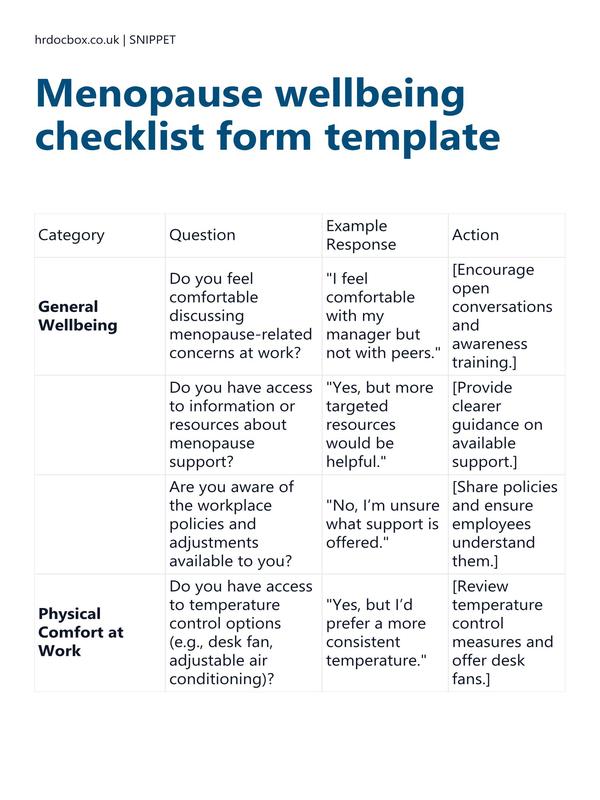
  • A wellbeing checklist covering temperature, ventilation, fatigue, sleep, concentration, workload and access to facilities.
  • Prompts to identify workplace tasks, environments or working patterns that may create difficulties.
  • Questions about existing support and adjustments that may be helpful.
  • A practical action plan with responsibilities, target dates and review arrangements.
  • Space to record employee comments, agreed next steps and follow-up dates.
  • Confidentiality and record-keeping reminders for managers and HR.
Template

Download .doc

Edit .xls

Copy [to paste]

Email

Menopause wellbeing checklist

Purpose

This checklist helps identify workplace factors that may affect an employee's wellbeing during perimenopause, menopause or post-menopause. It provides a starting point for discussing practical support, workplace adjustments and agreed actions.

Complete the sections relevant to your circumstances. You do not need to provide a detailed medical history or disclose information that is not necessary to discuss workplace support.

Section 1: Employee and discussion details

Employee name  
Job title / department  
Manager / HR representative  
Date completed  
Preferred way to complete [ ] Independently    [ ] With manager    [ ] With HR
Purpose of discussion [ ] Initial discussion    [ ] Review    [ ] Follow-up to a concern

Section 2: Wellbeing and workplace checklist

Tick any areas that are relevant to you. You may leave an item blank if it does not apply or you do not wish to discuss it.

A. Working environment and physical comfort

Select Consideration Comments / support that may help
[ ] Workplace temperature or hot flushes affect my comfort.  
[ ]
PREVIEW ENDS HERE

This is the end of the preview

You've seen 20% of how the Menopause wellbeing checklist form template is structured. Get the complete editable template instantly and customise it for your organisation.
£12.99
Specifications
Access 12 months, with updates
Length 3 pages • 1,115 words
Jurisdiction England, Wales, Scotland
Based on UK law, ACAS guidance
Last update 11/10/2026
Update reason ACAS guidance update.
Next review 11/04/2027
Delivery & Format Instant digital delivery, .doc · .xls · .txt · email

What is a menopause wellbeing checklist form?

Menopause wellbeing checklist form template preview

Menopause symptoms can affect people differently and may change over time. Workplace factors such as high temperatures, inadequate ventilation, limited toilet access, fatigue, disrupted sleep or difficulty concentrating can make it harder for some employees to work comfortably and effectively.

A menopause wellbeing checklist form gives employees and managers a practical starting point for discussing these issues. It focuses on the employee's experience at work, the support they would find helpful and the actions that could make a difference, rather than requiring detailed medical disclosure.

Identify workplace factors affecting wellbeing

The checklist prompts consideration of the working environment, physical comfort, workload, concentration, working hours and access to suitable facilities. Employees can identify relevant concerns without being expected to experience every symptom or answer every question.

Turn concerns into practical support

Use the completed checklist to explore reasonable and proportionate measures, such as access to drinking water and toilets, improved ventilation, suitable rest breaks, temporary flexibility in working hours, changes to work allocation or adjustments to uniform requirements where practicable.

Agree actions and review progress

The form includes an action plan to record what has been agreed, who will take responsibility and when each action should be completed. A follow-up discussion helps establish whether the measures are effective or whether further support, an occupational health referral or a workplace risk assessment should be considered.

Support a respectful and confidential process

The checklist should be used sensitively and in line with the organisation's menopause policy, equality responsibilities and data protection arrangements. Employees should be able to discuss their needs without pressure to share personal medical details. Managers should record only information that is necessary for providing support and managing agreed actions.

Best in class example

An employee tells their manager that hot conditions on the production floor, disrupted sleep and difficulty concentrating are making some shifts more challenging. The manager offers a private discussion and uses the menopause wellbeing checklist to identify the workplace factors causing the greatest difficulty.

The employee identifies ventilation, access to drinking water and the timing of breaks as immediate concerns. They also explain that occasional flexibility around start times would help after particularly poor sleep. The manager discusses which options are practicable and whether a workplace risk assessment should be reviewed.

The manager and employee agree actions, including checking ventilation, confirming access to drinking water and toilets, reviewing break arrangements and trialling an agreed degree of flexibility where production requirements allow. Each action is assigned an owner and target date.

Two weeks later, the manager meets the employee privately to review progress. The employee reports that some measures have helped, but further consideration is needed around the working environment. The remaining actions are updated, and only necessary information is retained in accordance with the organisation's confidentiality and data protection arrangements.

The wider HR process

Related HR resources and workflow

Explore the HR resources that may be relevant before and / or after using the Menopause wellbeing checklist form, helping you understand the wider process, maintain appropriate documentation and follow a consistent approach.

Previous
Guides
Managers guide to supporting Menopause at work

A manager's guide to supporting menopause at work provides practical guidance for UK managers on recognising workplace support needs, having sensitive conversations and responding appropriately to employees experiencing perimenopause, menopause or post-menopause.

This
Menopause wellbeing checklist form
Premium content

To continue reading, purchase this item or a parent toolkit, library or our full library.

Implementation guidance

Use these best practice actions, recommended timescales and process stages to understand when and how the Menopause wellbeing checklist form should be used, helping ensure each step is handled consistently and appropriately documented.

Step Description Responsibility Timing (Days from Issue)
1 Explain the purpose of the checklist, how information will be used and who may access it. Offer the employee the option to complete it independently or discuss it privately. Manager or HR Day 0 to 2
2 Invite the employee to identify relevant workplace concerns, existing support and any changes they would find helpful. Do not require unnecessary medical details. Employee, with manager or HR support if requested Days 1 to 5
3 Discuss practical options and assess whether further action is needed, including a workplace risk assessment, reasonable-adjustment consideration or occupational health advice. Manager, with HR and H&S support where appropriate Days 3 to 7
4 Record agreed actions, named owners and completion dates. Communicate any necessary arrangements to relevant people while limiting the sharing of personal information. Manager or HR, with action owners Days 5 to 10
5 Review the actions with the employee, check whether the measures are helping and agree any further support or revised actions. Manager or HR and employee Initial review around Day 14 to 28, then as agreed
Premium content

To continue reading, purchase this item or a parent toolkit, library or our full library.

Common mistakes

Understand the common mistakes to avoid when using this HR template, helping you reduce risk, prevent unnecessary costs and ensure the process is handled correctly.

  • Treating the checklist as a medical assessment. Focus on workplace wellbeing and support rather than attempting to diagnose symptoms or request unnecessary health information.
  • Making completion compulsory without good reason. Explain the purpose of the form and encourage participation in a supportive, non-pressurised way.
  • Assuming everyone experiences menopause in the same way. Ask the employee what affects them personally instead of making assumptions based on age, sex or symptoms.
  • Recording concerns without taking action. Agree practical next steps, assign responsibility and set realistic completion dates.
  • Promising adjustments without assessing feasibility. Discuss the employee's needs and consider appropriate options individually, including legal duties where applicable.
  • Sharing confidential information too widely. Restrict access to necessary information and follow the organisation's data protection and record-retention procedures.
Premium content

To continue reading, purchase this item or a parent toolkit, library or our full library.

HR considerations

UK employment law and best practice

This template is designed to support the process, but the document should be used alongside the relevant HR procedure and applied to the circumstances of the individual case.

A menopause wellbeing checklist is a practical HR tool rather than a statutory form. UK employers should use it alongside their menopause policy, relevant risk assessments, absence procedures and arrangements for workplace adjustments. The checklist does not replace individual assessment or professional advice where these are needed.

Equality Act 2010

The Equality Act 2010 protects employees against discrimination related to protected characteristics, including sex, age and disability. Menopause is not a separate protected characteristic, but menopause-related circumstances may engage these protections depending on the facts. Some symptoms may meet the legal definition of disability. Where the disability provisions apply, employers must consider their duty to make reasonable adjustments. Information about the legislation is available at https://www.legislation.gov.uk/ukpga/2010/15/contents.

Health and safety responsibilities

Under the Health and Safety at Work etc. Act 1974, employers must take reasonably practicable steps to protect employees' health, safety and welfare. The Management of Health and Safety at Work Regulations 1999 require suitable and sufficient risk assessments. Where workplace conditions or tasks may affect an employee experiencing menopause, employers should consider relevant risks and appropriate control measures. The checklist can help identify issues but does not replace a formal risk assessment where one is required. See https://www.legislation.gov.uk/ukpga/1974/37/contents and https://www.legislation.gov.uk/uksi/1999/3242/contents.

ACAS guidance and good practice

ACAS recommends that employers support staff experiencing menopause through open conversations, appropriate workplace support and consideration of adjustments. Managers should listen without making assumptions, discuss possible solutions with the employee and review whether agreed support is effective. Relevant guidance is available at https://www.acas.org.uk/menopause-at-work/supporting-staff-through-the-menopause and https://www.acas.org.uk/menopause-at-work/menopause-and-the-law.

Confidentiality and personal data

Information about an employee's symptoms or health may constitute special category personal data. Employers should identify an appropriate lawful basis and condition for processing, restrict access to those who need the information, explain how records will be used and retained, and avoid collecting unnecessary medical details. Relevant legislation includes the UK GDPR and Data Protection Act 2018: https://www.legislation.gov.uk/eur/2016/679/contents and https://www.legislation.gov.uk/ukpga/2018/12/contents.

Using the checklist appropriately

Completion should be voluntary and supportive, not a test of an employee's health, capability or commitment. Do not use the checklist as a substitute for medical advice, an occupational health assessment, a suitable risk assessment or a formal reasonable-adjustment process. Review the form periodically to ensure it remains appropriate for the organisation and its working environments.

You may also need these resources

FAQs

What is a menopause wellbeing checklist form?

It is a structured form used to identify workplace factors that may affect an employee experiencing perimenopause, menopause or post-menopause. It helps the employee and employer discuss concerns, consider support and record agreed actions. It is not a medical assessment or a statutory form.

Who should complete the checklist?

An employee can complete it independently or with support from a manager or HR representative. The organisation should explain the purpose and confidentiality arrangements and allow the employee to raise only the concerns relevant to their circumstances. The process should be supportive rather than intrusive.

What should be included in a menopause wellbeing checklist?

Useful topics include temperature, ventilation, access to toilets and drinking water, fatigue, sleep, concentration, workload, working hours, breaks and the availability of workplace support. The form should also record agreed actions, responsibilities and review dates without requiring unnecessary medical details.

Does an employer have to make menopause-related adjustments?

There is no single legal duty to provide every adjustment requested because of menopause. However, employers must consider their obligations under the Equality Act 2010, including the duty to make reasonable adjustments where the legal requirements for disability apply. Employers must also meet applicable health and safety duties. ACAS guidance is available at https://www.acas.org.uk/menopause-at-work/menopause-and-the-law.

Why use HRDocBox?

HRDocBox provides customisable HR templates designed for UK employers, helping businesses establish consistent processes and practical documentation. This checklist can be adapted to reflect your menopause policy, workplace environment, management responsibilities and internal procedures.

Why use HRDocBox rather than asking AI?

A dedicated HRDocBox template provides a structured starting point with relevant sections, prompts and an action-recording format that can be adapted for your organisation. AI can help tailor wording, but any generated content still needs to be checked for legal accuracy, suitability and consistency with your workplace policies. Employers remain responsible for how the form is implemented and how employee information is handled.

How this content is developed and reviewed

The Menopause wellbeing checklist form template is developed using a practical HR methodology that considers current UK employment legislation, ACAS guidance, CIPD good practice and the real-world HR process it supports. Templates and supporting information are regularly reviewed and updated, with additional reviews triggered by significant changes to legislation, guidance or established HR practice, helping ensure each document remains practical, relevant and suitable for UK employers.

About the author

Darryl Horn, Chartered HR Director

Darryl is a Chartered HR professional with over 25 years' experience in senior HR and employee relations roles.

He has extensive practical experience of managing wellbeing HR processes and founded hrdocbox to provide businesses with practical, professionally developed HR resources grounded in UK employment law and best practice.

HRDocBox has been creating practical UK HR documents since 2009.

Executive recommendation

"Darryl provides support and advice with excellent judgement, and has a strong understanding of people, policies and UK employment legislation."

"He is someone I trust; consistent, dependable, and committed to doing things properly."

RB
Ruth Brock Chief Executive Officer The Hygiene Bank
Get started today

HR confidence starts here

Whether you employ 5 people or 50, hrdocbox gives you the structure, documents and expertise needed to manage employees professionally and legally.

Download your FREE UK employment contract template

Professionally written and fully compliant with UK employment law
Download FREE contract
Free UK employment contract template