Reasonable adjustment confirmation letter template

£9.99

UK-specific • Editable • Instant download • 12 months' updates

A practical letter confirming the reasonable adjustments that have been agreed with an employee to help reduce or remove a disadvantage they may experience at work.

Use this template to:

  • Confirm adjustments agreed following a discussion with an employee.
  • Set out clearly what support or changes will be provided.
  • Record when the adjustments will start and how they will operate.
  • Make clear that adjustments will be reviewed and may need to change.
  • Provide the employee and manager with a shared written record.
  • Support consistent and fair management of workplace adjustments.
Reasonable adjustment confirmation letter template
2026 Reviewed

What's included in this template?

This template brings together the key information, sections and considerations you need to create a clear, comprehensive and professional HR document. Preview the document below.

  • Confirmation of agreed adjustments
  • Details of how the adjustments will operate
  • Start date and review arrangements
  • Employee and manager responsibilities
  • Provision for changes or further support
Specifications
Access 12 months (includes updates)
Length 2 pages • 293 words
Jurisdiction England, Wales and Scotland
Based on UK employment law, ACAS guidance
Last review 05/09/2026
Next review 05/03/2027
Delivery Instant download
Formats .doc · .txt · email

Download .doc

Copy [to paste]

Email
Template

[Sender name]

[Sender address]

[date]

[Recipient name]

[Recipient address]


Dear [Recipient first name],

Confirmation of reasonable adjustments

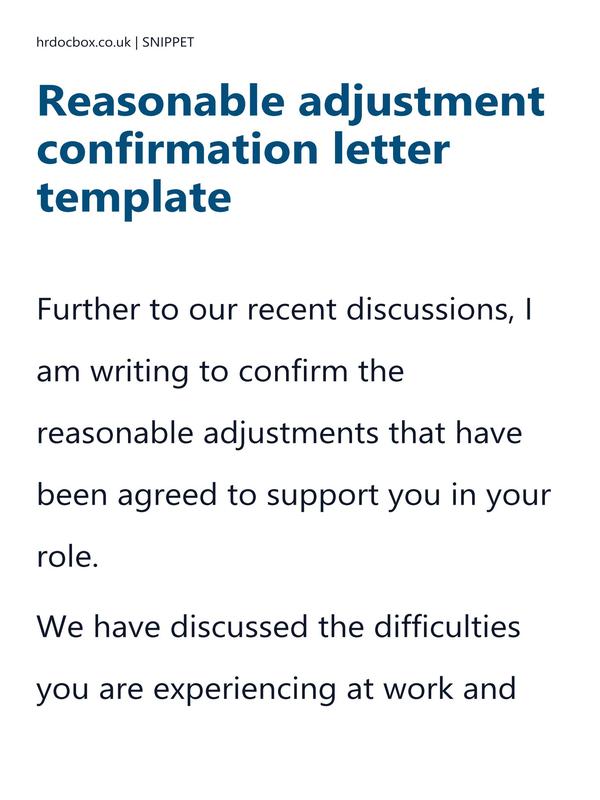
Further to our recent discussions, I am writing to confirm the reasonable adjustments that have been agreed to support you in your role.

We have discussed the difficulties you are experiencing at work and the ways in which these may affect you. Following those discussions, we have agreed the following adjustments:

Agreed adjustments

[Describe the agreed adjustment in clear, practical terms. Include any changes to working arrangements, hours, duties, equipment, workplace arrangements, breaks, communication arrangements or other support that has been agreed.]

How the adjustments will operate

The agreed

PREVIEW ENDS HERE

This is the end of the preview

You've seen just 30% of how the Reasonable adjustment confirmation letter template is structured. Get the complete editable template instantly and customise it for your organisation.
£9.99

Need the complete Wellbeing process?

Explore the Wellbeing templates toolkit

What is a reasonable adjustment confirmation letter?

Reasonable adjustment confirmation letter template preview

Once reasonable adjustments have been discussed and agreed, it is good practice to confirm the arrangements in writing. This letter provides a clear record of what has been agreed, helping the employee, manager and HR understand the support that will be provided and how it will be reviewed.

Confirming the agreed support

The letter records the specific adjustments that have been agreed, rather than relying on informal conversations or assumptions. This could include changes to working arrangements, duties, working hours, equipment, the workplace or additional support.

Making responsibilities clear

Setting out how the adjustments will work in practice helps everyone understand what is expected. The letter can also identify any actions required from the employee, manager or employer to put the arrangements into place.

Keeping adjustments under review

Reasonable adjustments may need to change as circumstances change. The letter therefore includes a review arrangement and makes clear that the organisation will discuss whether the adjustments remain appropriate or whether further changes are needed.

Creating a clear HR record

A written confirmation provides an accessible record for the employee and organisation. It can help managers apply agreed arrangements consistently and provide useful evidence that the organisation has considered and implemented appropriate support.

Example

An employee tells their manager that a long-term condition is making it difficult to work their existing shift pattern. Following a discussion with the employee and HR, the organisation agrees that they will temporarily change their start and finish times and take a short additional break during the working day.

The employer sends the employee a reasonable adjustment confirmation letter setting out the agreed arrangements, the date they will begin and who will be responsible for implementing them. The letter also confirms that the employee should speak to their manager if the arrangements are not working effectively.

A review is scheduled after eight weeks. At the review, the employee confirms that the revised working pattern has been effective but that one of the adjustments is no longer necessary. The arrangements are therefore updated and the revised position is recorded.

The wider HR process

Related HR resources and workflow

Explore the HR resources that may be relevant before and / or after using the Reasonable adjustment confirmation letter, helping you understand the wider process, maintain appropriate documentation and follow a consistent approach.

Previous
Plans
Reasonable Adjustment Plan

A practical reasonable adjustment plan for recording agreed workplace adjustments, the disadvantage they address, who is responsible for implementing them and when they should be reviewed.

This
Reasonable adjustment confirmation letter
Next
Forms
Reasonable adjustment review form

A practical form for reviewing reasonable adjustments with an employee and recording whether existing arrangements remain effective, need to be changed, or whether further support is required.

Premium content

To continue reading, purchase this item or a parent toolkit, library or our full library.

Implementation guidance

Use these best practice actions, recommended timescales and process stages to understand when and how the Reasonable adjustment confirmation letter should be used, helping ensure each step is handled consistently and appropriately documented.

Step Description Responsibility Timing
1 Discuss the employee's circumstances, any disadvantage they are experiencing and potential reasonable adjustments. Manager / HR Before confirmation
2 Agree the practical adjustments, including how they will operate and any actions needed to implement them. Manager / Employee Following discussion
3 Complete and issue the confirmation letter, ensuring it accurately reflects what has been agreed. HR / Manager Promptly after agreement
4 Put the agreed adjustments into practice and ensure relevant managers understand any changes they need to make. Manager / Employer From agreed start date
5 Review the arrangements with the employee and amend, continue or withdraw adjustments where appropriate. Manager / HR / Employee At agreed review date
Premium content

To continue reading, purchase this item or a parent toolkit, library or our full library.

Common mistakes

Understand the common mistakes to avoid when using this HR template, helping you reduce risk, prevent unnecessary costs and ensure the process is handled correctly.

  • Confirming adjustments that were not actually discussed or agreed with the employee.
  • Using vague wording that does not explain how an adjustment will operate in practice.
  • Failing to identify when the arrangements will start.
  • Treating adjustments as permanent without considering whether they should be reviewed.
  • Making assumptions about what an employee needs rather than discussing their individual circumstances.
  • Failing to communicate relevant arrangements to managers who need to implement them.
Premium content

To continue reading, purchase this item or a parent toolkit, library or our full library.

HR considerations

UK employment law and best practice

This template is designed to support the process, but the document should be used alongside the relevant HR procedure and applied to the circumstances of the individual case.

Equality Act 2010

Where an employee is disabled for the purposes of the Equality Act 2010, an employer has a duty to make reasonable adjustments where the relevant conditions are met. The duty can require changes to working arrangements, physical features or the provision of auxiliary aids. https://www.legislation.gov.uk/ukpga/2010/15/section/20

Individual assessment

Reasonable adjustments should be considered in relation to the individual's circumstances. Employers should discuss possible adjustments with the employee rather than making assumptions about what support they require. https://www.acas.org.uk/reasonable-adjustments

Knowing about the disadvantage

The duty to make reasonable adjustments can arise where the employer knows, or could reasonably be expected to know, that a worker is disabled and is experiencing a relevant disadvantage. An employee does not necessarily need to have a formal diagnosis before an employer considers whether support may be appropriate. https://www.acas.org.uk/reasonable-adjustments/asking-for-reasonable-adjustments

Recording and reviewing adjustments

Keeping a written record of agreed adjustments helps everyone understand what has been agreed. Adjustments should be reviewed where appropriate, particularly if the employee's circumstances, role or working environment changes. https://www.acas.org.uk/reasonable-adjustments/reviewing-and-keeping-a-record

Confidentiality and personal information

Information about an employee's health or disability should be handled appropriately and only shared where there is a legitimate reason to do so. Employers should consider data protection requirements when recording, storing and sharing information about workers' health. https://ico.org.uk/for-organisations/uk-gdpr-guidance-and-resources/employment/information-about-workers-health-data-protection-and-the-dpa-2018/

Best practice

A written confirmation is not a substitute for an ongoing conversation. Employers should remain open to reviewing arrangements where an adjustment is not effective, circumstances change or the employee identifies a further disadvantage.

You may also need these resources

FAQs

Does a reasonable adjustment confirmation letter have to be provided?

There is not generally a specific legal requirement to issue a letter in this particular format. However, confirming agreed adjustments in writing is good practice because it creates a clear record of the arrangements and helps prevent misunderstandings.

Should the letter say why the employee needs the adjustment?

Only information that is necessary should be included. The letter can usually focus on the agreed workplace adjustments rather than recording unnecessary medical details or a detailed diagnosis.

Can reasonable adjustments be changed after the letter has been issued?

Yes. Adjustments may need to change as the employee's circumstances or working arrangements change. Any changes should be discussed with the employee and confirmed appropriately.

Should a review date always be included?

A review date is good practice, although the appropriate approach will depend on the adjustment. Some arrangements may need an early review, while others may simply be reviewed if circumstances change.

Can an employer refuse a requested reasonable adjustment?

An employer is not required to make every adjustment requested by an employee. The employer should properly consider the request and whether the proposed adjustment, or an alternative adjustment, would be reasonable in the circumstances.

Why use HRDocBox rather than AI?

AI can help produce a generic letter, but HRDocBox templates are designed specifically around UK HR practice and employment law. This template provides a structured starting point covering the practical issues employers need to consider when confirming reasonable adjustments, which can then be adapted to the individual employee and circumstances.

How this content is developed and reviewed

The Reasonable adjustment confirmation letter template is developed using a practical HR methodology that considers current UK employment legislation, ACAS guidance, CIPD good practice and the real-world HR process it supports. Templates are regularly reviewed and updated, with additional reviews triggered by significant changes to legislation, guidance or established HR practice, helping ensure each document remains practical, relevant and suitable for UK employers.

About the author

Darryl Horn, Chartered HR Director

Darryl is a Chartered HR professional with over 25 years' experience in senior HR and employee relations roles.

He has extensive practical experience of managing wellbeing processes and founded hrdocbox to provide businesses with practical, professionally developed HR resources grounded in UK employment law and best practice.

HRDocBox has been creating practical UK HR documents since 2009.

Executive recommendation

"Darryl provides support and advice with excellent judgement, and has a strong understanding of people, policies and UK employment legislation."

"He is someone I trust; consistent, dependable, and committed to doing things properly."

RB
Ruth Brock Chief Executive Officer The Hygiene Bank
The Reasonable adjustment confirmation letter template is also included in these bundles:

Wellbeing toolkit Wellbeing toolkit 24 templates
£34.90

Management library Management library 470 templates
£79.99

Full library Full library 778 templates
£99.99

Get started today

HR confidence starts here

Whether you employ 5 people or 50, hrdocbox gives you the structure, documents and expertise needed to manage employees professionally and legally.

Download your FREE UK employment contract template

Professionally written and fully compliant with UK employment law
Download FREE contract
Free UK employment contract template