Libraries
780+ HR templates
Everything your business needs to stay compliant
Policies, contracts, letters, guidance and HR support tools for UK employers.
View full libraryPolicies, contracts, letters, guidance and HR support tools for UK employers.
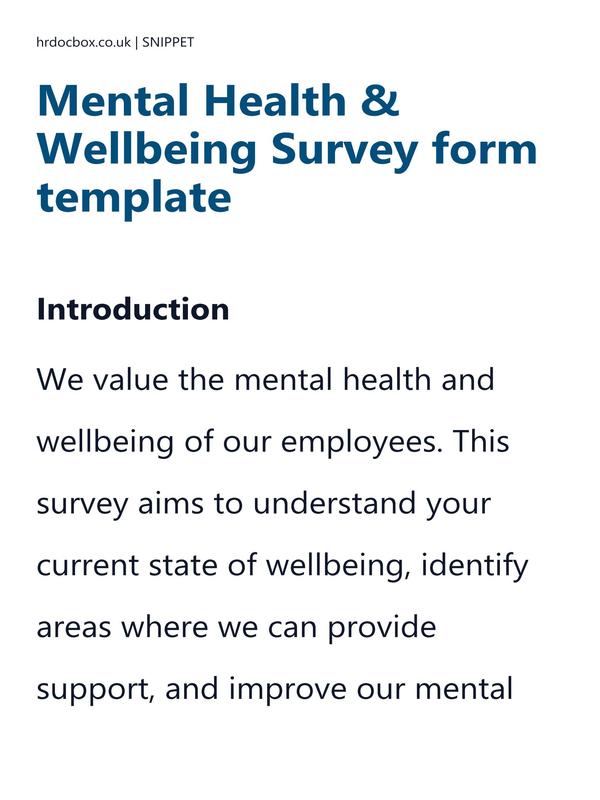
View full libraryThe Mental Health & Wellbeing Survey Form provides a structured way for employers to understand how employees are experiencing work, identify potential wellbeing concerns and gather feedback on the support available. It helps organisations identify themes around workload, communication, management, stress, work-life balance and psychological wellbeing while giving employees an opportunity to suggest improvements.
Use this template to:
If you are supporting employee wellbeing, the toolkit brings together practical HR templates covering wellbeing needs, assessment, support, communication and review.
About the survey
This survey is designed to help [Company Name] understand how employees are experiencing work and identify opportunities to improve mental health and wellbeing.
Please answer the questions honestly. You do not need to provide information that you are uncomfortable sharing. The survey is intended to identify workplace themes and opportunities for improvement and is not a substitute for medical or clinical support.
Survey information
| Survey date: | |
| Department / team: | |
| Length of service: | Less than 1 year / 1–3 years / 3–5 years / 5+ years / Prefer not to say |
How are you feeling at work?
| Statement: | Strongly agree | Agree | Neither | Disagree | Strongly disagree |
| I generally |
You've seen 20% of how the Mental Health & Wellbeing Survey form template is structured. Get the complete editable template instantly and customise it for your organisation.

A Mental Health & Wellbeing Survey Form gives employees a structured opportunity to provide feedback about how work is affecting their wellbeing. It covers areas such as workload, stress, management support, work-life balance and awareness of available support.
The results can help employers understand employee experience and identify themes that may require further attention.
The survey can help an organisation identify workplace factors that may contribute to stress or poor wellbeing and understand whether employees know how to access support.
Used alongside other people and management information, the findings can inform practical actions around workload, communication, management practice, working arrangements and wellbeing support.
The template is suitable for HR professionals, people managers and employers who want to gather structured feedback about employee mental health and workplace wellbeing.
It can be used as a standalone survey or as part of a wider employee engagement, health and wellbeing programme.
The survey should be introduced clearly, with employees told why the information is being collected, how responses will be used and whether responses are anonymous or identifiable. Questions should focus on workplace experience rather than asking employees to disclose unnecessary medical information.
Survey findings should be reviewed for themes and translated into proportionate action. Employees should also be told what the organisation has learned and, where appropriate, what it intends to do in response.
Related HR resources and workflow
Explore the HR resources that may be relevant before and / or after using the Mental Health & Wellbeing Survey form, helping you understand the wider process, maintain appropriate documentation and follow a consistent approach.

This Mental Health and Wellbeing Policy helps UK employers promote a supportive workplace, prevent and manage work-related stress, and provide appropriate support to employees experiencing mental health difficulties.
Use these best practice actions, recommended timescales and process stages to understand when and how the Mental Health & Wellbeing Survey form should be used, helping ensure each step is handled consistently and appropriately documented.
Understand the common mistakes to avoid when using this HR template, helping you reduce risk, prevent unnecessary costs and ensure the process is handled correctly.
Anonymous surveys can encourage more open feedback, particularly where employees may be reluctant to discuss wellbeing concerns. However, the appropriate approach depends on the purpose of the survey. Employees should be told clearly how their responses will be handled.
Employers can ask appropriate questions about workplace wellbeing and support needs, but should avoid collecting unnecessary medical information. The survey should focus on workplace factors and the support employees may need rather than attempting to diagnose individual conditions.
HRDocBox combines deep HR knowledge, practical application and years of experience with real workplace people issues. The survey is designed to help employers explore the workplace factors that influence wellbeing and turn employee feedback into practical improvements.
AI can generate generic wellbeing questions, but a useful workplace survey needs to distinguish between individual health information and organisational factors such as workload, management, support and work-related stress. HRDocBox combines UK HR knowledge, HSE guidance and practical workplace experience rather than relying on generic wellbeing questions.
Only information that is relevant to the purpose of the survey should be collected. Questions should generally focus on workplace experience, wellbeing, workload, support and potential areas for improvement rather than asking employees to disclose detailed medical histories.
The results should be reviewed for meaningful themes and used to identify proportionate actions. Where findings indicate potential work-related stress risks, employers should consider them alongside their wider risk assessment and stress-management arrangements.
How this content is developed and reviewed
The Mental Health & Wellbeing Survey form template is developed using a practical HR methodology that considers current UK employment legislation, ACAS guidance, CIPD good practice and the real-world HR process it supports. Templates and supporting information are regularly reviewed and updated, with additional reviews triggered by significant changes to legislation, guidance or established HR practice, helping ensure each document remains practical, relevant and suitable for UK employers.
Darryl Horn, Chartered HR Director
Darryl is a Chartered HR professional with over 25 years' experience in senior HR and employee relations roles.
He has extensive practical experience of managing wellbeing HR processes and founded hrdocbox to provide businesses with practical, professionally developed HR resources grounded in UK employment law and best practice.
HRDocBox has been creating practical UK HR documents since 2009.
"Darryl provides support and advice with excellent judgement, and has a strong understanding of people, policies and UK employment legislation."
"He is someone I trust; consistent, dependable, and committed to doing things properly."















Whether you employ 5 people or 50, hrdocbox gives you the structure, documents and expertise needed to manage employees professionally and legally.
Professionally written and fully compliant with UK employment law
Access a free contract template instantly - or save 10% on any document today.
Use this code at checkout for 10% off anything!
Includes instant download, updates, and full access to your HR templates.