Mental Health & Wellbeing Survey form template

£14.99

UK-specific • Editable • Instant download • 12 months' updates

The Mental Health & Wellbeing Survey Form provides a structured way for employers to understand how employees are experiencing work, identify potential wellbeing concerns and gather feedback on the support available. It helps organisations identify themes around workload, communication, management, stress, work-life balance and psychological wellbeing while giving employees an opportunity to suggest improvements.

Use this template to:

  • Gather employee feedback on mental health and wellbeing.
  • Identify workplace factors affecting wellbeing.
  • Understand employee experiences of workload and management support.
  • Identify gaps in existing wellbeing support.
  • Provide employees with a confidential route to share concerns.
  • Use survey findings to inform practical workplace improvements.
Mental Health & Wellbeing Survey form template
2026 Reviewed

What's included in this template?

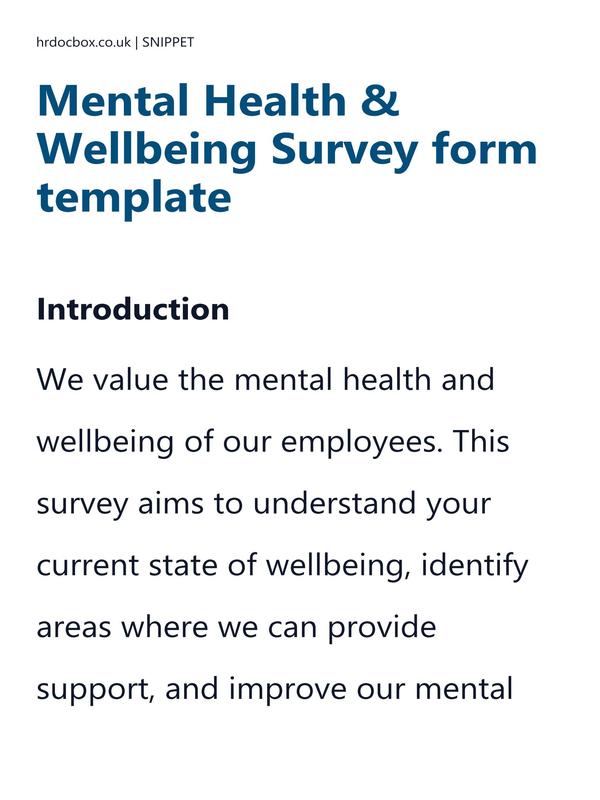
This template brings together the key information, sections and considerations you need to create a clear, comprehensive and professional HR document. Preview the document below.

  • Workplace wellbeing questions
  • Workload and work-life balance
  • Management and communication
  • Stress and psychological wellbeing
  • Support and resources
  • Employee comments and improvement suggestions
Specifications
Access 12 months (includes updates)
Length 2 pages • 717 words
Jurisdiction England, Wales and Scotland
Based on UK employment law, ACAS guidance
Last review 24/08/2026
Next review 24/02/2027
Delivery Instant download
Formats .doc · .xls · .txt · email

Download .doc

Edit .xls

Copy [to paste]

Email
Template

Mental Health & Wellbeing Survey

About the survey

This survey is designed to help [Company Name] understand how employees are experiencing work and identify opportunities to improve mental health and wellbeing.

Please answer the questions honestly. You do not need to provide information that you are uncomfortable sharing. The survey is intended to identify workplace themes and opportunities for improvement and is not a substitute for medical or clinical support.

Survey information

Survey date:  
Department / team:  
Length of service: Less than 1 year / 1–3 years / 3–5 years / 5+ years / Prefer not to say

How are you feeling at work?

Statement: Strongly agree Agree Neither Disagree Strongly disagree
I generally feel positive about coming to work.          
I feel comfortable being myself at work.          
I feel respected by the people I work with.          
I feel able to raise concerns when something is affecting my wellbeing.          
I feel supported by my manager.
PREVIEW ENDS HERE

This is the end of the preview

You've seen just 30% of how the Mental Health & Wellbeing Survey form template is structured. Get the complete editable template instantly and customise it for your organisation.
£14.99

Need the complete Wellbeing process?

Explore the Wellbeing templates toolkit

What is a mental health & wellbeing survey form?

Mental Health & Wellbeing Survey form template preview

A Mental Health & Wellbeing Survey Form gives employees a structured opportunity to provide feedback about how work is affecting their wellbeing. It covers areas such as workload, stress, management support, work-life balance and awareness of available support.

The results can help employers understand employee experience and identify themes that may require further attention.

What is it used for?

The survey can help an organisation identify workplace factors that may contribute to stress or poor wellbeing and understand whether employees know how to access support.

Used alongside other people and management information, the findings can inform practical actions around workload, communication, management practice, working arrangements and wellbeing support.

Who should use it?

The template is suitable for HR professionals, people managers and employers who want to gather structured feedback about employee mental health and workplace wellbeing.

It can be used as a standalone survey or as part of a wider employee engagement, health and wellbeing programme.

How should it be used?

The survey should be introduced clearly, with employees told why the information is being collected, how responses will be used and whether responses are anonymous or identifiable. Questions should focus on workplace experience rather than asking employees to disclose unnecessary medical information.

Survey findings should be reviewed for themes and translated into proportionate action. Employees should also be told what the organisation has learned and, where appropriate, what it intends to do in response.

Example

A business wants to understand why employee feedback has highlighted increasing workload and pressure across several teams. HR introduces a Mental Health & Wellbeing Survey covering workload, management support, work-life balance, stress and awareness of available support.

Employees are given two weeks to complete the survey anonymously. The results show that employees generally feel supported by their colleagues but that workload and the ability to switch off outside working hours are recurring concerns.

HR shares the key themes with managers and agrees actions around workload planning, management conversations and clearer communication about available wellbeing support.

The organisation then repeats the survey at a later stage to understand whether the changes have improved employee experience.

The wider HR process

Related HR resources and workflow

Explore the HR resources that may be relevant before and / or after using the Mental Health & Wellbeing Survey form, helping you understand the wider process, maintain appropriate documentation and follow a consistent approach.

Previous
Policies
Mental health and wellbeing policy

A comprehensive policy supporting employee mental health and wellbeing through awareness, early intervention, reasonable adjustments, and proactive workplace support.

This
Mental Health & Wellbeing Survey form
Premium content

To continue reading, purchase this item or a parent toolkit, library or our full library.

Implementation guidance

Use these best practice actions, recommended timescales and process stages to understand when and how the Mental Health & Wellbeing Survey form should be used, helping ensure each step is handled consistently and appropriately documented.

Step Description Responsibility Timing (Days from Issue)
1 Plan the Survey: Decide what the organisation needs to understand, how responses will be collected and whether the survey will be anonymous or identifiable. HR / Management Day -21 to Day -14
2 Issue the Survey: Explain the purpose of the survey, how information will be used and the support available to employees before inviting responses. HR / Management Day 0
3 Gather Responses: Give employees an appropriate period to complete the survey and provide a safe opportunity to raise concerns or identify workplace issues. HR / Employees Day 1 to Day 14
4 Analyse the Findings: Review responses for meaningful themes, including workload, stress, management, support and other workplace factors affecting wellbeing. HR / Management Day 15 to Day 21
5 Agree and Communicate Actions: Identify proportionate improvements, assign responsibility and communicate relevant findings and actions back to employees. Management / HR Day 22 onwards
Premium content

To continue reading, purchase this item or a parent toolkit, library or our full library.

Common mistakes

Understand the common mistakes to avoid when using this HR template, helping you reduce risk, prevent unnecessary costs and ensure the process is handled correctly.

  • Asking employees to disclose unnecessary or highly personal medical information.
  • Failing to explain whether responses are anonymous, confidential or identifiable.
  • Collecting wellbeing data without deciding how it will be used or protected.
  • Using survey results to diagnose individual employees rather than identify workplace themes.
  • Ignoring significant themes around workload, stress or management after asking employees to provide feedback.
  • Failing to communicate what has been learned and what action will follow.
Premium content

To continue reading, purchase this item or a parent toolkit, library or our full library.

HR considerations

UK employment law and best practice

This template is designed to support the process, but the document should be used alongside the relevant HR procedure and applied to the circumstances of the individual case.

Mental health and wellbeing surveys can form part of an employer's wider approach to managing workplace health, safety and employee wellbeing. The most useful surveys focus on workplace factors that employers can influence rather than attempting to diagnose individual mental health conditions.

Health and safety

The Health and Safety at Work etc. Act 1974 places general duties on employers to protect employees' health, safety and welfare so far as reasonably practicable. HSE guidance on work-related stress recommends that employers identify the causes of stress and take action to manage risks. https://www.hse.gov.uk/stress/risk-assessment.htm

A wellbeing survey can provide useful employee feedback as part of this wider process, particularly when questions explore workload, control, support, relationships, role and organisational change.

Work-related stress

HSE's Management Standards approach identifies six areas of work design that can contribute to stress: demands, control, support, relationships, role and change. https://www.hse.gov.uk/stress/standards/

Using questions around these areas can help employers identify workplace themes that may warrant further investigation or action rather than treating stress purely as an individual employee issue.

Equality Act 2010

Mental health conditions can amount to a disability under the Equality Act 2010 where the statutory definition is met. Employers may therefore need to consider reasonable adjustments for disabled employees. ACAS provides guidance on reasonable adjustments and mental health at work. https://www.acas.org.uk/reasonable-adjustments

A survey should not be used to determine whether an employee is legally disabled or to make assumptions about an individual's condition. Where an employee identifies a potential support need, the appropriate HR process should be followed.

Confidentiality and personal information

Mental health information can involve particularly sensitive personal information. Employers should be clear about whether survey responses are anonymous, confidential or identifiable and should only collect information that is necessary for the stated purpose.

The Information Commissioner's Office provides guidance on handling workers' health information and explains that employers should consider necessity, transparency, security and appropriate access when processing health information. https://ico.org.uk/for-organisations/uk-gdpr-guidance-and-resources/employment/

Acting on survey findings

A wellbeing survey is most effective when employees can see that their feedback has been considered. HSE's approach to work-related stress emphasises identifying risks, involving employees and taking action to address problems. https://www.hse.gov.uk/stress/what-to-do.htm

Employers should therefore avoid collecting sensitive wellbeing information without considering how meaningful themes will be reviewed and what action can reasonably be taken.

Support and signposting

A survey should not be presented as a substitute for professional mental health support. Employees should be signposted towards the organisation's existing support routes, such as an employee assistance programme, occupational health or other appropriate resources where these are available.

You may also need these resources

FAQs

Should a Mental Health & Wellbeing Survey be anonymous?

Anonymous surveys can encourage more open feedback, particularly where employees may be reluctant to discuss wellbeing concerns. However, the appropriate approach depends on the purpose of the survey. Employees should be told clearly how their responses will be handled.

Can an employer ask employees about their mental health?

Employers can ask appropriate questions about workplace wellbeing and support needs, but should avoid collecting unnecessary medical information. The survey should focus on workplace factors and the support employees may need rather than attempting to diagnose individual conditions.

Why use HRDocBox for a Mental Health & Wellbeing Survey?

HRDocBox combines deep HR knowledge, practical application and years of experience with real workplace people issues. The survey is designed to help employers explore the workplace factors that influence wellbeing and turn employee feedback into practical improvements.

Why use HRDocBox rather than asking AI to create the survey?

AI can generate generic wellbeing questions, but a useful workplace survey needs to distinguish between individual health information and organisational factors such as workload, management, support and work-related stress. HRDocBox combines UK HR knowledge, HSE guidance and practical workplace experience rather than relying on generic wellbeing questions.

How much information should a wellbeing survey collect?

Only information that is relevant to the purpose of the survey should be collected. Questions should generally focus on workplace experience, wellbeing, workload, support and potential areas for improvement rather than asking employees to disclose detailed medical histories.

What should an employer do with the results?

The results should be reviewed for meaningful themes and used to identify proportionate actions. Where findings indicate potential work-related stress risks, employers should consider them alongside their wider risk assessment and stress-management arrangements.

How this content is developed and reviewed

The Mental Health & Wellbeing Survey form template is developed using a practical HR methodology that considers current UK employment legislation, ACAS guidance, CIPD good practice and the real-world HR process it supports. Templates are regularly reviewed and updated, with additional reviews triggered by significant changes to legislation, guidance or established HR practice, helping ensure each document remains practical, relevant and suitable for UK employers.

About the author

Darryl Horn, Chartered HR Director

Darryl is a Chartered HR professional with over 25 years' experience in senior HR and employee relations roles.

He has extensive practical experience of managing wellbeing processes and founded hrdocbox to provide businesses with practical, professionally developed HR resources grounded in UK employment law and best practice.

HRDocBox has been creating practical UK HR documents since 2009.

Executive recommendation

"Darryl provides support and advice with excellent judgement, and has a strong understanding of people, policies and UK employment legislation."

"He is someone I trust; consistent, dependable, and committed to doing things properly."

RB
Ruth Brock Chief Executive Officer The Hygiene Bank
The Mental Health & Wellbeing Survey form template is also included in these bundles:

Wellbeing toolkit Wellbeing toolkit 22 templates
£34.90

Management library Management library 468 templates
£79.99

Full library Full library 776 templates
£99.99

Get started today

HR confidence starts here

Whether you employ 5 people or 50, hrdocbox gives you the structure, documents and expertise needed to manage employees professionally and legally.

Download your FREE UK employment contract template

Professionally written and fully compliant with UK employment law
Download FREE contract
Free UK employment contract template