Libraries
780+ HR templates
Everything your business needs to stay compliant
Policies, contracts, letters, guidance and HR support tools for UK employers.
View full libraryPolicies, contracts, letters, guidance and HR support tools for UK employers.
View full libraryUse this Pregnancy Risk Assessment template to identify workplace hazards affecting a pregnant employee, a worker who has recently given birth or a breastfeeding worker. Record appropriate controls, agreed actions and review arrangements to help protect health and safety at work.
Use this template to:
Assess workplace hazards with templates for identifying risks, people affected, control measures and actions. Support a structured approach to workplace risk management.
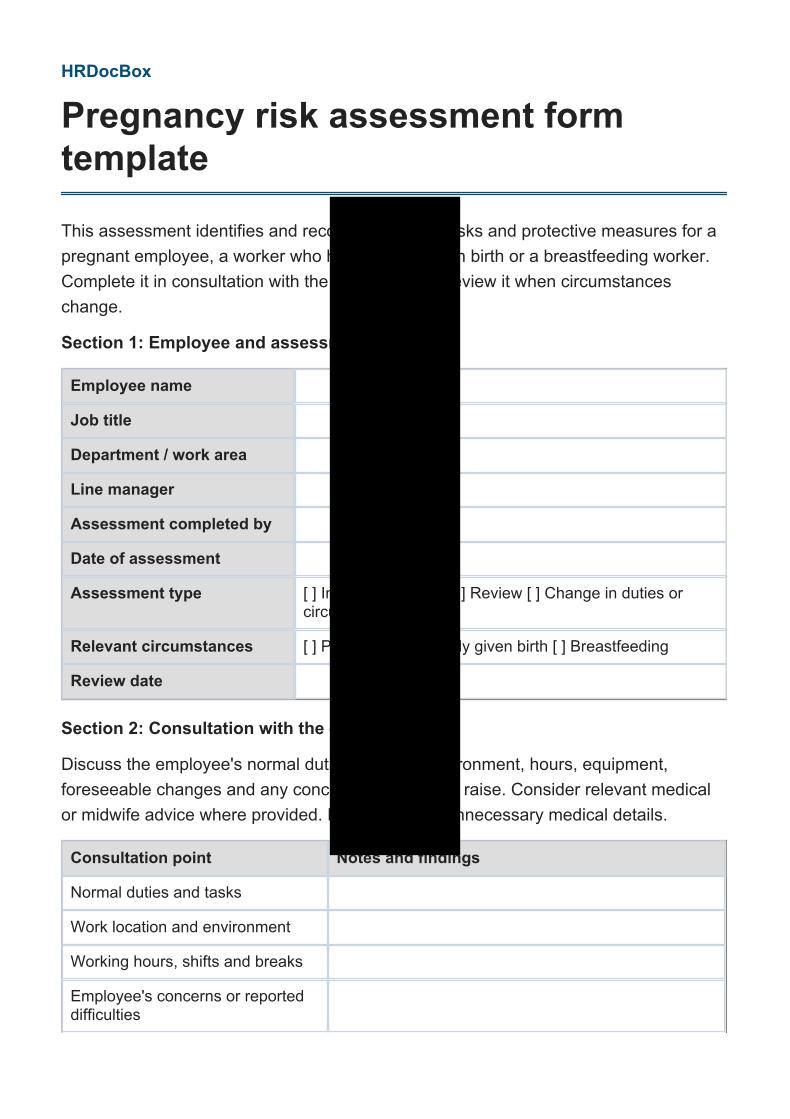
This assessment identifies and records workplace risks and protective measures for a pregnant employee, a worker who has recently given birth or a breastfeeding worker. Complete it in consultation with the employee and review it when circumstances change.
Section 1: Employee and assessment details
| Employee name | |
| Job title | |
| Department / work area | |
| Line manager | |
| Assessment completed by | |
| Date of assessment | |
| Assessment type | [ ] Initial assessment [ ] Review [ ] Change in duties or circumstances |
| Relevant circumstances | [ ] Pregnant [ ] Recently given birth [ ] Breastfeeding |
| Review date |
Section 2: Consultation with the employee
Discuss the employee's normal duties, working environment, hours, equipment, foreseeable changes and any concerns they wish to raise. Consider relevant medical or midwife advice where provided. Do not request unnecessary medical details.
| Consultation point | Notes and findings |
| Normal duties and tasks | |
| Work location and environment | |
| Working hours, shifts and breaks | |
| Employee's concerns or reported difficulties |
You've seen 20% of how the Pregnancy risk assessment form template is structured. Get the complete editable template instantly and customise it for your organisation.

A pregnancy risk assessment helps employers identify and manage work-related risks to a pregnant employee, someone who has recently given birth or a breastfeeding worker. The assessment should reflect the actual job, workplace hazards and individual circumstances, rather than relying on a generic checklist alone.
This template provides a structured way to record the assessment, consult the employee, identify control measures and track actions through to completion. It can be adapted for manufacturing, warehousing, retail, office environments and other workplaces.
Consider the employee's duties, physical demands, working hours, equipment, substances, workplace layout and access to welfare facilities. Potential hazards include manual handling, prolonged standing, slips and falls, hazardous substances, biological agents, fatigue, night work and workplace transport. Assess only what is relevant to the individual's work, while ensuring that other role-specific hazards are not overlooked.
Discuss the findings with the employee and record the steps needed to remove or reduce identified risks. Controls may include changing tasks, adjusting working conditions or hours, improving access to rest facilities or preventing exposure to particular hazards. If risks cannot be avoided, the employer must consider the applicable legal requirements for suitable alternative work or suspension on full pay.
A pregnancy risk assessment should remain active throughout the relevant period. Review it when pregnancy progresses, duties or working conditions change, new concerns arise or relevant medical or midwife advice is received. Consider risks following birth and during breastfeeding where applicable.
Record the hazards, controls, responsible people, deadlines and outstanding actions. Discuss the outcome with the employee and explain how to raise further concerns. Pregnancy-related information should be handled confidentially and shared only where there is a legitimate and lawful reason to do so.
Related HR resources and workflow
Explore the HR resources that may be relevant before and / or after using the Pregnancy risk assessment form, helping you understand the wider process, maintain appropriate documentation and follow a consistent approach.

Use this Pregnancy Notification Checklist to manage the key actions following an employee's pregnancy notification.

Use this Maternity Leave Acknowledgement Letter to confirm an employee's maternity leave arrangements and eligibility for Statutory Maternity Pay (SMP), enhanced Company Maternity Pay, or both where applicable.
Use these best practice actions, recommended timescales and process stages to understand when and how the Pregnancy risk assessment form should be used, helping ensure each step is handled consistently and appropriately documented.
Understand the common mistakes to avoid when using this HR template, helping you reduce risk, prevent unnecessary costs and ensure the process is handled correctly.
Employers should already have a suitable general workplace risk assessment. When a worker gives written notification that they are pregnant, have given birth within the previous six months or are breastfeeding, the employer must consider and implement the applicable individual protective measures. Arrange the assessment promptly and take immediate action where a known risk requires it.
A manager may complete the assessment if competent to assess the relevant hazards. Involve a health and safety adviser or other competent specialist where risks are complex. Consult the employee because they understand their daily duties and may identify concerns that are not apparent from the job description.
Consider the employee's actual work, including manual handling, prolonged standing or sitting, awkward postures, slips and falls, moving vehicles, hazardous substances, biological agents, noise, vibration, temperature, fatigue, night work and access to suitable welfare facilities. The template provides prompts rather than an exhaustive list, so include any additional hazards relevant to the workplace.
The employer must follow the applicable statutory requirements. Depending on the circumstances, this may involve adjusting working conditions or hours, offering suitable alternative work on appropriate terms and conditions, or suspension on full pay where the legal conditions are met. Consult HR and competent health and safety support before deciding on the appropriate action.
HRDocBox provides practical HR resources to help employers document important workplace processes consistently. This pregnancy risk assessment provides a structured record of hazards, controls, responsibilities, employee consultation and review arrangements, which can be adapted to the employee's role and working environment.
AI can suggest potential hazards, but it may overlook workplace-specific risks or misstate a legal requirement. HRDocBox provides a reusable assessment structure that can be adapted to the actual workplace and supported by official guidance. The completed assessment must still reflect the circumstances, competent judgement and the employer's legal duties.
How this content is developed and reviewed
The Pregnancy risk assessment form template is developed using a practical HR methodology that considers current UK employment legislation, ACAS guidance, CIPD good practice and the real-world HR process it supports. Templates and supporting information are regularly reviewed and updated, with additional reviews triggered by significant changes to legislation, guidance or established HR practice, helping ensure each document remains practical, relevant and suitable for UK employers.
Darryl Horn, Chartered HR Director
Darryl is a Chartered HR professional with over 25 years' experience in senior HR and employee relations roles.
He has extensive practical experience of managing risk assessment HR processes and founded hrdocbox to provide businesses with practical, professionally developed HR resources grounded in UK employment law and best practice.
HRDocBox has been creating practical UK HR documents since 2009.
"Darryl provides support and advice with excellent judgement, and has a strong understanding of people, policies and UK employment legislation."
"He is someone I trust; consistent, dependable, and committed to doing things properly."

















Whether you employ 5 people or 50, hrdocbox gives you the structure, documents and expertise needed to manage employees professionally and legally.
Professionally written and fully compliant with UK employment law
Access a free contract template instantly - or save 10% on any document today.
Use this code at checkout for 10% off anything!
Includes instant download, updates, and full access to your HR templates.