Modern Slavery Risk Assessment form template

£19.90

UK-specific • Editable • Instant download • 12 months' updates

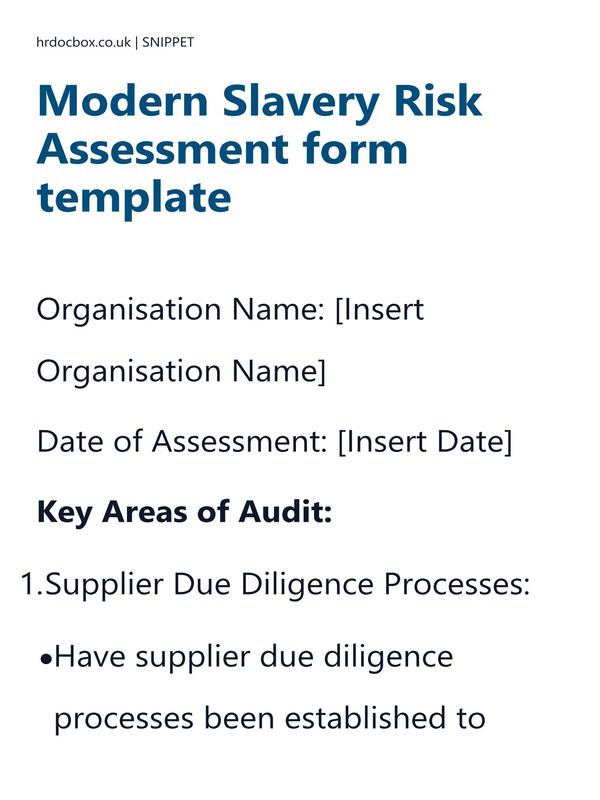
The Modern Slavery Risk Assessment Template provides a structured way for employers to identify, assess and manage the risk of modern slavery and human trafficking within their own operations and supply chains. It helps organisations consider workforce, supplier, geographic and sector risks, record existing controls and establish proportionate actions to reduce identified risks.

Use this template to:
  • Identify modern slavery risks within the business and supply chain.
  • Assess higher-risk workers, activities, suppliers and locations.
  • Record existing prevention and due diligence controls.
  • Assign risk ratings and prioritise action.
  • Record mitigation measures and responsible owners.
  • Create an auditable record of modern slavery risk management.
Modern Slavery Risk Assessment form template
2026 Reviewed

What's included in this template?

This template brings together the key information, sections and considerations you need to create a clear, comprehensive and professional HR document. Preview the document below.

  • Business and supply chain risk profile
  • Modern slavery risk factors
  • Risk scoring and priority rating
  • Existing controls and due diligence
  • Mitigation actions and responsibilities
  • Review and monitoring record
Specifications
Access 12 months (includes updates)
Length 2 pages • 441 words
Jurisdiction England, Wales and Scotland
Based on UK employment law, ACAS guidance
Last review 24/08/2026
Next review 24/02/2027
Delivery Instant download
Formats .doc · .xls · .txt · email

Download .doc

Edit .xls

Copy [to paste]

Email
Template

Modern Slavery Risk Assessment

Assessment details

Organisation / business area:  
Assessment date:  
Completed by:  
Reviewed by:  
Next review date:  

Risk assessment

Risk area: Risk factors / evidence: Likelihood: Impact: Risk rating: Existing controls:
Workforce          
Recruitment practices          
Labour providers / agencies          
Suppliers and contractors          
Geographic location          
Industry / sector        
PREVIEW ENDS HERE

This is the end of the preview

You've seen just 30% of how the Modern Slavery Risk Assessment form template is structured. Get the complete editable template instantly and customise it for your organisation.

£19.90

Need the complete Equal opportunities process?

Explore the Equal opportunities templates toolkit

What is a modern slavery risk assessment form?

Modern Slavery Risk Assessment form template preview

A Modern Slavery Risk Assessment is a structured review of the circumstances in which modern slavery, human trafficking, forced labour or exploitation could arise within an organisation or its supply chain. It helps employers identify where exposure may be higher and document the controls used to prevent and reduce those risks.

The assessment creates a practical record that can support procurement, supplier management, HR and wider ethical business processes.

What is it used for?

The assessment helps an organisation move beyond a general commitment to preventing modern slavery by identifying specific risks and deciding what action is appropriate. It can be used to assess suppliers, labour providers, recruitment practices, geographic exposure and other relevant factors.

It also provides a useful basis for reviewing whether existing policies, contractual controls, training and reporting arrangements are working effectively.

Who should use it?

The template is suitable for HR professionals, procurement teams, compliance managers, business owners and senior managers responsible for ethical employment, supply chain due diligence or modern slavery compliance.

It can be particularly useful for organisations that need to demonstrate a proportionate and documented approach to identifying and managing modern slavery risks.

How should it be used?

The assessment should consider the organisation's actual operations and supply chains rather than relying on a generic risk rating. Higher-risk areas should receive greater scrutiny, with controls and mitigation actions recorded alongside the evidence supporting the assessment.

The assessment should be reviewed periodically and when there are significant changes to suppliers, labour arrangements, geographic exposure, business activities or other factors that could alter the organisation's risk profile.

Example

A manufacturing business completes a modern slavery risk assessment covering its own workforce and key suppliers. The assessment identifies relatively low direct risk within the business but higher potential exposure through labour-intensive suppliers and an agency supplying temporary workers.

The business reviews its agency arrangements and finds that it does not currently obtain sufficient assurance about recruitment fees, worker contracts or the agency's own modern slavery controls.

The risk is therefore rated medium. The business agrees actions including obtaining additional supplier information, strengthening contractual requirements, reviewing the agency's recruitment practices and providing modern slavery awareness training to relevant managers.

The actions are assigned to named owners with target dates and the assessment is scheduled for review. The results can then inform the organisation's wider modern slavery statement, procurement decisions and supplier management.

The wider HR process

Related HR resources and workflow

Explore the HR resources that may be relevant before and / or after using the Modern Slavery Risk Assessment form, helping you understand the wider process, maintain appropriate documentation and follow a consistent approach.

Previous
Policies
Modern slavery policy

A Modern Slavery Policy sets out an organisation's commitment to preventing modern slavery, forced labour, human trafficking and exploitation within its workforce and supply chain.

This
Modern Slavery Risk Assessment form
Next
Forms
Modern slavery policy statement form

Our Modern Slavery Policy Statement empowers ethical practices, showcasing dedication to responsible conduct and accountability.

Premium content

To continue reading, purchase this item or a parent toolkit, library or our full library.

Implementation guidance

Use these best practice actions, recommended timescales and process stages to understand when and how the Modern Slavery Risk Assessment form should be used, helping ensure each step is handled consistently and appropriately documented.

Step Description Responsibility Timing (Days from Issue)
1 Map the Risk: Identify the organisation's workforce, suppliers, contractors, labour providers, locations and activities that may create exposure to modern slavery. HR / Procurement / Management Day -21 to Day -14
2 Assess the Risk: Consider relevant factors such as sector, geography, workforce vulnerability, recruitment arrangements, subcontracting and supply chain visibility and record the evidence supporting each assessment. HR / Procurement / Compliance Day -14 to Day -7
3 Review Existing Controls: Assess the effectiveness of recruitment checks, supplier due diligence, contractual requirements, reporting routes, training and other measures already in place. HR / Procurement / Compliance Day -7 to Day -3
4 Implement Mitigation: Prioritise higher-risk areas and agree proportionate actions, assigning responsibility and target dates for addressing identified weaknesses. Management / Risk Owners Day 0 to Day 14
5 Review and Monitor: Record progress, reassess significant risks and update the assessment when circumstances change or as part of the organisation's regular review cycle. HR / Procurement / Compliance Ongoing
Premium content

To continue reading, purchase this item or a parent toolkit, library or our full library.

Common mistakes

Understand the common mistakes to avoid when using this HR template, helping you reduce risk, prevent unnecessary costs and ensure the process is handled correctly.

  • Completing a generic assessment without considering the organisation's actual workforce and supply chain.
  • Giving every supplier or business activity the same risk rating without considering relevant risk factors.
  • Focusing only on direct suppliers while ignoring subcontractors or lower-tier supply chain exposure.
  • Identifying risks without assigning practical mitigation actions or responsible owners.
  • Treating the assessment as a one-off exercise rather than reviewing it when risks change.
  • Failing to connect the assessment with recruitment, procurement, supplier management, training and reporting arrangements.
Premium content

To continue reading, purchase this item or a parent toolkit, library or our full library.

HR considerations

UK employment law and best practice

This template is designed to support the process, but the document should be used alongside the relevant HR procedure and applied to the circumstances of the individual case.

The Modern Slavery Act 2015 established offences relating to slavery, servitude, forced or compulsory labour and human trafficking. For organisations, effective prevention requires consideration of risks both within their own operations and, where relevant, across their supply chains. The Home Office's guidance specifically encourages businesses to understand their modern slavery risks and take proportionate action to address them.

Transparency in supply chains

Section 54 of the Modern Slavery Act 2015 requires certain commercial organisations with a total turnover of at least £36 million to publish an annual modern slavery statement setting out the steps they have taken to prevent modern slavery in their business and supply chains.

A documented risk assessment can provide valuable evidence for the risk assessment and due diligence sections of that statement. The Home Office encourages organisations to identify their modern slavery risks, prioritise those risks and demonstrate progress in addressing them.

Risk-based due diligence

Government guidance supports a risk-based approach rather than treating every supplier or business activity as presenting the same level of exposure. Relevant factors can include the nature of the goods or services, the workforce involved, geographic location, use of subcontractors and the visibility of lower-tier supply chains.

The assessment therefore records both the underlying risk and the controls already in place, helping organisations prioritise resources where they are most likely to reduce exploitation risks.

Recruitment and labour providers

Recruitment arrangements can create particular risks where workers are vulnerable, dependent on intermediaries or required to pay fees or other costs to obtain work. Employers should understand how workers are recruited and whether labour providers have appropriate controls to prevent exploitation.

Government and public-sector examples of modern slavery due diligence include checking suppliers, considering labour and supply chain risks and seeking assurance about how suppliers manage modern slavery in their own operations and supply chains.

Identifying concerns

The Home Office's statutory guidance identifies a range of circumstances and indicators that can be relevant when identifying potential victims of modern slavery. Organisations should ensure that managers and relevant workers know how to recognise concerns and what internal or external reporting route should be followed.

A risk assessment should therefore sit alongside appropriate reporting, safeguarding, procurement, recruitment and employee policies rather than operate as a standalone compliance exercise.

Monitoring effectiveness

Modern slavery risk management should be reviewed rather than treated as a one-off exercise. Government guidance encourages organisations to demonstrate how they are targeting actions where they can have the greatest impact and making progress over time.

Useful evidence can include supplier due diligence, completion of relevant training, identified concerns, corrective actions, contract reviews and changes in the organisation's risk profile.

You may also need these resources

FAQs

Who needs to complete a Modern Slavery Risk Assessment?

There is no general statutory requirement for every employer to complete a document specifically called a Modern Slavery Risk Assessment. However, a documented risk assessment is a strong practical way to identify and manage modern slavery risks and can support organisations subject to the Modern Slavery Act's transparency requirements.

Does every business have to publish a modern slavery statement?

No. Section 54 currently applies to certain commercial organisations supplying goods or services and carrying on business in the UK with a total turnover of at least £36 million. Smaller organisations may still choose to assess and manage modern slavery risks as part of responsible business and supply chain management.

What should a modern slavery risk assessment consider?

It should consider the organisation's actual risk exposure, including workforce arrangements, recruitment and labour providers, suppliers, subcontracting, geography, sector and supply chain visibility. The Home Office recommends a proportionate, risk-based approach that prioritises areas where the risk may be greatest.

Why use HRDocBox for a Modern Slavery Risk Assessment?

HRDocBox combines deep HR knowledge, practical application and years of experience with workplace compliance. The assessment is designed to turn modern slavery obligations and best-practice principles into a practical process for identifying risks, recording controls and assigning actions.

Why use HRDocBox rather than asking AI to create the assessment?

AI can generate a generic risk matrix, but modern slavery risk management needs to consider supply chains, recruitment practices, vulnerable workers, due diligence and proportionate mitigation. HRDocBox combines UK employment and compliance knowledge with practical HR experience and structured documentation rather than relying on generic questions.

How often should a Modern Slavery Risk Assessment be reviewed?

There is no single statutory review frequency for every organisation. It should be reviewed periodically and when there are material changes to suppliers, labour arrangements, locations, business activities or other factors that could change the risk profile. The Home Office encourages organisations to review risks and demonstrate progress in addressing them over time. :contentReference[oaicite:10]{index=10}

How this content is developed and reviewed

The Modern Slavery Risk Assessment form template is developed using a practical HR methodology that considers current UK employment legislation, ACAS guidance, CIPD good practice and the real-world HR process it supports. Templates are regularly reviewed and updated, with additional reviews triggered by significant changes to legislation, guidance or established HR practice, helping ensure each document remains practical, relevant and suitable for UK employers.

About the author

Darryl Horn, Chartered HR Director

Darryl is a Chartered HR professional with over 25 years' experience in senior HR and employee relations roles.

He has extensive practical experience of managing equal opportunities processes and founded hrdocbox to provide businesses with practical, professionally developed HR resources grounded in UK employment law and best practice.

HRDocBox has been creating practical UK HR documents since 2009.

Executive recommendation

"Darryl provides support and advice with excellent judgement, and has a strong understanding of people, policies and UK employment legislation."

"He is someone I trust; consistent, dependable, and committed to doing things properly."
RB
Ruth Brock Chief Executive Officer The Hygiene Bank
Get started today

HR confidence starts here

Whether you employ 5 people or 50, hrdocbox gives you the structure, documents and expertise needed to manage employees professionally and legally.

Download your FREE UK employment contract template

Professionally written and fully compliant with UK employment law
Download FREE contract
Free UK employment contract template