Libraries
780+ HR templates
Everything your business needs to stay compliant
Policies, contracts, letters, guidance and HR support tools for UK employers.
View full libraryPolicies, contracts, letters, guidance and HR support tools for UK employers.
View full libraryUse this Zero Hours Contract Template to establish clear, flexible working arrangements where an organisation does not need to guarantee a minimum number of hours. It sets out how work is offered and accepted, pay arrangements, holiday entitlement, responsibilities and how the relationship may end.
Use this template to:
<p>If you are creating or reviewing employment contracts, the toolkit brings together practical HR templates covering terms, drafting, review, issue and updates.</p>
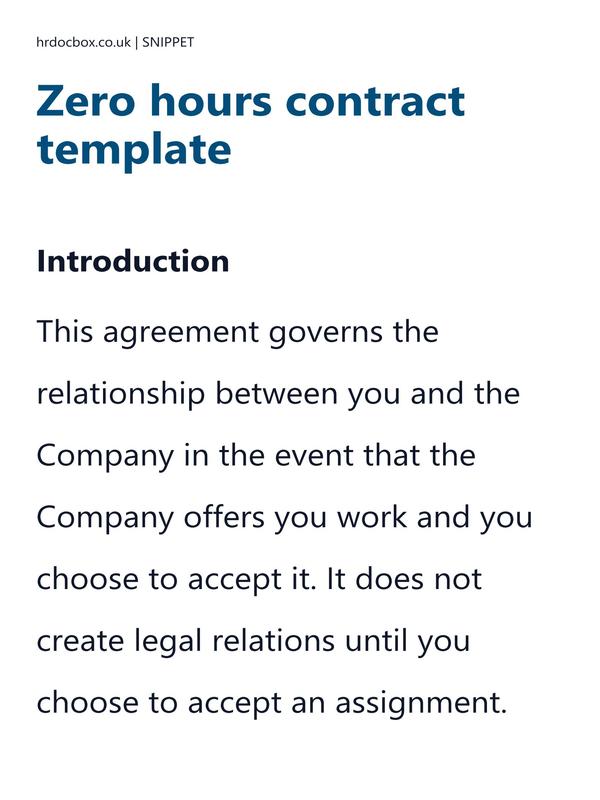
This template brings together the key information, sections and considerations you need to create a clear, comprehensive and professional HR document. Preview the document below.
1 Parties and commencement
1.1 Employer: [Company Name]
1.2 Individual: [Full Name]
1.3 Job Title / Role: [Job Title]
1.4 Start Date: [Date]
1.5 Place of Work: [Workplace / Locations]
1.6 Reporting To: [Manager / Job Title]
2 Employment Status
2.1 You are employed by the Company as an employee on a zero-hours basis. Your employment is subject to this agreement and applicable employment legislation.
3 Nature of the Arrangement
3.1 This is a zero-hours arrangement. The Company does not guarantee to offer you any minimum number of hours, shifts or assignments. The amount of work available may vary according to business demand, customer requirements, seasonal activity and other operational needs.
3.2 You are not required to accept an offer of work under this zero-hours arrangement. The Company is not required to offer you work. Once you have accepted a shift or assignment, you are expected to attend and complete the agreed work unless you have a legitimate reason for being unable to do so and notify the Company as soon as reasonably practicable.
3.3 The Company will not treat the absence of guaranteed hours as removing any statutory employment rights or other obligations that apply to the actual working relationship.
4 Offering and Accepting Work
4.1 The Company may offer shifts or assignments by [email / telephone / text message / scheduling system / other method]. Offers will normally specify the date, start and finish times, location, duties and applicable rate of pay.
4.2 You should confirm whether you accept an offer using [method] by [deadline, where applicable]. You may decline an offer without being required to give a reason, subject to any separate lawful obligations that apply to work you have already accepted.
4.3 The Company will aim to provide as much notice of work as reasonably practicable. The timing and availability of offers may vary according to operational requirements. The Company will explain any applicable procedures for changing or cancelling shifts and will comply with relevant legal requirements.
5 Availability and Communication
5.1 You may notify the Company of your availability using [method] by [time / deadline, if applicable]. Providing availability does not guarantee that work will be offered.
5.2 You should keep your contact details up to date and notify [manager / department] if your circumstances affect a shift you have already accepted. The Company will communicate relevant shift information and changes using the agreed contact method wherever reasonably practicable.
Any availability requirements must be applied consistently with the zero-hours arrangement and applicable law. The Company will not use this
You've seen 20% of how the Zero hours contract of employment template is structured. Get the complete editable template instantly and customise it for your organisation.

A zero-hours contract provides a flexible way to engage people where the amount of work available may vary. This Zero Hours Contract Template helps employers document the arrangement clearly, explaining how work is offered, whether it can be refused, how payment is calculated and which rights and responsibilities apply. It is designed for UK employers and should be adapted to the actual working relationship and the organisation's needs.
The contract should explain that no minimum number of hours is guaranteed, how shifts are offered and accepted, how much notice is normally provided and how cancellations are handled. Employers should avoid using a zero-hours arrangement where the reality is a regular, predictable pattern that would be better documented through a part-time or fixed-hours contract. The contract should reflect actual practice rather than simply relying on its title.
A person engaged on a zero-hours basis may legally be a worker or an employee. Their status depends on the substance of the relationship and affects the rights available to them. Continuity of employment is also important: periods without shifts do not automatically reset service, and a new document or gap between engagements does not necessarily break continuity. Employers should keep accurate records and assess continuity under the statutory rules.
Zero-hours arrangements do not remove statutory employment rights. Employers must apply the relevant National Minimum Wage or National Living Wage rules, working-time protections, paid annual leave and applicable health and safety duties. Holiday entitlement and holiday pay must be calculated using the correct rules for the individual's working pattern. Rolled-up holiday pay may be used only where legally permitted and must be handled correctly.
Before issue, employers should choose and check the correct employment status, complete the relevant contractual details and ensure the terms match how work will actually be managed. They should also monitor changes to legislation and official guidance, particularly the forthcoming reforms to guaranteed hours, shift notice and short-notice cancellations. The contract should be reviewed periodically and whenever the working arrangement changes materially.
This template is a starting point for documenting a lawful and transparent arrangement, not a substitute for assessing employment status or obtaining advice where the circumstances are complex.
Related HR resources and workflow
Explore the HR resources that may be relevant before and / or after using the Zero hours contract of employment, helping you understand the wider process, maintain appropriate documentation and follow a consistent approach.

This Offer of Employment Letter provides a clear written confirmation of the key terms offered to a successful candidate before they start employment.
Use these best practice actions, recommended timescales and process stages to understand when and how the Zero hours contract of employment should be used, helping ensure each step is handled consistently and appropriately documented.
Understand the common mistakes to avoid when using this HR template, helping you reduce risk, prevent unnecessary costs and ensure the process is handled correctly.
No. A zero-hours contract does not automatically break continuity, and a period without shifts does not necessarily mean that service has ended. Continuity depends on the statutory rules and the circumstances of the employment relationship. Employers should not assume that a new contract or a gap between shifts automatically resets service.
Potentially, yes. The individual's employment status, continuity of employment and the qualifying requirements for the relevant right must be assessed. A zero-hours contract does not automatically exclude someone from these protections. Employers should check the individual's circumstances before making decisions about termination or redundancy.
Yes. Workers on zero-hours contracts are generally entitled to statutory paid annual leave. The correct accrual and holiday-pay calculation depends on their working pattern and the applicable rules. Eligible irregular-hours and part-year workers may be able to receive rolled-up holiday pay, provided the statutory requirements are followed. Workers must still be able to take their annual leave.
Generally, no. Prohibited exclusivity terms cannot be used to prevent zero-hours workers from looking for or accepting work with another employer. Employers should manage legitimate confidentiality concerns, conflicts of interest and working-time requirements through appropriate, lawful provisions rather than a blanket restriction on other employment.
Yes. The legislation provides for reforms involving guaranteed-hours offers, reasonable notice of shifts and changes, and payments in certain short-notice cancellation circumstances. The Government's guidance published in August 2026 states that these measures are not yet in force. Employers should monitor implementation and review their arrangements as the relevant provisions come into effect.
HRDocBox provides practical, editable HR templates designed for UK employers and SMEs. The templates help employers document arrangements consistently, understand key compliance considerations and apply processes in a structured way. They should be adapted to the organisation's circumstances and reviewed when legislation or official guidance changes.
HRDocBox combines practical HR experience, structured documentation and a focus on UK employment practice. A dedicated template provides a consistent starting point and helps employers consider important issues that a generic AI response may overlook. AI can assist with tailoring and explanation, but employers should verify legal requirements and obtain specialist advice where appropriate.
How this content is developed and reviewed
The Zero hours contract of employment template is developed using a practical HR methodology that considers current UK employment legislation, ACAS guidance, CIPD good practice and the real-world HR process it supports. Templates and supporting information are regularly reviewed and updated, with additional reviews triggered by significant changes to legislation, guidance or established HR practice, helping ensure each document remains practical, relevant and suitable for UK employers.
Darryl Horn, Chartered HR Director
Darryl is a Chartered HR professional with over 25 years' experience in senior HR and employee relations roles.
He has extensive practical experience of managing employment contract HR processes and founded hrdocbox to provide businesses with practical, professionally developed HR resources grounded in UK employment law and best practice.
HRDocBox has been creating practical UK HR documents since 2009.
"Darryl provides support and advice with excellent judgement, and has a strong understanding of people, policies and UK employment legislation."
"He is someone I trust; consistent, dependable, and committed to doing things properly."




















Whether you employ 5 people or 50, hrdocbox gives you the structure, documents and expertise needed to manage employees professionally and legally.
Professionally written and fully compliant with UK employment law

Access a free contract template instantly - or save 10% on any document today.
Use this code at checkout for 10% off anything!
Includes instant download, updates, and full access to your HR templates.