Libraries
780+ HR templates
Everything your business needs to stay compliant
Policies, contracts, letters, guidance and HR support tools for UK employers.
View full libraryPolicies, contracts, letters, guidance and HR support tools for UK employers.
View full libraryThe Contract of Employment sets out the key terms and conditions governing the employment relationship between an employer and employee. It provides a clear written record of the role, pay, hours, holiday, benefits, notice, probation, duties and other contractual arrangements, helping both parties understand their rights and responsibilities from the outset.
Use this template to:

If you are creating or reviewing employment contracts, the toolkit brings together practical HR templates covering terms, drafting, review, issue and updates.
This template brings together the key information, sections and considerations you need to create a clear, comprehensive and professional HR document.
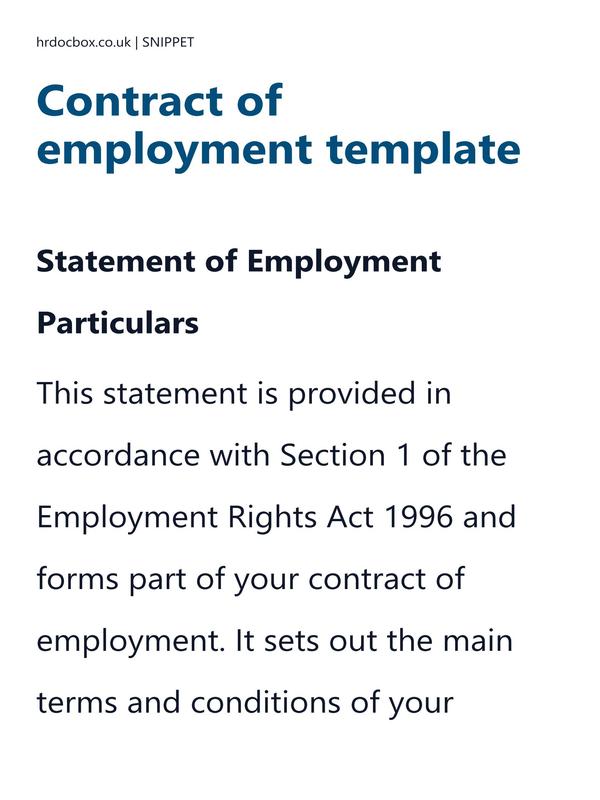
Statement of Employment Particulars
This statement is provided in accordance with Section 1 of the Employment Rights Act 1996 and forms part of your contract of employment. It sets out the main terms and conditions of your employment with [Employer Name].
Where the wording refers to the Employee Handbook or Company policies, these are available on request and form part of your employment framework. This statement is intended to be clear and transparent and to reflect both statutory minimums and the Company’s good employment practice.
1. Employer and Employee Details
Employer: [Employer name], [Employer address]
Employee: [Employee name], [Employee address]
Job Title: [Job title]
Start Date: [Start date]
Continuous Employment Date: [Continuous employment date]
2. Probationary Period
You will be subject to a probationary period of [number] months from your start date. This period allows both you and the Company to confirm suitability for the role. Your manager will review progress during probation, provide feedback and reasonable support, and record outcomes.
The Company may extend the probationary period where, in its reasonable opinion, further time is required to assess performance. During probation, either party may terminate employment by giving [shorter notice period]. Any extension or change to probation will be confirmed to you in writing, with reasons and the duration of the extension.
3. Place of Work
Your normal place of work will be [address]. You may be required to work at other locations as reasonably required by the employer. Where relocation or regular travel would cause unreasonable hardship, the Company will consult with you and seek to agree a suitable arrangement prior to any change.
If your role includes homeworking or hybrid working, specific arrangements will be set out separately and are subject to review.
4. Duties and Responsibilities
You will carry out the duties set out in your job description and any other reasonable tasks required by the employer from time to time. The Company may update your job description to reflect changing business needs; any major changes will be discussed with you in advance. You are expected to comply with reasonable managerial instructions and to perform your duties to the standard reasonably expected for your role.
5. Pay
Rate of Pay: £[amount] per [hour/week/month/year].
Payment Frequency: Paid [weekly/monthly] in arrears/on [day] by [method].
Deductions: Any deductions required by law (e.g. PAYE tax and National Insurance) will be made from your pay. Other deductions (for example, for overpayments or agreed benefits) will only be made with your prior written consent or where permitted by law. The Company will provide payslips detailing pay and deductions.
The Company is committed to pay practices that are fair and transparent and which meet statutory requirements, including the National Minimum/Living Wage where applicable.
6. Hours of Work
Your normal hours are [number] per week, worked between [days/times]. Reasonable additional hours may be required to meet business needs; where this is expected to be regular and substantial the Company will discuss options such as time off in lieu or other arrangements in line with policy.
Working time, rest breaks and maximum weekly working hours are provided in accordance with the Working Time Regulations. Where flexible or agile working is agreed, the specifics will be recorded separately.
7. Holiday Entitlement
You are entitled to [number] days paid holiday per holiday year, plus [public/bank] holidays. Holiday entitlement is pro-rated for part-time employees. The holiday year runs from [date] to [date].
Holiday requests must be approved in advance by your line manager. The Company will endeavour to accommodate preferences but may refuse requests where operational needs require it; any refusal will be communicated promptly with reasoning. Unused holiday should normally be taken in the holiday year in which it is due, though carry-over may be permitted in line with statutory provisions and Company policy (for example where illness prevents taking holiday).
8. Sickness and Absence
If you are unable to attend work, you must notify your manager as soon as possible on the first day of absence and provide an indication of likely duration. Failure to follow the reporting procedure may affect entitlement to pay.
You may be entitled to Statutory Sick Pay (SSP) if you meet the eligibility criteria. The Company may operate an enhanced sick pay scheme; details are set out in the Employee Handbook. The Company encourages early and open communication about health issues so that reasonable adjustments and support can be considered where appropriate.
9. Pension
You will be enrolled into the company’s workplace pension scheme if eligible, in accordance with auto-enrolment legislation. Full details of the pension scheme, contribution rates and opt-out arrangements will be provided separately.
10. Notice Periods
Employee: [notice period]
After one month’s service, at least the statutory minimum notice will apply unless a longer period is stated above. Where the Company seeks to dismiss for gross misconduct, in accordance with disciplinary policy the Company may dismiss without notice where lawfully permitted.
11. Policies and Procedures
Your employment is subject to the Company’s policies and procedures set out in the Employee Handbook, which is non-contractual unless otherwise stated. These policies include, but are not limited to, equal opportunities, disciplinary, grievance, health & safety, data protection and absence management. The Company will make copies of key policies available and will consult with employees on significant changes.
12. Changes to Terms and Conditions
The employer may make reasonable changes to these terms and conditions to reflect changing business needs or legal requirements. Where a change is significant the Company will consult with you and provide written notice of the change. In circumstances where individual consent is required, the Company will seek to obtain it; where lawful variation without consent is necessary, the Company will act reasonably and proportionately.
Signed for and on behalf of [Employer Name]:
Signature: ___________________________
Name: ______________________________
Position: ___________________________
Date: _______________________________
Signed by the Employee:
Signature: ___________________________
Name: ______________________________
Date: _______________________________
A Contract of Employment is a legal agreement between an employer and employee setting out the terms governing their employment relationship. It can contain express contractual terms agreed between the parties as well as terms incorporated from other documents, such as relevant policies, handbooks or collective agreements.
The contract provides a clear framework for the employment relationship, covering matters such as the employee's role, pay, working hours, holiday, benefits, probation, notice and key contractual obligations.
A written contract helps both the employer and employee understand what has been agreed and can reduce uncertainty and disputes about employment terms. It can also provide an important reference point when dealing with changes to employment, performance, absence, disciplinary matters, resignation or termination.
Employers must also provide employees and workers with a written statement of employment particulars containing specified information. The principal statement must generally be provided on or before the first day of employment, with certain wider particulars capable of being provided separately within two months. https://www.gov.uk/employment-contracts-and-conditions/written-statement-of-employment-particulars
The template is suitable for employers and HR professionals preparing written employment terms for new employees or reviewing and updating existing contractual arrangements.
A Contract of Employment sets out the contractual relationship between an employer and an employee, including the terms and conditions that have been agreed between the parties. It can contain both the terms required by employment law and additional contractual provisions that are relevant to the employment relationship.
A Written Statement of Employment Particulars is the information that an employer is legally required to provide to an employee or worker. The principal statement must generally be provided on or before the first day of employment and includes key information such as pay, working hours, holiday entitlement, place of work, job title or description, probation arrangements and notice requirements.
The two should not automatically be treated as the same document. An employment contract may incorporate the required written particulars while also containing additional contractual terms, such as confidentiality, intellectual property, restrictive covenants or specific arrangements relating to the role.
A well-drafted UK Contract of Employment should clearly set out the main terms governing the employment relationship. Depending on the role and circumstances, this will normally include the employer and employee's details, job title and duties, start date, place of work, pay, working hours, holiday entitlement, probation arrangements, benefits, pension arrangements and notice periods.
Employers may also include appropriate provisions covering sickness absence, confidentiality, intellectual property, data protection, disciplinary and grievance procedures, company property, post-termination restrictions and other terms relevant to the particular role. Some provisions may be contractual, while others may be contained within company policies or procedures that are referred to in the contract.
The terms should accurately reflect the arrangements that have been agreed with the employee. Employers should avoid using generic clauses that do not apply to the role or including provisions that are unclear, unnecessarily broad or inconsistent with other employment documentation.
Employers should provide the employee with the required written statement of employment particulars on or before the first day of employment. The principal statement should contain the key information required by employment law, with certain additional information capable of being provided separately within the required timescale.
In practice, employers should aim to issue the full Contract of Employment before the employee starts work wherever possible. This gives both parties an opportunity to understand and confirm the agreed terms before the employment relationship begins and reduces the risk of misunderstandings about pay, working arrangements, holiday, probation or other contractual provisions.
Where an offer of employment is conditional on matters such as satisfactory references, right to work checks or other pre-employment checks, employers should ensure that the appropriate conditions have been satisfied before confirming the appointment and issuing the relevant contractual documentation.
Not every document or statement relating to employment necessarily forms part of the employee's contract. Contractual terms are terms that form part of the legally binding agreement between the employer and employee. These can include express terms contained in the written contract as well as certain terms that may arise through legislation, collective agreements, custom and practice or other recognised sources.
Non-contractual terms are generally intended to provide guidance or explain how an organisation operates without creating a contractual entitlement. For example, an employer handbook may contain workplace procedures, management guidance or discretionary arrangements that are not intended to form part of the employment contract.
Employers should make the distinction clear when drafting employment documentation. Where a policy or handbook is intended to be incorporated into the contract, this should be stated clearly. Where it is intended to remain non-contractual, the wording should avoid inadvertently creating a contractual obligation.
Employment contracts often refer employees to the organisation's policies and procedures. This can provide a practical way of explaining how matters such as absence, disciplinary procedures, health and safety, data protection, equality and flexible working are managed.
However, employers should consider carefully whether each policy is intended to form part of the employee's contractual terms. Incorporating a policy into the contract can make changes to that policy more difficult because contractual changes may require employee agreement. For this reason, policies that need to be updated regularly are often better kept separate from the contractual terms, unless there is a specific reason to incorporate them.
The contract should therefore make clear which documents form part of the employee's contractual terms and which policies are provided as guidance or may be amended by the employer from time to time, subject to applicable employment law.
An employment contract is a legally binding agreement, so employers should not assume that contractual terms can simply be changed whenever business requirements change. Depending on the proposed change, the employer may need to discuss the change with the employee, explain the reasons for it and obtain agreement before implementing a new contractual term.
Changes might relate to pay, working hours, duties, place of work, benefits or other contractual arrangements. Employers should consider the wording of the existing contract, any relevant collective arrangements and the circumstances surrounding the proposed change before taking action.
A clear consultation and communication process is particularly important where a proposed change may have a significant impact on employees. Once changes have been agreed, the amended terms should be confirmed in writing and the employer should ensure that its payroll, HR records and other relevant documentation are updated.
A template provides a practical starting point, but employers should adapt it to reflect the organisation, role and individual employment arrangements. The completed contract should be checked to ensure that the terms are accurate, consistent with the employee's offer and compliant with current UK employment law before it is issued.
Related HR resources and workflow
Explore the HR resources that may be relevant before and / or after using the Contract of employment, helping you understand the wider process, maintain appropriate documentation and follow a consistent approach.

A welcome letter to a new employee gets them excited for their first day, prepares them for orientation and gives necessary first-day info.
Use these best practice actions, recommended timescales and process stages to understand when and how the Contract of employment should be used, helping ensure each step is handled consistently and appropriately documented.
Understand the common mistakes to avoid when using this HR template, helping you reduce risk, prevent unnecessary costs and ensure the process is handled correctly.
An employment contract can contain terms that are agreed verbally as well as in writing. However, employers must provide employees and workers with a written statement of employment particulars containing specified information, with the principal statement generally required on or before the first day of employment. https://www.gov.uk/employment-contracts-and-conditions/written-statement-of-employment-particulars
Not exactly. The written statement sets out particular information that the law requires an employer to provide. The employment contract is broader and can include additional express, implied and incorporated terms. ACAS specifically distinguishes between the two. https://www.acas.org.uk/employment-contracts-and-the-law
HRDocBox combines deep HR knowledge, practical application and years of experience with real employment situations. The document is designed to help employers bring the important terms of the employment relationship together in a clear and practical format rather than simply providing a bare list of statutory particulars.
AI can generate a generic employment contract, but a useful contract needs to reflect the practical realities of the employment relationship as well as the legal requirements. HRDocBox combines UK employment-law knowledge, practical HR experience and best practice to provide a structured starting point covering the key terms employers need to consider.
The principal statement must generally be provided on or before the employee or worker's first day of employment. Certain wider written particulars can be provided separately, but generally no later than two months after employment starts. https://www.acas.org.uk/what-must-be-written-in-an-employment-contract/when-an-employee-must-get-their-written-statement
Yes. Some policies or parts of policies can be incorporated into an employment contract. Employers should make clear which terms are contractual and ensure employees can access any documents that form part of their contractual arrangements.
Contractual changes normally require agreement unless the employer has a valid contractual mechanism or another lawful basis for making the change. Employers should consider the circumstances carefully and confirm agreed changes in writing.
No. A signed contract does not make an unlawful or otherwise unenforceable term enforceable. Contractual provisions must operate within statutory employment rights and other applicable law, and some restrictions may need to satisfy additional requirements to be enforceable.
How this content is developed and reviewed
The Contract of employment template is developed using a practical HR methodology that considers current UK employment legislation, ACAS guidance, CIPD good practice and the real-world HR process it supports. Templates and supporting information are regularly reviewed and updated, with additional reviews triggered by significant changes to legislation, guidance or established HR practice, helping ensure each document remains practical, relevant and suitable for UK employers.
Darryl Horn, Chartered HR Director
Darryl is a Chartered HR professional with over 25 years' experience in senior HR and employee relations roles.
He has extensive practical experience of managing employment contract HR processes and founded hrdocbox to provide businesses with practical, professionally developed HR resources grounded in UK employment law and best practice.
HRDocBox has been creating practical UK HR documents since 2009.
"Darryl provides support and advice with excellent judgement, and has a strong understanding of people, policies and UK employment legislation."
"He is someone I trust; consistent, dependable, and committed to doing things properly."




















Whether you employ 5 people or 50, hrdocbox gives you the structure, documents and expertise needed to manage employees professionally and legally.
Professionally written and fully compliant with UK employment law

Access a free contract template instantly - or save 10% on any document today.
Use this code at checkout for 10% off anything!
Includes instant download, updates, and full access to your HR templates.