Libraries
780+ HR templates
Everything your business needs to stay compliant
Policies, contracts, letters, guidance and HR support tools for UK employers.
View full libraryPolicies, contracts, letters, guidance and HR support tools for UK employers.
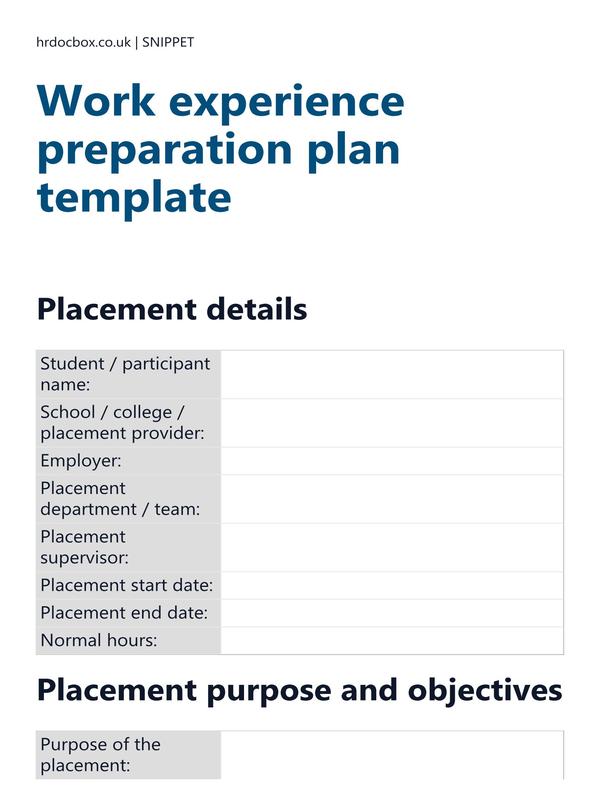
View full libraryThe Work Experience Preparation Plan provides a structured framework for planning a student's or young person's work experience placement before they start. It helps the employer, placement provider and individual agree the purpose of the placement, activities, supervision, health and safety arrangements, learning objectives and practical requirements so that the experience is organised, meaningful and appropriate.
Use this template to:
<p>If you are introducing new employees, the toolkit brings together practical HR templates covering preparation, orientation, training, documentation and review.</p>
Placement details
| Student / participant name: | |
| School / college / placement provider: | |
| Employer: | |
| Placement department / team: | |
| Placement supervisor: | |
| Placement start date: | |
| Placement end date: | |
| Normal hours: |
Placement purpose and objectives
| Purpose of the placement: | |
| What the participant would like to learn: | |
| Skills to |
You've seen 20% of how the Work experience preparation plan template is structured. Get the complete editable template instantly and customise it for your organisation.

A Work Experience Preparation Plan provides a structured record of how a work experience placement will operate before the participant starts. It brings together the placement objectives, planned activities, supervision, health and safety arrangements and practical information in one place.
It helps ensure that the placement is planned around meaningful learning and appropriate activities rather than simply providing someone with a temporary place in the workplace.
The plan helps employers and placement providers agree what the participant should experience and learn, who will supervise them and what arrangements need to be in place before the placement begins.
It can also provide a useful record of discussions around safeguarding, health and safety, support needs and any restrictions on activities.
The template is suitable for employers, HR professionals, managers, schools, colleges and other organisations arranging work experience placements for young people or other participants.
The plan should be completed before the placement starts, with input from the employer and relevant placement provider or educational establishment. It should reflect the participant's circumstances and the actual workplace rather than being treated as a generic checklist.
The arrangements should be reviewed if the placement, activities, risks or support requirements change.
Related HR resources and workflow
Explore the HR resources that may be relevant before and / or after using the Work experience preparation plan, helping you understand the wider process, maintain appropriate documentation and follow a consistent approach.

An offer letter for work experience or an internship, covering worker status, unpaid placements, National Minimum Wage exemptions and when an intern must be paid.
Use these best practice actions, recommended timescales and process stages to understand when and how the Work experience preparation plan should be used, helping ensure each step is handled consistently and appropriately documented.
Understand the common mistakes to avoid when using this HR template, helping you reduce risk, prevent unnecessary costs and ensure the process is handled correctly.
Employers should assess the risks associated with work experience and take account of the participant's age, lack of experience and unfamiliarity with the workplace. HSE provides specific guidance for employers arranging work experience placements. https://www.hse.gov.uk/young-workers/employer/index.htm
It depends on the equipment, the participant's age and the specific risks involved. Employers should assess the activity carefully and provide appropriate instruction and supervision. Some activities may be unsuitable or subject to additional restrictions for young people. https://www.hse.gov.uk/young-workers/employer/index.htm
HRDocBox combines deep HR knowledge, practical application and years of experience with real workplace arrangements. The plan brings together learning objectives, supervision, health and safety, support and practical arrangements so that the placement is properly structured before it begins.
AI can produce a generic work experience checklist, but a useful placement plan needs to connect learning objectives with supervision, workplace risks, young worker considerations and practical arrangements. HRDocBox combines UK HR knowledge, health and safety guidance and practical workplace experience rather than relying on generic wording.
It should contain enough information for everyone involved to understand what the participant will be doing, who will supervise them, what risks and restrictions apply and what support is available. The level of detail should reflect the participant, workplace and activities involved.
It is best completed collaboratively by the employer and relevant placement provider, with input from the participant where appropriate. This helps ensure that the placement objectives and practical arrangements are understood before the placement starts.
How this content is developed and reviewed
The Work experience preparation plan template is developed using a practical HR methodology that considers current UK employment legislation, ACAS guidance, CIPD good practice and the real-world HR process it supports. Templates and supporting information are regularly reviewed and updated, with additional reviews triggered by significant changes to legislation, guidance or established HR practice, helping ensure each document remains practical, relevant and suitable for UK employers.
Darryl Horn, Chartered HR Director
Darryl is a Chartered HR professional with over 25 years' experience in senior HR and employee relations roles.
He has extensive practical experience of managing induction and onboarding HR processes and founded hrdocbox to provide businesses with practical, professionally developed HR resources grounded in UK employment law and best practice.
HRDocBox has been creating practical UK HR documents since 2009.
"Darryl provides support and advice with excellent judgement, and has a strong understanding of people, policies and UK employment legislation."
"He is someone I trust; consistent, dependable, and committed to doing things properly."




















Whether you employ 5 people or 50, hrdocbox gives you the structure, documents and expertise needed to manage employees professionally and legally.
Professionally written and fully compliant with UK employment law

Access a free contract template instantly - or save 10% on any document today.
Use this code at checkout for 10% off anything!
Includes instant download, updates, and full access to your HR templates.