Introduction to an Employee Handbook script template

Quick preview
£9.99
UK-specific Editable Instant download 12 months' updates

This Introduction to an Employee Handbook provides a structured document for introducing a new employee to the organisation’s handbook, policies, workplace expectations and key sources of information. It helps HR and managers explain how the handbook should be used.

Use this document to:
  • Introduce the purpose and contents of the Employee Handbook
  • Explain the organisation’s key policies and ways of working
  • Identify information that the employee needs to understand during induction
  • Direct the employee to important sources of support and information
  • Provide a consistent introduction to the handbook for new starters
Introduction to an Employee Handbook script template
2026 Reviewed
Get the complete resource

Don't just buy one template — get the complete Induction and onboarding templates toolkit

If you are introducing new employees, the toolkit brings together practical HR templates covering preparation, orientation, training, documentation and review.

15 templates • £24.99 • 12 months' access & updates
View the complete toolkit

What's included in this template?

This template brings together the key information, sections and considerations you need to create a clear, comprehensive and professional HR document. Preview the document below.

  • Employee and induction details
  • Purpose and structure of the Employee Handbook
  • Key policies and workplace expectations
  • Organisation information, values and ways of working
Template

Download .doc

Copy [to paste]

Email

1. Introduction

The Employee Handbook provides information about working for [Company Name], including our policies, procedures, workplace expectations, benefits and ways of working.

The handbook is intended to be a practical source of information that you can refer back to throughout your employment. You are not expected to remember everything covered in the handbook during your induction.

We will explain the areas that are particularly important to your role and will provide additional information or training where necessary.

2.

PREVIEW ENDS HERE

This is the end of the preview

You've seen 20% of how the Introduction to an Employee Handbook script template is structured. Get the complete editable template instantly and customise it for your organisation.

£9.99
Specifications
Access 12 months, with updates
Length 2 pages • 394 words
Jurisdiction England, Wales, Scotland
Based on UK law, ACAS guidance
Last update 23/09/2026
Update reason Description update.
Next review 23/03/2027
Delivery & Format Instant digital delivery, .doc · .txt · email

What is an introduction to an employee handbook script?

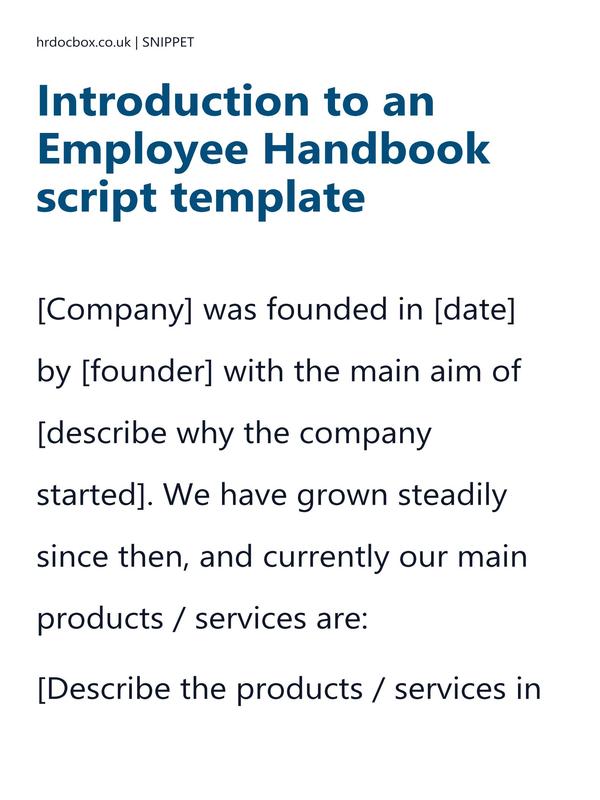
Introduction to an Employee Handbook script template preview

This document provides a structured way to introduce a new employee to the organisation’s Employee Handbook as part of their induction. Rather than simply providing a handbook and asking the employee to read it, it gives HR or the line manager a practical framework for explaining what the handbook contains, which areas are particularly important and where the employee can obtain further help.

Introducing the handbook

The document explains the purpose of the handbook and helps the employee understand how it fits into their wider employment and induction. It can be used alongside the employee’s written statement of employment particulars and other onboarding information.

Understanding key policies

The document provides a structured opportunity to highlight important policies such as absence, health and safety, equality, bullying and harassment, data protection, disciplinary and grievance procedures, IT use and other workplace requirements.

Understanding the organisation

As well as policies, the introduction can be used to explain the organisation’s values, culture, ways of working, communication arrangements and expectations of employees.

Recording questions and follow-up

Employees will often have questions after receiving a handbook. The document provides space to record questions, areas requiring further explanation and actions that need to be followed up during the induction period.

Creating a consistent induction experience

Using a standard document helps managers cover the important areas consistently while still allowing the discussion to be tailored to the employee’s role, location, working arrangements and individual needs.

Example

A new Production Operative joins a manufacturing business and receives the Employee Handbook as part of their induction. Rather than being asked simply to read the handbook, the Production Manager uses this document to work through the key areas with them.

The manager explains the organisation’s values and ways of working before highlighting the policies that are particularly relevant to the employee’s role. These include health and safety, absence reporting, working hours, overtime, personal protective equipment, disciplinary and grievance procedures, equality and workplace behaviour.

The employee is shown where the full handbook is stored and is encouraged to review it in their own time. They raise questions about overtime arrangements and who they should contact if they are going to be absent. The manager records these questions and provides the relevant information.

The manager also identifies areas that will be covered separately, including machine-specific health and safety training and other role-specific requirements. These are recorded as follow-up actions rather than attempting to cover everything during the handbook introduction.

At the end of the discussion, the employee confirms that they have been given access to the handbook and understands where to find further information. The completed document is retained as part of the induction record.

The wider HR process

Related HR resources and workflow

Explore the HR resources that may be relevant before and / or after using the Introduction to an Employee Handbook script, helping you understand the wider process, maintain appropriate documentation and follow a consistent approach.

This
Introduction to an Employee Handbook script
Next
Letters
Handbook policies and templates letter

The Handbook Policies and Templates Library gives employers a practical collection of workplace policies to establish clear expectations, support consistent people management and keep key HR processes documented.

Premium content

To continue reading, purchase this item or a parent toolkit, library or our full library.

Implementation guidance

Use these best practice actions, recommended timescales and process stages to understand when and how the Introduction to an Employee Handbook script should be used, helping ensure each step is handled consistently and appropriately documented.

Step Description Responsibility Timing
1 Provide the employee with access to the current Employee Handbook and prepare the relevant introduction document. HR / Manager Before or during first week
2 Introduce the purpose, structure and key content of the handbook, tailoring the discussion to the employee’s role and working arrangements. HR / Manager During first week
3 Discuss the key policies and workplace expectations that the employee needs to understand, including any role-specific requirements. Manager / HR During first week / induction period
4 Record questions, areas requiring clarification and any follow-up training or information required. Manager / Employee During discussion and within 5 working days
5 Review outstanding actions, confirm the employee knows where to find the current handbook and retain the completed document as part of the induction record. HR / Manager Within first month
Premium content

To continue reading, purchase this item or a parent toolkit, library or our full library.

Common mistakes

Understand the common mistakes to avoid when using this HR template, helping you reduce risk, prevent unnecessary costs and ensure the process is handled correctly.

  • Simply giving the employee the handbook without explaining its purpose or contents
  • Trying to cover every policy in detail during one meeting
  • Failing to highlight policies particularly relevant to the employee’s role
  • Not allowing the employee to ask questions or raise concerns
  • Failing to record follow-up actions or additional training requirements
  • Using an outdated version of the handbook
Premium content

To continue reading, purchase this item or a parent toolkit, library or our full library.

HR considerations

UK employment law and best practice

This template is designed to support the process, but the document should be used alongside the relevant HR procedure and applied to the circumstances of the individual case.

Induction

There is no general legal requirement to provide a formal induction, but a well-structured induction helps workers understand their role, what is expected of them and how the organisation operates. Acas recommends planning an induction and tailoring it to the individual and their role.

https://www.acas.org.uk/inductions

https://www.acas.org.uk/inductions/planning-an-induction-programme

Written statement of employment particulars

The Employee Handbook should not be treated as a substitute for the required written statement of employment particulars. Employees and workers must receive the required principal statement from the first day of employment, with additional information provided within the applicable statutory timescale.

https://www.gov.uk/employment-contracts-and-conditions/written-statement-of-employment-particulars

Handbook terms and contractual status

Some terms contained in an employee handbook can form part of an employment contract. Employers should therefore make clear which provisions are contractual and which are intended to operate as non-contractual policies, procedures or guidance.

https://www.gov.uk/employment-contracts-and-conditions/contract-terms

Health and safety

Health and safety information should form part of the induction process, including relevant workplace risks, emergency arrangements, reporting procedures and required training. A handbook introduction should complement rather than replace role-specific health and safety instruction and training.

https://www.acas.org.uk/inductions/planning-an-induction-programme

https://www.hse.gov.uk/workers/employers.htm

Equality and workplace behaviour

Employees should understand the organisation’s expectations regarding equality, discrimination, bullying and harassment. Relevant policies should be explained and employees should know how to raise concerns and where to obtain support.

https://www.acas.org.uk/discrimination-and-the-law

Policies and changes

Where policies are updated, employers should ensure that employees can access the current version and are appropriately informed about material changes. Where a change affects a contractual term, the employer must consider the contractual position and applicable requirements for communicating the change.

https://www.gov.uk/your-employment-contract-how-it-can-be-changed/making-changes

You may also need these resources

FAQs

Is this document the same as an induction checklist?

No. An induction checklist records the tasks and activities that need to be completed. This document is specifically designed to support a structured discussion about the Employee Handbook and the organisation’s policies, expectations and ways of working.

Does the employee need to read the whole handbook during induction?

No. A handbook may contain a substantial amount of information. The purpose of this document is to introduce the handbook, highlight the most important areas and help the employee understand where to find further information. Other policies and training can be covered throughout the induction period.

Should the employee sign the document?

The organisation can ask the employee to acknowledge that they have received access to the handbook and that it has been introduced to them. This should not be presented as confirmation that the employee agrees to every provision or that every handbook provision is contractual.

Can this be used for remote employees?

Yes. The discussion can take place online and the handbook can be provided through the organisation’s intranet, HR system or other electronic platform. The organisation should ensure that the employee can actually access the information and understands where to find it.

Should role-specific policies be included?

Yes. The introduction should be tailored to the employee’s role. For example, a manufacturing employee may need particular attention drawn to health and safety, PPE, machinery and reporting procedures, while an office-based employee may need greater emphasis on IT, data protection and information security.

Why use HRDocBox rather than AI?

HRDocBox templates provide a structured starting point based on UK HR practice and employment requirements. They save time by bringing the relevant information and practical structure together while allowing employers to adapt the document to their own handbook, policies and induction process.

How this content is developed and reviewed

The Introduction to an Employee Handbook script template is developed using a practical HR methodology that considers current UK employment legislation, ACAS guidance, CIPD good practice and the real-world HR process it supports. Templates and supporting information are regularly reviewed and updated, with additional reviews triggered by significant changes to legislation, guidance or established HR practice, helping ensure each document remains practical, relevant and suitable for UK employers.

About the author

Darryl Horn, Chartered HR Director

Darryl is a Chartered HR professional with over 25 years' experience in senior HR and employee relations roles.

He has extensive practical experience of managing induction and onboarding HR processes and founded hrdocbox to provide businesses with practical, professionally developed HR resources grounded in UK employment law and best practice.

HRDocBox has been creating practical UK HR documents since 2009.

Executive recommendation

"Darryl provides support and advice with excellent judgement, and has a strong understanding of people, policies and UK employment legislation."

"He is someone I trust; consistent, dependable, and committed to doing things properly."

RB
Ruth Brock Chief Executive Officer The Hygiene Bank
Get started today

HR confidence starts here

Whether you employ 5 people or 50, hrdocbox gives you the structure, documents and expertise needed to manage employees professionally and legally.

Download your FREE UK employment contract template

Professionally written and fully compliant with UK employment law

Download FREE contract
Free UK employment contract template