Libraries
780+ HR templates
Everything your business needs to stay compliant
Policies, contracts, letters, guidance and HR support tools for UK employers.
View full libraryPolicies, contracts, letters, guidance and HR support tools for UK employers.
View full libraryA practical manager's guide to withdrawing a job offer, helping managers understand when an offer may need to be withdrawn, what to consider before making the decision, and how to work with HR to handle the situation fairly, consistently and appropriately.
Use this guide to:

If you are making job offers, the toolkit brings together practical HR templates covering conditional offers, checks, acceptance, terms and contract issue.
This guide brings together the key information, considerations and practical guidance you need to understand the subject, make informed decisions and take an appropriate and consistent approach. Preview the document below.
Overview
Withdrawing a job offer is a decision that should be taken carefully. An offer may create contractual obligations, particularly where the candidate has accepted it, and the organisation should not assume that an offer can simply be cancelled.
The first step should always be to establish the exact terms of the offer, understand why withdrawal is being considered and speak to HR before taking action.
1. Check what was offered
Review the offer letter and any employment contract or associated documentation.
Establish:
Do not rely on memory or verbal discussions where written documentation is available.
2. Understand why the offer is being withdrawn
Be clear about the reason for the proposed withdrawal.
Common situations may include:
You've seen 20% of how the Managers guide to withdrawing a job offer is structured. Get the complete editable template instantly and customise it for your organisation.
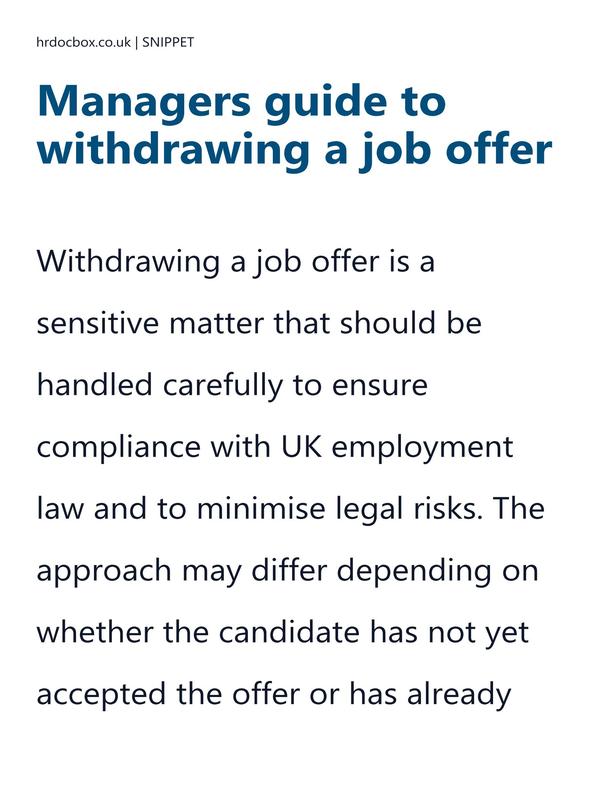
Withdrawing a job offer can be necessary where circumstances change, a candidate does not satisfy a condition of the offer or an issue arises before employment begins. However, withdrawing an offer can create contractual, legal and reputational risks, particularly where the candidate has already accepted an unconditional offer.
Before withdrawing an offer, managers should establish exactly what was offered, whether the candidate has accepted it and whether any conditions remain outstanding. The wording of the offer and any employment contract should be reviewed rather than assuming that an offer can simply be cancelled.
The reason for withdrawing an offer should be legitimate, clearly understood and supported by the relevant information. Particular care is required where the decision could be connected to discrimination, protected characteristics or information obtained during recruitment or pre-employment checks.
Managers should involve HR before confirming that an offer is being withdrawn. HR can help establish the contractual position, assess potential risks and ensure the decision is consistent with the organisation's recruitment process.
Where an offer does need to be withdrawn, the candidate should be informed promptly and professionally. The communication should clearly confirm the decision without providing unnecessary or speculative detail and should be consistent with the circumstances of the case.
Related HR resources and workflow
Explore the HR resources that may be relevant before and / or after using the Managers guide to withdrawing a job offer, helping you understand the wider process, maintain appropriate documentation and follow a consistent approach.

This Offer of Employment Letter provides a clear written confirmation of the key terms offered to a successful candidate before they start employment.
Our Offer of Employment Withdrawal Letter Template formally and respectfully notifies a candidate that their job offer is being withdrawn, maintaining professionalism and clarity in communication.
Use the following as a practical framework for assessing the situation, considering the available options and deciding on the appropriate course of action. Follow each step in sequence to support consistent, informed and appropriate decision-making.
Understand the common mistakes to avoid when using this HR template, helping you reduce risk, prevent unnecessary costs and ensure the process is handled correctly.
It may be possible, but an accepted offer can create contractual obligations even before the employee starts work. The offer wording and circumstances should be reviewed with HR before any decision is communicated.
A conditional offer may provide greater flexibility where a clearly stated condition has not been satisfied. However, the employer should still check the precise wording of the offer and apply the condition fairly and consistently.
This can increase the potential consequences of withdrawing the offer. It does not automatically mean that the offer cannot be withdrawn, but the contractual position and potential liabilities should be reviewed with HR before action is taken.
If the offer was expressly conditional on satisfactory references, this may provide a basis for withdrawing it. However, the reference and the terms of the offer should be reviewed carefully before making the decision.
Where the individual does not have the required right to work and the appropriate checks cannot be satisfied, the organisation may be unable to employ them. The employer should follow the applicable Home Office checking requirements and take HR advice.
The candidate should be given a clear and appropriate explanation. The amount of detail will depend on the circumstances, and managers should agree the wording with HR before communicating the decision.
This will depend on the organisation's recruitment process. The hiring manager or HR may communicate the decision, but the approach should be agreed in advance so that the candidate receives a clear and consistent message.
AI can provide general recruitment advice, but HRDocBox provides structured, UK-focused HR guidance designed around practical workplace situations. This guide gives managers a straightforward framework for checking the position, involving HR, assessing the risks and handling the withdrawal professionally.
How this content is developed and reviewed
The Managers guide to withdrawing a job offer is developed using a practical HR methodology that considers current UK employment legislation, ACAS guidance, CIPD good practice and the real-world HR process it supports. Templates and supporting information are regularly reviewed and updated, with additional reviews triggered by significant changes to legislation, guidance or established HR practice, helping ensure each document remains practical, relevant and suitable for UK employers.
Darryl Horn, Chartered HR Director
Darryl is a Chartered HR professional with over 25 years' experience in senior HR and employee relations roles.
He has extensive practical experience of managing job offer HR processes and founded hrdocbox to provide businesses with practical, professionally developed HR resources grounded in UK employment law and best practice.
HRDocBox has been creating practical UK HR documents since 2009.
"Darryl provides support and advice with excellent judgement, and has a strong understanding of people, policies and UK employment legislation."
"He is someone I trust; consistent, dependable, and committed to doing things properly."


















Whether you employ 5 people or 50, hrdocbox gives you the structure, documents and expertise needed to manage employees professionally and legally.
Professionally written and fully compliant with UK employment law
Access a free contract template instantly - or save 10% on any document today.
Use this code at checkout for 10% off anything!
Includes instant download, updates, and full access to your HR templates.