Company welcome letter template

£12.99
Editable template
Instant download
UK-specific & legally compliant
12 months updates included
2026 Reviewed

Welcome new employees to your organisation with a professional, friendly letter that introduces your company, explains its values and helps them prepare for their first day.

Use this template to:
  • Give new employees a warm and positive welcome to the organisation.
  • Introduce the company's purpose, values, culture and approach to working together.
  • Confirm the employee's start date, arrival time, location and first-day contact.
  • Explain what to expect during induction and initial training.
  • Signpost key policies, support arrangements and practical information.
  • Encourage questions and help the employee feel confident about joining the team.
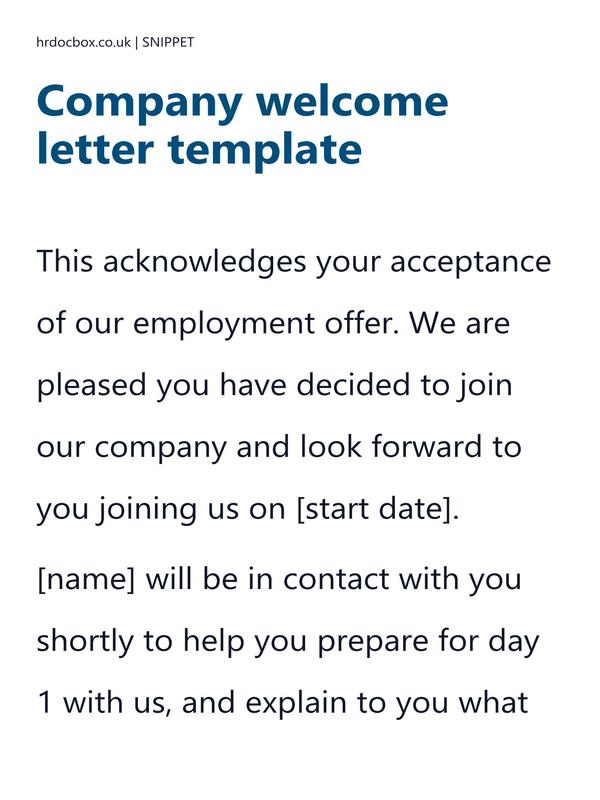
Company welcome letter template preview

What you get with your purchase - much more than just a template!

Best practice example See what good looks like
Wider HR process Understand the bigger picture
Implementation guide Practical steps to follow
Common mistakes Know what to avoid
Get the complete resource

Don't just buy one template — get the complete Job offer process toolkit

<p>If you are making job offers, the toolkit brings together practical HR templates covering conditional offers, checks, acceptance, terms and contract issue.</p>

13 templates • £29.99 • 12 months' access & updates
View the process toolkit

What's in this template?

  • A warm welcome and confirmation of the employee's appointment.
  • An introduction to the organisation, its purpose and values.
  • Confirmation of first-day arrangements and the employee's main contact.
  • An overview of induction, training and initial expectations.
  • Information about workplace policies, procedures and support.
  • Guidance on practical preparations and questions before starting.
  • A friendly closing that reinforces the employee's importance to the team.
Template

Download .doc

Copy [to paste]

Email

[Sender name]

[Sender address]

[date]

[Recipient name]

[Recipient address]


Dear [Recipient first name],

Welcome to [Company Name]

Welcome to [Company Name]. We are delighted that you will be joining us as our new [Job Title], and we look forward to working with you.

We want everyone who joins our organisation to feel welcome, supported and able to make a positive contribution. This letter introduces you to our business and provides some useful information to help you prepare for your first day.

About us

[Company Name] is [briefly describe the organisation, what it does, the customers or communities it serves and what makes it distinctive]. We believe that our success depends on the people who work here, the quality of what we do and the way we work together.

Our values are [insert company values]. These values guide how we

PREVIEW ENDS HERE

This is the end of the preview

You've seen 20% of how the Company welcome letter template is structured. Get the complete editable template instantly and customise it for your organisation.

£12.99
Specifications
Access 12 months, with updates
Length 2 pages • 612 words
Jurisdiction England, Wales, Scotland
Based on UK law, ACAS guidance
Last update 19/10/2026
Update reason ACAS guidance update.
Next review 19/04/2027
Delivery & Format Instant digital delivery, .doc · .txt · email

What is a company welcome letter?

Company welcome letter template

A company welcome letter is a simple but valuable part of the employee onboarding experience. It gives new starters a personal introduction to the organisation, helps them understand the company's culture and values, and provides reassurance about what to expect when they join. A thoughtful welcome can help employees feel valued before they have even arrived.

Making a positive first impression

The welcome letter introduces the organisation in a friendly and professional way. It can explain the company's purpose, its approach to customers and colleagues, and the behaviours expected of everyone. The wording should reflect the organisation's actual culture rather than relying on generic corporate statements.

Preparing employees for their first day

Providing practical information in advance helps new starters arrive feeling prepared. The letter can confirm the start date, arrival time, location, dress requirements, parking or access arrangements, and the name of the person who will meet them. For shift-based or operational roles, include any relevant instructions about personal protective equipment, site access or safety footwear.

Explaining induction and support

New employees should know that they will receive the information, training and support needed to settle into their role. The letter can introduce the line manager, explain the initial induction arrangements and identify a colleague or buddy who can help with day-to-day questions. Information should be tailored to the role and delivered in manageable stages.

Creating a consistent onboarding experience

Using a standard welcome letter helps the organisation communicate consistently while still allowing personal details to be included for each new starter. The letter should complement the job offer, employment contract and induction plan, with clear separation between welcoming information and formal employment terms. Used effectively, it supports a positive start and reinforces the organisation's commitment to its people.

Best in class example

A manufacturing business recruits a new Production Operative to join its day-shift team. HR sends a company welcome letter several days before the employee's start date, confirming when to arrive, where to report and who will meet them on arrival.

The letter introduces the company's values and explains that the first day will include a site tour, introductions to colleagues, health and safety induction and an overview of the role. It also explains what clothing and safety footwear the employee should bring, along with any site-specific arrival instructions.

The employee is told who their line manager will be and who to contact if they have questions before starting. The letter also explains that role-specific training will be provided before the employee undertakes tasks requiring particular instruction or authorisation.

On the first day, the manager welcomes the employee, checks that the planned arrangements are in place and begins the induction. The welcome letter has helped the employee arrive prepared, feel expected and understand the support available during their first few weeks.

The wider HR process

Related HR resources and workflow

Explore the HR resources that may be relevant before and / or after using the Company welcome letter, helping you understand the wider process, maintain appropriate documentation and follow a consistent approach.

Previous
Letters
Offer of employment letter

This Offer of Employment Letter provides a clear written confirmation of the key terms offered to a successful candidate before they start employment.

This
Company welcome letter
Next
Letters
Probation introduction letter

Our Probation Introduction Letter Template clarifies probation terms, setting expectations for both employer and new employee with ease.

Premium content

To continue reading, purchase this item or a parent toolkit, library or our full library.

Implementation guidance

Use these best practice actions, recommended timescales and process stages to understand when and how the Company welcome letter should be used, helping ensure each step is handled consistently and appropriately documented.

Step Description Responsibility Timing (Days from Issue)
1 Confirm the employee's details, job title, start date, work location and any role-specific requirements. HR / Recruitment Before issue
2 Personalise the welcome letter with the organisation's values, first-day arrangements and contact details. HR / Hiring Manager Before issue
3 Send the letter and any relevant pre-start information, ensuring that formal employment documents are provided separately where necessary. HR / Recruitment Ideally 3–5 days before starting
4 Prepare the employee's arrival, introductions, induction schedule, equipment and required training. Line Manager / HR / Relevant Teams Before the start date
5 Welcome the employee, check that the planned induction is underway and arrange an early check-in to address questions or support needs. Line Manager / Buddy Day 1 and within the first week
Premium content

To continue reading, purchase this item or a parent toolkit, library or our full library.

Common mistakes

Understand the common mistakes to avoid when using this HR template, helping you reduce risk, prevent unnecessary costs and ensure the process is handled correctly.

  • Sending a generic letter that does not reflect the organisation's culture, values or the employee's role.
  • Omitting practical first-day details such as arrival time, location, parking, dress requirements or the person to report to.
  • Including information that conflicts with the job offer, employment contract or confirmed working arrangements.
  • Making promises about benefits, progression, training or job security that have not been approved.
  • Assuming the welcome letter replaces the written statement of employment particulars, health and safety instruction or the induction programme.
  • Sending the letter without checking its accuracy or arranging the practical support and introductions it promises.
Premium content

To continue reading, purchase this item or a parent toolkit, library or our full library.

HR considerations

UK employment law and best practice

This template is designed to support the process, but the document should be used alongside the relevant HR procedure and applied to the circumstances of the individual case.

A company welcome letter is generally a good-practice onboarding document rather than a statutory requirement in its own right. It should provide accurate information, avoid conflicting with the employment offer or contract, and support the employer's wider obligations when a new employee or worker starts.

Written statement of employment particulars

Do not use the welcome letter as a substitute for the required written statement of employment particulars. The principal statement must be provided on or before the first day of employment and must contain the required information. Other required particulars may be provided in a wider written statement within the applicable period. The welcome letter can signpost these documents but should not imply that it replaces them. https://www.gov.uk/employment-contracts-and-conditions/written-statement-of-employment-particulars

Health and safety and induction

Employers must take appropriate steps to protect the health and safety of employees and workers. The welcome letter should direct new starters to their induction and relevant safety training, but it does not replace site-specific instruction, risk assessments, supervision or mandatory training. For manufacturing, warehouse and other operational roles, ensure that appropriate workplace safety arrangements are in place before the employee undertakes relevant tasks. https://www.acas.org.uk/inductions/planning-an-induction-programme

Equality, accessibility and reasonable adjustments

Communicate with new starters fairly and without discrimination. Consider whether information needs to be provided in an accessible format or whether reasonable adjustments are needed for the induction process. The same welcome process can be used as a foundation while allowing appropriate individual arrangements.

Accuracy and consistency with employment terms

Check that the start date, job title, location, working arrangements and other information in the letter are accurate and consistent with the job offer and contractual documentation. Avoid making promises about benefits, progression, working patterns or job security unless they have been approved and are intended. If any employment terms change, deal with those changes through the appropriate process rather than relying on an informal welcome letter.

Confidentiality and personal information

Include only information that is appropriate for the recipient. Do not disclose personal details about colleagues or other employees. If the letter is sent electronically, use the correct recipient address and follow the organisation's normal procedures for handling personal information.

Good practice for onboarding

Plan the induction before the employee starts and tailor it to the role and working environment. Provide practical first-day information, arrange introductions and training, and give the employee an opportunity to ask questions. Avoid overwhelming the new starter with too much information at once; use the welcome letter to signpost the wider induction process. https://www.acas.org.uk/inductions/planning-an-induction-programme

You may also need these resources

FAQs

When should a company welcome letter be sent?

Ideally, send it a few days before the employee's start date so they have time to read it and ask questions. It can be sent with other onboarding information, provided the welcome letter is clearly distinguished from formal employment documents.

What should a company welcome letter include?

It should include a warm welcome, an introduction to the organisation and its values, the employee's start date, first-day arrangements, the name of their main contact and a brief explanation of induction and support. Tailor the content to the role and workplace.

Is a company welcome letter the same as a job offer letter?

No. A job offer letter communicates the offer of employment and its relevant conditions. A company welcome letter focuses on welcoming the employee and helping them prepare to join. It should not contradict or unintentionally alter the agreed employment terms.

Should the welcome letter include health and safety information?

It can explain what safety induction or training the employee should expect and any practical preparations they need to make. However, it does not replace the employer's responsibility to provide appropriate instruction, training, supervision and workplace safety arrangements.

Why use HRDocBox?

HRDocBox provides practical, customisable HR templates designed for UK employers, including small and medium-sized businesses. This welcome letter helps you provide a consistent, professional onboarding experience while allowing you to personalise the message for each new starter.

Why use HRDocBox rather than asking AI?

AI can help draft welcome messages, but a ready-made HRDocBox template provides a structured starting point that can be reused across your recruitment process. It helps you cover the key communication points consistently while leaving room to personalise the wording. You should still check that the final letter reflects your actual arrangements and complements your formal employment documents.

How this content is developed and reviewed

The Company welcome letter template is developed using a practical HR methodology that considers current UK employment legislation, ACAS guidance, CIPD good practice and the real-world HR process it supports. Templates and supporting information are regularly reviewed and updated, with additional reviews triggered by significant changes to legislation, guidance or established HR practice, helping ensure each document remains practical, relevant and suitable for UK employers.

About the author

Darryl Horn, Chartered HR Director

Darryl is a Chartered HR professional with over 25 years' experience in senior HR and employee relations roles.

He has extensive practical experience of managing job offer HR processes and founded hrdocbox to provide businesses with practical, professionally developed HR resources grounded in UK employment law and best practice.

HRDocBox has been creating practical UK HR documents since 2009.

Executive recommendation

"Darryl provides support and advice with excellent judgement, and has a strong understanding of people, policies and UK employment legislation."

"He is someone I trust; consistent, dependable, and committed to doing things properly."

RB
Ruth Brock Chief Executive Officer The Hygiene Bank
Get started today

HR confidence starts here

Whether you employ 5 people or 50, hrdocbox gives you the structure, documents and expertise needed to manage employees professionally and legally.

Download your FREE UK employment contract template

Professionally written and fully compliant with UK employment law
Download FREE contract
Free UK employment contract template