Equipment use and management policy template

£12.99
Editable template
Instant download
UK-specific & legally compliant
12 months updates included
2026 Reviewed

The Equipment Use and Management Policy sets out how workplace equipment must be selected, used, inspected, maintained, stored and reported on to help protect employees and others. It establishes clear responsibilities for employees and managers, supports safe working practices and helps ensure equipment remains suitable and safe throughout its working life.

Use this template to:
  • Set clear expectations for the safe use of workplace tools, machinery, devices and other equipment.
  • Define responsibilities for equipment selection, authorisation, inspection and maintenance.
  • Establish procedures for reporting defects, damage and unsafe equipment.
  • Clarify when equipment must be taken out of service and prevented from further use.
  • Support appropriate training, supervision, record-keeping and compliance with health and safety requirements.
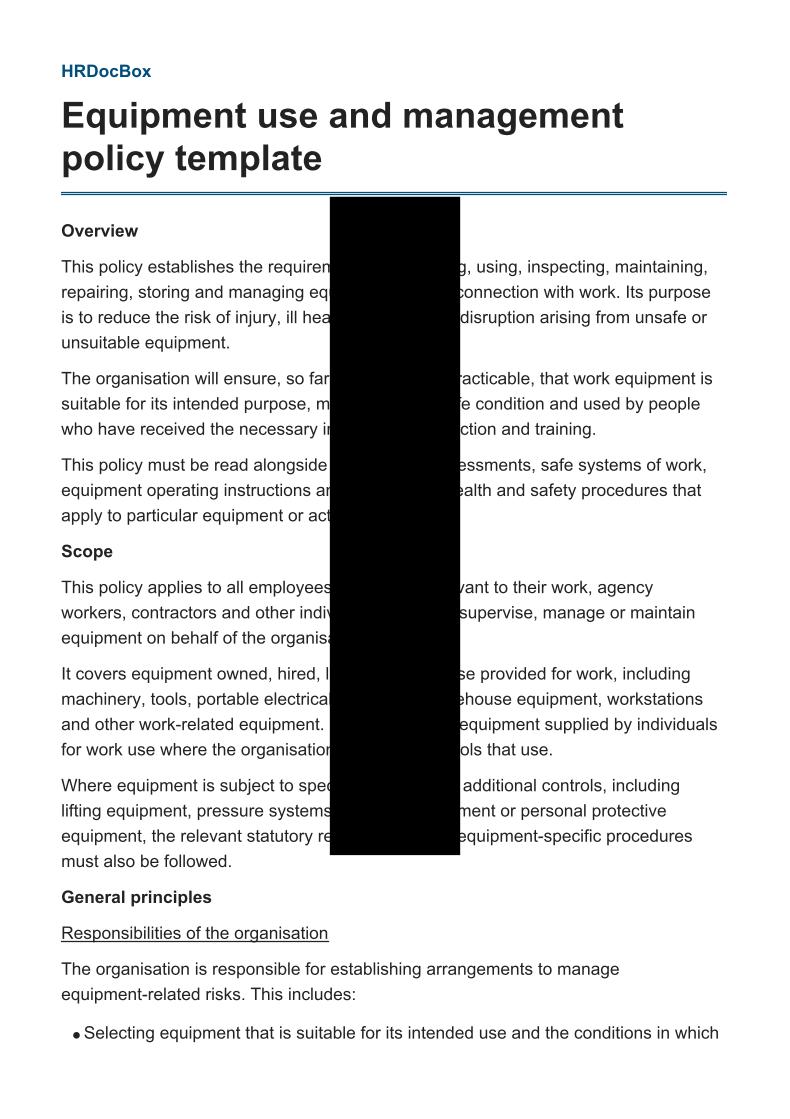
Equipment use and management policy template preview

What you get with your purchase - much more than just a template!

Best practice example See what good looks like
Wider HR process Understand the bigger picture
Implementation guide Practical steps to follow
Common mistakes Know what to avoid
Get the complete resource

Don't just buy one policy — get the complete Conduct policies set

If you are establishing clear workplace standards, these conduct policy templates give you a practical set of policies covering expected behaviour, employee responsibilities and managing concerns.

15 templates • £29.99 • 12 months' access & updates
View the policies

What's in this template?

  • Scope and responsibilities for employees, managers and equipment owners.
  • Equipment selection, suitability, authorisation and safe operation.
  • Pre-use checks, inspections, testing and planned maintenance.
  • Defect reporting, isolation, removal from service and repair arrangements.
  • Training, supervision and access to operating instructions.
  • Equipment records, incident reporting and periodic policy reviews.
Template

Download .doc

Copy [to paste]

Email

Equipment use and management policy

1   Overview

1.1   This policy establishes the requirements for selecting, using, inspecting, maintaining, repairing, storing and managing equipment used in connection with work. Its purpose is to reduce the risk of injury, ill health, damage and disruption arising from unsafe or unsuitable equipment.

1.2   The organisation will ensure, so far as reasonably practicable, that work equipment is suitable for its intended purpose, maintained in a safe condition and used by people who have received the necessary information, instruction and training.

1.3   This policy must be read alongside relevant risk assessments, safe systems of work, equipment operating instructions and any specific health and safety procedures that apply to particular equipment or activities.

2   Scope

2.1   This policy applies to all employees and, where relevant to their work, agency workers, contractors and other individuals who use, supervise, manage or maintain equipment on behalf of the organisation.

2.2   It covers equipment owned, hired, leased or otherwise provided for work, including machinery, tools, portable electrical equipment, warehouse equipment, workstations and other work-related equipment. It also applies to equipment supplied by individuals for work use where the organisation permits or controls that use.

2.3   Where equipment is subject to specific legislation or additional controls, including lifting equipment, pressure systems, electrical equipment or personal protective equipment, the relevant statutory requirements and equipment-specific procedures must also be followed.

3   General principles

3.1   Responsibilities of the organisation

3.1.1   The organisation is responsible for establishing arrangements to manage equipment-related risks. This includes:

  • Selecting equipment that is suitable for its intended use and the conditions in which it will operate.
  • Ensuring that appropriate risk assessments are completed and reviewed where necessary.
  • Providing suitable safeguards, protective devices, operating instructions and warning information where required.
  • Establishing appropriate inspection, maintenance, servicing and statutory examination arrangements.
  • Ensuring that people who use, supervise or maintain equipment receive the information, instruction and training they need.
  • Providing a clear process for reporting defects, damage, unsafe conditions and equipment-related incidents.
  • Keeping appropriate equipment, inspection,

PREVIEW ENDS HERE

This is the end of the preview

You've seen 20% of how the Equipment use and management policy template is structured. Get the complete editable template instantly and customise it for your organisation.

£12.99
Specifications
Access 12 months, with updates
Length 4 pages • 1,589 words
Jurisdiction England, Wales, Scotland
Based on UK law, ACAS guidance
Last update 11/10/2026
Update reason ACAS guidance update.
Next review 11/04/2027
Delivery & Format Instant digital delivery, .doc · .txt · email

What is an equipment use and management policy?

Equipment use and management policy template

Workplace equipment must be suitable for its intended purpose, maintained in a safe condition and used by people who have the necessary information, instruction and training. The Equipment Use and Management Policy provides a structured framework for managing equipment throughout its working life, from selection and introduction into the workplace through to inspection, repair, replacement and disposal.

The policy is suitable for employers that need to establish consistent responsibilities across offices, workshops, warehouses, manufacturing sites and other working environments. It can be adapted to cover the equipment relevant to your organisation, including tools, machinery, workstations, portable electrical equipment and other work-related items.

Safe use and employee responsibilities

The policy explains that employees must use equipment only for authorised purposes, follow instructions and safety procedures, use required safeguards and protective equipment, and report defects promptly. Equipment must not be modified, misused or operated by someone who has not received the required training or authorisation.

Inspection and maintenance

Employers should identify which equipment requires routine checks, formal inspections, servicing or statutory examination. The frequency and level of checking should reflect the equipment, the risks associated with its use, the manufacturer's recommendations and applicable legal requirements. Defective or unsafe equipment should be taken out of use until it has been assessed and made safe.

Management and record-keeping

Managers and designated equipment owners should ensure that responsibilities are allocated, maintenance and inspection arrangements are followed, and appropriate records are retained. These records can help demonstrate that equipment risks are being managed and identify recurring defects, maintenance needs and opportunities to improve working practices.

Review and continuous improvement

The policy should be supported by suitable risk assessments, safe systems of work, training and equipment-specific procedures. It should be reviewed when equipment changes, incidents occur, risks are identified or legal requirements change. Organisations should tailor the policy to their actual equipment and operations rather than relying on a generic document alone.

Best in class example

A manufacturing business identifies that employees are using shared cutting tools, portable electrical equipment and pallet trucks, but inspection practices vary between departments. Some minor defects have not been reported, and managers are unsure who is responsible for arranging repairs.

The business introduces an Equipment Use and Management Policy, allocates responsibility for equipment records and maintenance, and establishes clear instructions for pre-use checks and defect reporting. Relevant risk assessments and manufacturer instructions are reviewed to identify any additional inspection or training requirements.

Employees are briefed on the policy and instructed to stop using equipment that appears damaged or unsafe, report the problem immediately and prevent others from using the item where this can be done safely. Managers arrange assessment and repair by appropriately competent people before equipment is returned to service.

Regular reviews of inspection and maintenance records help managers identify overdue checks, recurring faults and equipment requiring replacement. The business develops a more consistent approach to equipment safety and improves its ability to demonstrate that relevant risks are being managed.

Implementation guidance

Use these best practice actions, recommended timescales and process stages to understand when and how the Equipment use and management policy should be used, helping ensure each step is handled consistently and appropriately documented.

Step Description Responsibility Timing (Days from Issue)
1 Review the equipment used across the organisation, identify the relevant risks and legal requirements, and adapt the policy to reflect actual operations and equipment types. Health and Safety Lead / Operations Manager Days -10 to -5 – before issue
2 Confirm who is responsible for equipment selection, authorisation, inspection, maintenance, record-keeping and defect escalation. Identify equipment requiring specific checks or statutory examination. Operations Manager / Department Managers Days -5 to 0 – before implementation
3 Issue the policy to employees, explain the requirements, provide access to relevant operating instructions and arrange any necessary equipment-specific training before affected employees use the equipment. HR / Line Managers / Health and Safety Lead Days 0–5 – on issue and before relevant equipment use
4 Check that inspection schedules, maintenance arrangements, defect reporting methods and equipment records are operating. Remove unsafe equipment from service and address any overdue safety-critical actions promptly. Equipment Owners / Maintenance Team / Supervisors Days 5–15 – initial implementation check
5 Review compliance, inspection and maintenance records, reported defects, incidents and employee feedback. Address gaps and establish a review frequency appropriate to the risks and equipment involved. Health and Safety Lead / Operations Manager Days 30–45 – initial effectiveness review, then at risk-based intervals
Premium content

To continue reading, purchase this item or a parent toolkit, library or our full library.

Common mistakes

Understand the common mistakes to avoid when using this HR template, helping you reduce risk, prevent unnecessary costs and ensure the process is handled correctly.

  • Applying the same inspection frequency to every item of equipment without considering risk, manufacturer instructions or statutory requirements.
  • Allowing employees to use equipment without the necessary information, instruction, training or authorisation.
  • Failing to isolate or clearly identify defective equipment, allowing someone else to use it.
  • Assuming routine servicing replaces statutory thorough examination where LOLER or other requirements apply.
  • Keeping incomplete maintenance records or failing to act on overdue inspections and reported defects.
  • Issuing the policy without explaining responsibilities or checking that supporting risk assessments and procedures are in place.
Premium content

To continue reading, purchase this item or a parent toolkit, library or our full library.

HR considerations

UK employment law and best practice

This template is designed to support the process, but the document should be used alongside the relevant HR procedure and applied to the circumstances of the individual case.

This policy supports employers in managing risks arising from equipment used at work. The precise legal requirements depend on the type of equipment, the work being undertaken and the risks involved. Employers should identify the legislation applicable to their operations and ensure that the policy is supported by suitable risk assessments, safe systems of work, training, inspections and maintenance arrangements.

Health and Safety at Work etc. Act 1974

Section 2 places a general duty on employers to ensure, so far as is reasonably practicable, the health, safety and welfare of employees at work. Section 3 addresses risks to people who are not employees but may be affected by the undertaking. Equipment management arrangements should therefore consider employees, contractors, visitors and other people who could be affected. The legislation is available at https://www.legislation.gov.uk/ukpga/1974/37/contents.

Provision and Use of Work Equipment Regulations 1998 (PUWER)

PUWER requires work equipment to be suitable for its intended purpose, maintained in an efficient state, in efficient working order and in good repair, and inspected where required. People using, supervising or managing equipment must receive adequate information, instruction and training. Appropriate safeguards, controls and isolation arrangements must also be provided where required. Inspection needs and intervals should reflect risk and the relevant circumstances rather than applying an arbitrary frequency to every item. HSE guidance is available at https://www.hse.gov.uk/work-equipment-machinery/puwer-overview.htm and https://www.hse.gov.uk/work-equipment-machinery/inspection.htm.

Management of Health and Safety at Work Regulations 1999

Employers must assess risks to employees and others arising from their work and implement appropriate preventive and protective measures. Where equipment presents a risk, the assessment should inform its selection, safe use, inspection, maintenance and the level of instruction or supervision needed. Risk assessments should be reviewed where there is reason to suspect they are no longer valid or where there has been a significant change in the matters to which they relate. The Regulations are available at https://www.legislation.gov.uk/uksi/1999/3242/contents.

Lifting Operations and Lifting Equipment Regulations 1998 (LOLER)

LOLER applies where work involves lifting equipment and lifting operations within its scope. It requires lifting operations to be properly planned by a competent person, appropriately supervised and carried out safely. Certain lifting equipment and accessories must undergo thorough examination by a competent person at the required intervals or in accordance with a suitable examination scheme. LOLER requirements are additional to relevant PUWER duties. HSE guidance is available at https://www.hse.gov.uk/work-equipment-machinery/loler-overview.htm and https://www.hse.gov.uk/work-equipment-machinery/thorough-examinations-lifting-equipment.htm.

Other applicable requirements and good practice

Depending on the equipment and working environment, additional requirements may apply, including legislation concerning personal protective equipment, electricity at work, hazardous substances, pressure systems, workplace conditions and machinery supply. Employers should identify the requirements relevant to their equipment rather than assume that one policy covers every legal duty. Allocating equipment ownership, maintaining records, training employees, reporting defects promptly and reviewing recurring problems are practical management measures that support compliance but do not replace specific statutory duties.

You may also need these resources

FAQs

What is an Equipment Use and Management Policy?

It is a workplace policy setting out how equipment must be selected, used, inspected, maintained and reported on. It defines responsibilities for employees and managers and helps the organisation manage risks associated with work equipment.

What equipment should the policy cover?

The scope should reflect the organisation's activities and may include machinery, hand tools, portable electrical equipment, warehouse equipment, workstations and other equipment used for work. Equipment requiring specific controls, such as lifting equipment, may need additional procedures to address its particular risks and legal requirements.

How often should equipment be inspected?

There is no single inspection frequency suitable for every item. The employer should consider the risk assessment, the equipment's condition and use, manufacturer recommendations and applicable legislation. Some equipment may need pre-use checks, while other equipment requires inspections at appropriate intervals or statutory thorough examinations.

What should employees do if equipment is damaged or unsafe?

Employees should stop using the equipment where it may be unsafe, report the defect promptly and follow the organisation's procedure for preventing further use. Managers should arrange an appropriate assessment, repair or replacement and ensure that equipment is not returned to service until it is safe to use.

Why use HRDocBox?

HRDocBox provides customisable HR policies and workplace documents that give employers a structured starting point for establishing consistent procedures. This policy can be adapted to reflect your equipment, working environment, responsibilities and existing health and safety arrangements.

Why use HRDocBox rather than asking AI?

A ready-made HRDocBox template provides a structured document that can be adapted for your organisation, rather than requiring you to build the policy from scratch. AI can help tailor wording, but any policy should be checked against current legislation, official guidance, the equipment in use and the risks identified in your workplace.

How this content is developed and reviewed

The Equipment use and management policy template is developed using a practical HR methodology that considers current UK employment legislation, ACAS guidance, CIPD good practice and the real-world HR process it supports. Templates and supporting information are regularly reviewed and updated, with additional reviews triggered by significant changes to legislation, guidance or established HR practice, helping ensure each document remains practical, relevant and suitable for UK employers.

About the author

Darryl Horn, Chartered HR Director

Darryl is a Chartered HR professional with over 25 years' experience in senior HR and employee relations roles.

He has extensive practical experience of managing conduct HR processes and founded hrdocbox to provide businesses with practical, professionally developed HR resources grounded in UK employment law and best practice.

HRDocBox has been creating practical UK HR documents since 2009.

Executive recommendation

"Darryl provides support and advice with excellent judgement, and has a strong understanding of people, policies and UK employment legislation."

"He is someone I trust; consistent, dependable, and committed to doing things properly."

RB
Ruth Brock Chief Executive Officer The Hygiene Bank
Get started today

HR confidence starts here

Whether you employ 5 people or 50, hrdocbox gives you the structure, documents and expertise needed to manage employees professionally and legally.

Download your FREE UK employment contract template

Professionally written and fully compliant with UK employment law

Download FREE contract
Free UK employment contract template