Alcohol and drugs policy template

Quick preview
£9.99
UK-specific Editable Instant download 12 months' updates

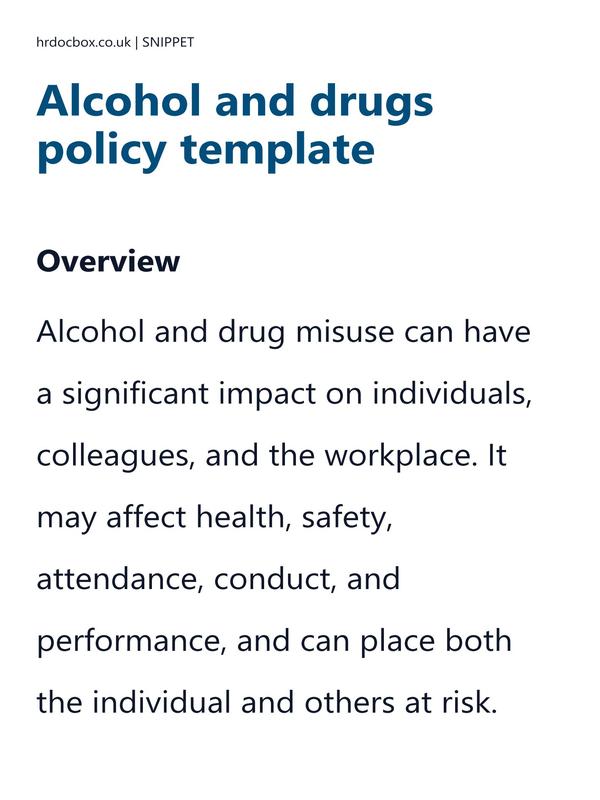
This Alcohol and Drugs Policy sets out the organisation's expectations around alcohol, illegal drugs, prescription medication and other substances that may affect an employee's ability to work safely. It combines clear workplace standards with a supportive approach to employees who may need help with substance misuse.

Use this policy to:
  • Set clear expectations about alcohol and drug use at work
  • Manage risks arising from impairment, particularly in safety-critical roles
  • Provide a supportive approach where an employee identifies a substance misuse problem
  • Explain restrictions on possession, supply and use of substances at work
  • Set expectations around prescription and over-the-counter medication
  • Explain when concerns may result in investigation or disciplinary action
Alcohol and drugs policy template
2026 Reviewed
Get the complete resource

Don't just buy one policy — get the complete Conduct policy templates

If you are establishing clear workplace standards, these conduct policy templates give you a practical set of policies covering expected behaviour, employee responsibilities and managing concerns.

15 templates • £24.99 • 12 months' access & updates
View the policy templates

What's included in this template?

This template brings together the key information, sections and considerations you need to create a clear, comprehensive and professional HR document. Preview the document below.

  • Alcohol and drug use at work
  • Impairment and safety-critical activities
  • Prescription and over-the-counter medication
  • Possession, supply and prohibited substances
  • Support, confidentiality and occupational health
  • Testing, investigations and disciplinary action
Template

Download .doc

Copy [to paste]

Email

Alcohol and drugs policy

1   Overview

1.1   [Company Name] is committed to providing a safe, healthy and productive working environment for employees, workers, contractors, visitors and anyone else who may be affected by our activities.

1.2   Alcohol, illegal drugs and the misuse of medication or other substances can affect judgement, coordination, behaviour, attendance, performance and the ability to work safely. These risks can be particularly serious where an individual drives, operates machinery, uses workplace transport or carries out other safety-critical activities.

1.3   The purpose of this policy is to establish clear expectations while recognising that alcohol or drug misuse may sometimes be a health and wellbeing issue requiring appropriate support.

2   Scope

2.1   This policy applies to all employees and, where relevant, workers, agency workers, contractors and other individuals working on behalf of [Company Name].

2.2   The policy applies when individuals are:

  • Working on company premises
  • Working at another location on behalf of the company
  • Operating company vehicles or machinery
  • Driving or carrying out workplace transport activities for work purposes
  • Representing the company at work-related events or activities
  • Carrying out safety-critical duties

The organisation recognises that employees may lawfully

PREVIEW ENDS HERE

This is the end of the preview

You've seen 10% of how the Alcohol and drugs policy template is structured. Get the complete editable template instantly and customise it for your organisation.

£9.99
Specifications
Access 12 months, with updates
Length 5 pages • 1,804 words
Jurisdiction England, Wales, Scotland
Based on UK law, ACAS guidance
Last update 21/09/2026
Update reason Enhanced description wording.
Next review 21/03/2027
Delivery & Format Instant digital delivery, .doc · .txt · email

What is an alcohol and drugs policy?

Alcohol and drugs policy template preview

This policy provides a practical framework for managing alcohol and drug-related risks in the workplace. It establishes clear standards while recognising that substance misuse can sometimes be a health and wellbeing issue requiring appropriate support rather than an immediate disciplinary response.

Setting clear workplace standards

The policy explains that employees must not attend work or carry out duties while impaired by alcohol, illegal drugs or any other substance that could affect their ability to work safely. It can also establish clear rules covering possession, consumption, supply and being in control of vehicles or machinery.

Managing safety-critical work

Particular attention is given to roles where impairment could create a significant risk, such as driving, operating machinery, using workplace transport or carrying out other safety-critical activities. The policy allows employers to take appropriate precautions where an employee may not be fit to carry out those duties.

Prescription and other medication

The policy distinguishes between the use of medication and misuse of substances. Employees should be encouraged to tell an appropriate manager if prescribed or over-the-counter medication could affect their ability to work safely, without requiring unnecessary disclosure of confidential medical information.

Supporting employees with substance misuse

Where an employee identifies an alcohol or drug problem, the organisation can consider appropriate support, including occupational health, medical advice, specialist services, agreed time away from work and temporary changes to duties where appropriate. Support does not prevent the organisation from addressing serious misconduct or immediate safety concerns.

Testing and disciplinary action

Where drug or alcohol testing is used, the policy should make the circumstances and purpose of testing clear. Testing should be justified by the risks involved, particularly in safety-critical roles, and handled in accordance with applicable data protection requirements. Breaches of the policy may be investigated and dealt with under the organisation's disciplinary procedure.

Example

An employee working on a production site was observed behaving unusually at the start of a shift. Their manager noticed that their speech and coordination appeared different from normal and was concerned because the employee was due to operate machinery.

The manager did not make an immediate assumption about alcohol or drug use. The employee was removed from the safety-critical activity and spoken to privately. The employee explained that they had taken prescribed medication that morning and had not realised that it could affect their alertness.

The manager discussed the situation with HR and the employee was advised to seek appropriate medical advice about the medication. An occupational health referral was also considered to establish whether any temporary adjustments were required. The employee was not permitted to operate machinery while there was a reasonable concern about their fitness to do so.

The organisation subsequently reviewed the incident and identified that employees needed clearer information about reporting medication that could affect their ability to work safely. The policy and manager guidance were updated, and a reminder was included in the site's health and safety briefing.

The wider HR process

Related HR resources and workflow

Explore the HR resources that may be relevant before and / or after using the Alcohol and drugs policy, helping you understand the wider process, maintain appropriate documentation and follow a consistent approach.

This
Alcohol and drugs policy
Next
Forms
Drug and alcohol testing consent form

The Drug and Alcohol Testing Consent Form provides a clear record of an employee's informed agreement to workplace drug or alcohol testing.

Premium content

To continue reading, purchase this item or a parent toolkit, library or our full library.

Implementation guidance

Use these best practice actions, recommended timescales and process stages to understand when and how the Alcohol and drugs policy should be used, helping ensure each step is handled consistently and appropriately documented.

Step Description Responsibility Timing
1 Assess the organisation's alcohol and drug-related risks, including identifying safety-critical activities such as driving, machinery operation and workplace transport. Employer / H&S / HR Before introducing the policy
2 Define the organisation's rules, including impairment, alcohol at work, illegal drugs, medication, possession, supply and any testing arrangements. HR / H&S / Management Within 5 working days
3 Consult employees or relevant representatives and ensure the policy is consistent with the organisation's health and safety, disciplinary, absence and wellbeing arrangements. HR / Management Within 5–10 working days
4 Communicate the policy to employees and train managers on recognising concerns, responding to suspected impairment, providing support and escalating serious safety or conduct issues. HR / Managers Before implementation / at induction
5 Monitor how the policy operates, review incidents and update the policy where risks, legislation, working practices or testing arrangements change. HR / H&S / Management At least annually / when circumstances change
Premium content

To continue reading, purchase this item or a parent toolkit, library or our full library.

Common mistakes

Understand the common mistakes to avoid when using this HR template, helping you reduce risk, prevent unnecessary costs and ensure the process is handled correctly.

  • Taking a purely disciplinary approach without considering whether an employee needs support
  • Failing to distinguish impairment from lawful use of prescribed medication
  • Allowing someone who may be impaired to continue safety-critical work
  • Introducing drug or alcohol testing without establishing a clear and proportionate purpose
  • Failing to explain the policy and testing arrangements clearly to employees
  • Sharing sensitive information about an employee's substance misuse unnecessarily
Premium content

To continue reading, purchase this item or a parent toolkit, library or our full library.

HR considerations

UK employment law and best practice

This template is designed to support the process, but the document should be used alongside the relevant HR procedure and applied to the circumstances of the individual case.

Health and safety duties

Employers have a general duty to protect, so far as reasonably practicable, the health, safety and welfare of employees and others affected by their work. Alcohol and drug misuse can create particular risks where employees drive, operate machinery, use workplace transport or carry out other safety-critical activities. https://www.hse.gov.uk/alcoholdrugs/the-law.htm https://www.hse.gov.uk/workplacetransport/personnel/induction.htm

Risk assessment and safety-critical work

Employers should identify where alcohol or drug impairment could create significant workplace risks and consider appropriate controls. HSE identifies activities such as using machinery, electrical equipment, ladders, driving and operating heavy lifting equipment as examples of work where impairment can create serious consequences. https://www.hse.gov.uk/alcoholdrugs/look-at-safety-critical-work.htm

Supporting employees with substance misuse

Alcohol and drug dependence can be medical problems. HSE recommends that employers consider whether substance misuse should be approached as a health concern as well as considering disciplinary implications. Appropriate support may include occupational health, medical advice, specialist treatment and, where appropriate, temporary changes to duties. https://www.hse.gov.uk/alcoholdrugs/support-employees.htm

Disciplinary action

Serious breaches of an alcohol and drugs policy may require investigation and disciplinary action. Employers should establish the facts, consider the employee's explanation and follow a fair procedure before reaching a disciplinary decision. The Acas Code of Practice provides minimum standards of fairness for disciplinary cases. https://www.acas.org.uk/disciplinary-procedure-step-by-step https://www.acas.org.uk/codes-of-practice

Drug and alcohol testing

Where an employer introduces drug or alcohol testing, it should be justified by a legitimate workplace purpose and proportionate to the risk. HSE highlights particular justification for testing in safety-critical roles. Employees must consent to screening, and employers should make the purpose, testing arrangements and consequences clear in advance. https://www.hse.gov.uk/alcoholdrugs/screening-testing-drugs-alcohol.htm https://www.gov.uk/monitoring-work-workers-rights/drug-testing

Data protection and health information

Information about a worker's health, including the results of alcohol or drug testing, is sensitive health information and requires additional protection under UK data protection law. Employers should identify an appropriate lawful basis and special category condition, minimise the information collected and ensure workers understand when testing may take place and how information will be used. https://ico.org.uk/for-organisations/uk-gdpr-guidance-and-resources/employment/information-about-workers-health/data-protection-and-workers-health-information/ https://ico.org.uk/for-organisations/uk-gdpr-guidance-and-resources/employment/information-about-workers-health/what-if-we-use-medical-examinations-and-drugs-and-alcohol-testing/

Disability and reasonable adjustments

Where alcohol or drug-related issues are connected with a disability or another health condition, employers should consider the circumstances carefully and whether reasonable adjustments may be required. The organisation should avoid making assumptions about an employee's health and should seek appropriate medical or occupational health advice where necessary. https://www.acas.org.uk/reasonable-adjustments https://www.acas.org.uk/supporting-disabled-people

Workplace policy and consultation

HSE recommends having an agreed policy on drug and alcohol misuse and consulting employees or their representatives on health and safety matters. The policy should be communicated to employees and managers should understand how to respond to suspected impairment and requests for help. https://www.hse.gov.uk/alcoholdrugs/develop-policy.htm https://www.hse.gov.uk/alcoholdrugs/consult-your-employees.htm

You may also need these resources

FAQs

Does an alcohol and drugs policy mean employees cannot drink alcohol outside work?

Not generally. The policy should focus on behaviour, fitness for work and circumstances that could affect workplace safety or the employment relationship. There may be additional restrictions where an employee is required to drive, operate machinery or perform safety-critical duties.

Can employees take prescribed medication while at work?

Yes. Prescribed medication is not treated in the same way as illegal drug use. However, employees should tell an appropriate manager if medication could affect their ability to work safely, particularly when driving, operating machinery or carrying out other safety-critical work.

Can an employer automatically dismiss someone who has an alcohol or drug problem?

No. The circumstances should be considered carefully. HSE recommends that employers consider support and treatment where an employee identifies a substance misuse problem. Serious misconduct, safety risks and breaches of workplace rules may still require formal action following a fair process.

Can an employer introduce random drug and alcohol testing?

Testing may be appropriate in some safety-critical roles, but it should not be introduced simply because an employer wants to identify illegal drug use. The purpose, necessity, proportionality, testing population and data protection implications should be considered carefully before testing is introduced.

What should a manager do if they believe someone is under the influence at work?

The manager should prioritise safety, prevent the employee from undertaking safety-critical work and contact HR or an appropriate senior manager. They should avoid making unsupported assumptions about the cause and should deal with the matter privately and sensitively while establishing the facts.

Why use HRDocBox rather than AI?

HRDocBox policies are designed around practical UK HR processes, employment law, health and safety requirements and established HR practice. They provide a structured starting point that can be adapted to the organisation, rather than relying on a generic AI-generated policy that may overlook practical implementation and compliance considerations.

How this content is developed and reviewed

The Alcohol and drugs policy template is developed using a practical HR methodology that considers current UK employment legislation, ACAS guidance, CIPD good practice and the real-world HR process it supports. Templates and supporting information are regularly reviewed and updated, with additional reviews triggered by significant changes to legislation, guidance or established HR practice, helping ensure each document remains practical, relevant and suitable for UK employers.

About the author

Darryl Horn, Chartered HR Director

Darryl is a Chartered HR professional with over 25 years' experience in senior HR and employee relations roles.

He has extensive practical experience of managing conduct HR processes and founded hrdocbox to provide businesses with practical, professionally developed HR resources grounded in UK employment law and best practice.

HRDocBox has been creating practical UK HR documents since 2009.

Executive recommendation

"Darryl provides support and advice with excellent judgement, and has a strong understanding of people, policies and UK employment legislation."

"He is someone I trust; consistent, dependable, and committed to doing things properly."
RB
Ruth Brock Chief Executive Officer The Hygiene Bank
Get started today

HR confidence starts here

Whether you employ 5 people or 50, hrdocbox gives you the structure, documents and expertise needed to manage employees professionally and legally.

Download your FREE UK employment contract template

Professionally written and fully compliant with UK employment law
Download FREE contract
Free UK employment contract template