Suspension policy template

Quick preview
£9.99
4.3
Customer reviews 3 reviews
UK-specific Editable Instant download 12 months' updates

A suspension policy setting out when an employee may be suspended from work, the alternatives that should be considered, and how suspension should be authorised, communicated, reviewed and managed during an investigation or formal process.

Use this template to:
  • Explain when suspension may be appropriate
  • Help managers consider alternatives before suspending an employee
  • Set out the approval and communication process
  • Confirm arrangements for pay, contact and confidentiality
  • Ensure suspension is regularly reviewed
  • Provide a consistent approach for managers and HR
Suspension policy template
2026 Reviewed
Get the complete resource

Don't just buy one policy — get the complete Conduct policy templates

If you are establishing clear workplace standards, these conduct policy templates give you a practical set of policies covering expected behaviour, employee responsibilities and managing concerns.

15 templates • £24.99 • 12 months' access & updates
View the policy templates

What's included in this template?

This template brings together the key information, sections and considerations you need to create a clear, comprehensive and professional HR document. Preview the document below.

  • When suspension may be appropriate
  • Alternatives to suspension
  • Approval and communication
  • Pay, contact and confidentiality
  • Reviewing suspension
  • Ending suspension and returning to work
Template

Download .doc

Copy [to paste]

Email

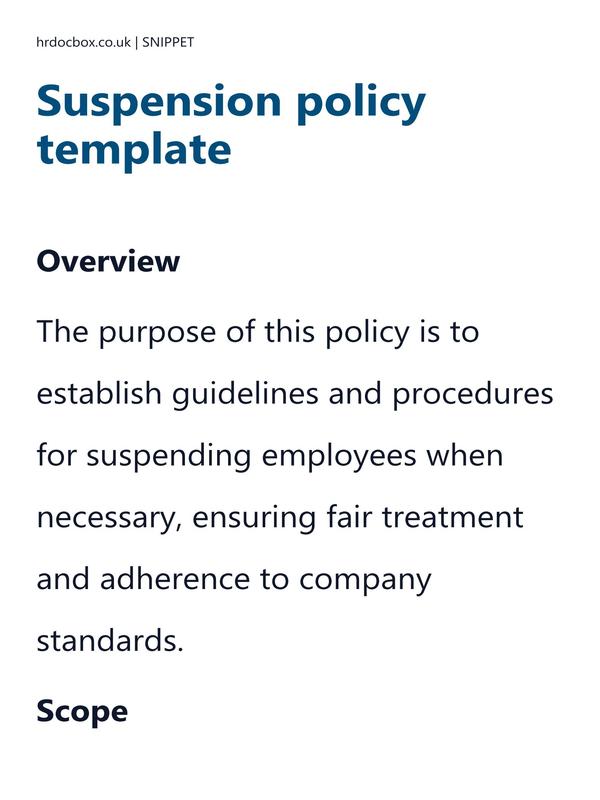
Suspension policy

1   Overview

1.1   This policy sets out when an employee may be suspended from work while an investigation or formal process is carried out.

1.2   Suspension is a neutral precautionary measure. It is not a disciplinary sanction and does not mean that an allegation has been proven.

1.3   The organisation will consider whether the circumstances can reasonably be managed without suspension before making a decision.

2   Scope

2.1   This policy applies to all employees who may be considered for suspension in connection with an investigation, disciplinary matter or other workplace concern.

2.2   It should be read alongside the organisation's disciplinary, grievance and investigation procedures.

3   General principles

3.1   When suspension may be appropriate

Suspension may be considered where there is a genuine concern that the employee remaining at

PREVIEW ENDS HERE

This is the end of the preview

You've seen 20% of how the Suspension policy template is structured. Get the complete editable template instantly and customise it for your organisation.

£9.99
Specifications
Access 12 months, with updates
Length 2 pages • 600 words
Jurisdiction England, Wales, Scotland
Based on UK law, ACAS guidance
Last update 12/09/2026
Update reason Links and references review.
Next review 12/03/2027
Delivery & Format Instant digital delivery, .doc · .txt · email

What is a suspension policy?

Suspension policy template preview

This policy provides a clear framework for managing situations where an employee may need to be temporarily removed from work while an investigation or formal process takes place. It helps ensure suspension is considered carefully and used only where appropriate.

Deciding whether suspension is necessary

The policy explains the circumstances in which suspension may be appropriate and encourages managers to consider the actual risks involved rather than treating suspension as an automatic response to a serious allegation.

Considering alternatives

Before suspending an employee, managers can consider whether temporary changes to duties, shifts, reporting lines, work location or contact arrangements could manage the situation while allowing the employee to remain at work.

Managing the suspension

Where suspension is necessary, the policy sets out how the decision should be authorised and communicated, together with arrangements covering pay, contact, confidentiality and the employee's involvement in the ongoing process.

Reviewing the position

Suspension should not simply continue without review. The policy helps managers and HR keep the decision under consideration, progress the underlying investigation and bring the suspension to an end when it is no longer necessary.

Example

An employee is accused of serious misconduct involving a colleague. The manager believes the employee may need to be suspended because they are concerned that the employee could influence witnesses or interfere with the investigation. Before taking action, the manager discusses the circumstances with HR.

The manager and HR consider whether the risks can be managed without removing the employee from work. They agree that the employee could temporarily report to another manager, work different duties and have no contact with the colleague involved. The employee can therefore remain at work while the initial investigation takes place.

In another situation, the alleged conduct creates a significant risk that the investigation could be compromised if the employee remains in the workplace. Alternative arrangements are considered but would not adequately manage the risks. The employee is therefore suspended on their normal pay as a neutral precaution while the investigation is progressed.

The employee is told that suspension is not a finding of guilt, is given clear instructions about contact with the organisation and is informed who their main point of contact will be. The suspension is subsequently reviewed to establish whether it remains necessary as the investigation progresses.

Implementation guidance

Use these best practice actions, recommended timescales and process stages to understand when and how the Suspension policy should be used, helping ensure each step is handled consistently and appropriately documented.

Step Description Responsibility Timing
1 Assess the allegation or concern and identify the risks associated with the employee remaining at work. Manager / HR Before decision
2 Consider whether the risks can be managed through temporary changes to duties, shifts, reporting lines or other working arrangements. Manager / HR Before suspension
3 Where suspension is considered necessary, agree the approach and ensure it is appropriately authorised. Manager / HR Before suspension
4 Communicate the suspension clearly, confirm the arrangements and continue progressing the underlying investigation or formal process. Manager / HR At suspension
5 Review whether suspension remains necessary and end it when the circumstances no longer justify keeping the employee away from work. Manager / HR Ongoing
Premium content

To continue reading, purchase this item or a parent toolkit, library or our full library.

Common mistakes

Understand the common mistakes to avoid when using this HR template, helping you reduce risk, prevent unnecessary costs and ensure the process is handled correctly.

  • Suspending automatically – a serious allegation does not automatically mean suspension is necessary.
  • Using suspension as punishment – suspension should be a neutral precautionary measure.
  • Failing to consider alternatives – temporary changes to working arrangements may manage the risks without suspension.
  • Failing to involve HR – suspension decisions should be carefully considered and appropriately authorised.
  • Allowing suspension to drift – the position should be reviewed regularly.
  • Failing to progress the investigation – suspension should not become a substitute for dealing with the underlying matter.
Premium content

To continue reading, purchase this item or a parent toolkit, library or our full library.

HR considerations

UK employment law and best practice

This template is designed to support the process, but the document should be used alongside the relevant HR procedure and applied to the circumstances of the individual case.

Use of suspension

Suspension should only be considered where it is necessary and appropriate in the circumstances. Employers should consider whether the situation can be managed through alternatives that allow the employee to remain at work. https://www.acas.org.uk/suspension-during-an-investigation

Fair investigation

Where suspension forms part of a disciplinary or grievance process, the employer should carry out a fair investigation and establish the facts before reaching conclusions. https://www.acas.org.uk/investigations-for-discipline-and-grievance-step-by-step

Pay during suspension

An employee will normally continue to receive their usual pay and contractual benefits while suspended, subject to their employment contract and applicable law. https://www.acas.org.uk/suspension-during-an-investigation/pay-and-holiday

Reviewing suspension

Suspension should be kept as short as possible and reviewed regularly. The underlying investigation should also be progressed without unnecessary delay. https://www.acas.org.uk/suspension-during-an-investigation/when-the-investigation-ends

Disciplinary and grievance procedures

Where suspension is connected with disciplinary or grievance action, employers should follow a fair procedure and take account of the Acas Code of Practice on disciplinary and grievance procedures. https://www.acas.org.uk/acas-code-of-practice-on-disciplinary-and-grievance-procedures

Equality

Suspension decisions should be made consistently and without unlawful discrimination. Employers should consider whether decisions could be connected to a protected characteristic under the Equality Act 2010. https://www.legislation.gov.uk/ukpga/2010/15/contents

You may also need these resources

FAQs

What is suspension?

Suspension is a temporary precautionary measure where an employee is asked not to attend work while an investigation or formal process takes place.

Is suspension a disciplinary sanction?

No. Suspension should normally be a neutral precautionary measure and should not be treated as punishment or evidence that the employee is guilty.

When might suspension be appropriate?

It may be appropriate where there is a genuine risk to the investigation, other employees, witnesses, customers, property or the business that cannot reasonably be managed through alternative arrangements.

Do I have to suspend someone accused of serious misconduct?

No. The seriousness of an allegation does not automatically require suspension. The circumstances and risks should be assessed on their merits.

What alternatives can be considered?

Depending on the circumstances, alternatives may include changing duties, shifts, reporting arrangements, work location or restricting contact with particular employees.

Does an employee receive pay during suspension?

Employees will normally remain on their usual pay and contractual benefits during suspension, subject to their contract and applicable law.

How long can suspension last?

There is no single statutory maximum period, but suspension should be kept as short as reasonably possible and reviewed regularly.

Should colleagues be told why someone has been suspended?

Only information that is necessary and appropriate should normally be shared. Managers should protect confidentiality and avoid implying that the employee is guilty.

Customer reviews

What people are saying

Back to product

A small win for the HR inbox for a small HR function

Andrew • 09 Apr 2026

We made a handful of changes for our own terminology and were then happy with the result. It was clear enough to use as an actual workplace document.

A small win for the HR inbox

simon • 07 Jun 2025

It gave managers something concrete to refer to when questions came up. It gave us a consistent position to work from when managers asked questions. The document gave us a sensible basis for checking our existing arrangements.

Good detail without the waffle when the manager needed something practical

Ama Boateng • 22 Mar 2025

We appreciated the practical emphasis rather than just a list of principles. It was easier to review because the main principles were clearly set out.

How this content is developed and reviewed

The Suspension policy template is developed using a practical HR methodology that considers current UK employment legislation, ACAS guidance, CIPD good practice and the real-world HR process it supports. Templates and supporting information are regularly reviewed and updated, with additional reviews triggered by significant changes to legislation, guidance or established HR practice, helping ensure each document remains practical, relevant and suitable for UK employers.

About the author

Darryl Horn, Chartered HR Director

Darryl is a Chartered HR professional with over 25 years' experience in senior HR and employee relations roles.

He has extensive practical experience of managing conduct HR processes and founded hrdocbox to provide businesses with practical, professionally developed HR resources grounded in UK employment law and best practice.

HRDocBox has been creating practical UK HR documents since 2009.

Executive recommendation

"Darryl provides support and advice with excellent judgement, and has a strong understanding of people, policies and UK employment legislation."

"He is someone I trust; consistent, dependable, and committed to doing things properly."

RB
Ruth Brock Chief Executive Officer The Hygiene Bank
Get started today

HR confidence starts here

Whether you employ 5 people or 50, hrdocbox gives you the structure, documents and expertise needed to manage employees professionally and legally.

Download your FREE UK employment contract template

Professionally written and fully compliant with UK employment law
Download FREE contract
Free UK employment contract template