Libraries
780+ HR templates
Everything your business needs to stay compliant
Policies, contracts, letters, guidance and HR support tools for UK employers.
View full libraryPolicies, contracts, letters, guidance and HR support tools for UK employers.
View full libraryA practical Sick Pay Policy covering company sick pay, Statutory Sick Pay, eligibility, reporting absence, evidence, payment, long-term sickness and return to work arrangements.
Use this template to:
If you are reviewing your pay and benefits arrangements, these pay and benefits policy templates give you a practical set of policies covering review, decisions, communication, implementation and administration.
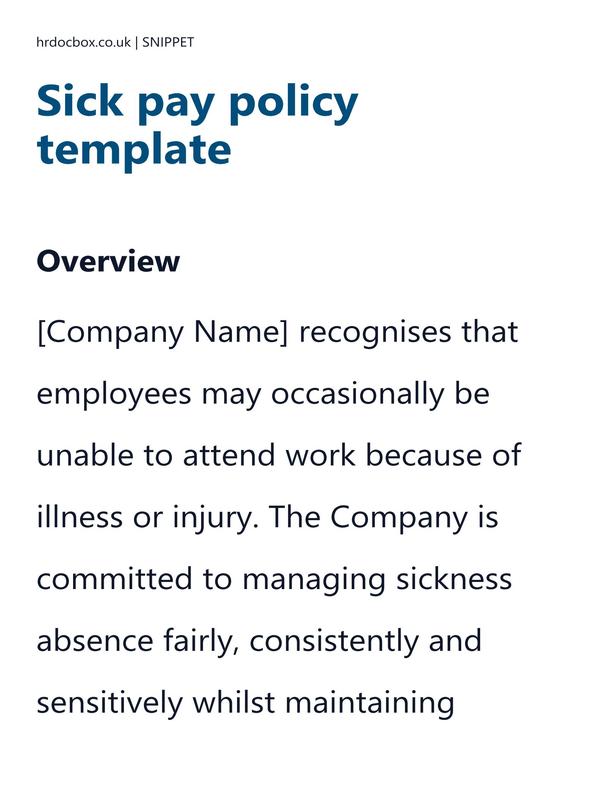
1 Overview
1.1 [Company Name] recognises that employees may occasionally be unable to attend work because of illness or injury. The Company is committed to managing sickness absence fairly, consistently and sensitively whilst maintaining appropriate levels of attendance and business continuity.
1.2 This policy explains the Company's approach to sick pay, including Statutory Sick Pay (SSP) and any contractual or discretionary company sick pay available to eligible employees.
1.3 The Company will comply with applicable employment legislation and will review its sick pay arrangements when statutory requirements change.
2 Scope
2.1 This policy applies to all employees of [Company Name], subject to any specific contractual terms or arrangements that apply to particular employees or groups of employees.
2.2 Separate arrangements may apply where an employee's contract, collective agreement or other written terms provide enhanced sick pay provisions.
3 General principles
3.1 The Company will:
4 Statutory Sick Pay
4.1 Where an employee meets the statutory eligibility requirements, the Company will pay Statutory Sick Pay (SSP) in accordance with the prevailing legislation and applicable government guidance.
SSP is a statutory entitlement and
You've seen 20% of how the Sick pay policy template is structured. Get the complete editable template instantly and customise it for your organisation.

A clear sick pay policy helps employers manage one of the most common areas of employment administration consistently. It should explain what employees can expect when they are unable to work due to illness, whilst making clear the difference between statutory entitlement and any enhanced or contractual sick pay provided by the organisation.
The template provides a flexible framework for documenting both Statutory Sick Pay and company sick pay. It can be adapted to reflect the organisation's actual entitlement, including qualifying requirements, limits and any enhanced arrangements provided under individual contracts.
Sick pay is closely linked to effective absence management. The policy sets out expectations around reporting sickness, maintaining contact, providing medical evidence and keeping the employer informed during longer periods of absence.
The template addresses the different considerations that can arise during longer periods of sickness, including medical advice, reasonable adjustments, maintaining appropriate contact and supporting a return to work.
The policy distinguishes between SSP, which is a statutory entitlement subject to the rules in force at the time, and company sick pay, which depends on the organisation's contractual arrangements. This makes it easier for employees and managers to understand what applies to them.
Alongside payment arrangements, the policy covers return to work, confidentiality, overpayments and potential misuse of sick pay. This gives managers a clearer framework for handling sickness absence whilst ensuring individual circumstances and relevant legal requirements are taken into account.
Related HR resources and workflow
Explore the HR resources that may be relevant before and / or after using the Sick pay policy, helping you understand the wider process, maintain appropriate documentation and follow a consistent approach.

The Sick Absence Policy Template provides a clear framework for managing employee sickness absence fairly, consistently and sensitively.

The Return to Work Interview Script provides a practical framework for managers and HR professionals to conduct a consistent, supportive return-to-work discussion after sickness absence.
Use these best practice actions, recommended timescales and process stages to understand when and how the Sick pay policy should be used, helping ensure each step is handled consistently and appropriately documented.
Understand the common mistakes to avoid when using this HR template, helping you reduce risk, prevent unnecessary costs and ensure the process is handled correctly.
A Sick Pay Policy explains how an organisation manages payment when employees are absent because of sickness. It should distinguish between Statutory Sick Pay and any contractual or enhanced company sick pay and explain the relevant reporting and evidence requirements.
An employer is not generally required to provide enhanced company sick pay unless this forms part of an employee's contractual terms or another binding arrangement. However, eligible employees may have a statutory entitlement to SSP subject to the rules in force at the time.
This depends on whether the payment is statutory or contractual and the circumstances involved. Employers should not withhold SSP unlawfully. Contractual sick pay may be subject to the terms of the contract and applicable policy, but employers should establish a lawful and reasonable basis before withholding it.
Long-term sickness should normally be managed through an appropriate absence management process. This may include maintaining reasonable contact, reviewing medical information, considering reasonable adjustments and discussing support or a return to work. Where appropriate, employers should also consider whether the employee may be disabled for Equality Act purposes.
Yes. Sickness absence and annual leave can overlap, and employees can in appropriate circumstances take or accrue statutory holiday while absent due to sickness. Employers should follow the Working Time Regulations and relevant case law when dealing with holiday entitlement during sickness absence.
The policy should be reviewed regularly and whenever there is a change to SSP legislation, rates, eligibility requirements or the organisation's contractual sick pay arrangements. Regular review helps prevent payroll errors and ensures managers are working from current requirements.
How this content is developed and reviewed
The Sick pay policy template is developed using a practical HR methodology that considers current UK employment legislation, ACAS guidance, CIPD good practice and the real-world HR process it supports. Templates and supporting information are regularly reviewed and updated, with additional reviews triggered by significant changes to legislation, guidance or established HR practice, helping ensure each document remains practical, relevant and suitable for UK employers.
Darryl Horn, Chartered HR Director
Darryl is a Chartered HR professional with over 25 years' experience in senior HR and employee relations roles.
He has extensive practical experience of managing pay and benefits HR processes and founded hrdocbox to provide businesses with practical, professionally developed HR resources grounded in UK employment law and best practice.
HRDocBox has been creating practical UK HR documents since 2009.
"Darryl provides support and advice with excellent judgement, and has a strong understanding of people, policies and UK employment legislation."
"He is someone I trust; consistent, dependable, and committed to doing things properly."




















Whether you employ 5 people or 50, hrdocbox gives you the structure, documents and expertise needed to manage employees professionally and legally.
Professionally written and fully compliant with UK employment law
Access a free contract template instantly - or save 10% on any document today.
Use this code at checkout for 10% off anything!
Includes instant download, updates, and full access to your HR templates.