Buying or selling annual leave policy template

Preview , or scroll for more content and supporting information
£12.99
UK-specific Editable Instant download 12 months' updates

The Buying or Selling Annual Leave Policy sets out the rules and procedures for employees who wish to purchase additional annual leave or sell back a portion of their existing entitlement. It explains eligibility, approval requirements, limits, payment arrangements and the impact on annual leave balances, helping employers manage requests consistently while maintaining adequate staffing and compliance with UK holiday entitlement requirements.

Use this template to:

  • Establish rules for buying additional annual leave.
  • Set out when employees may sell back unused annual leave.
  • Define eligibility criteria, limits and approval arrangements.
  • Explain how purchased or sold leave affects pay and holiday balances.
  • Ensure employees retain their statutory minimum holiday entitlement.
  • Promote consistent decision-making and effective workforce planning.
Buying or selling annual leave policy template
2026 Reviewed
Get the complete resource

Don't just buy one policy — get the complete Pay and benefits policies set

If you are reviewing your pay and benefits arrangements, these pay and benefits policy templates give you a practical set of policies covering review, decisions, communication, implementation and administration.

14 templates • £29.99 • 12 months' access & updates
View the policies

What's included in this template?

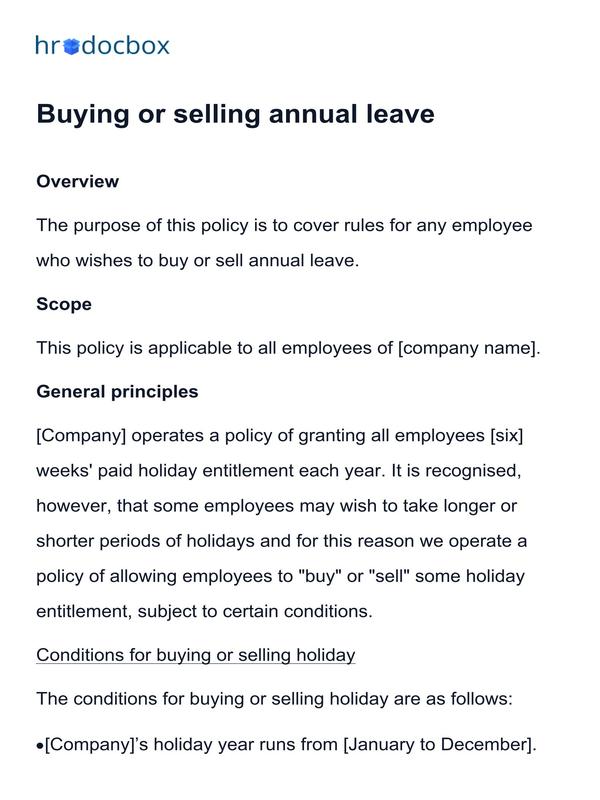
This template brings together the key information, sections and considerations you need to create a clear, comprehensive and professional HR document. Preview the document below.

  • Purpose and scope of the policy
  • Rules for purchasing additional annual leave
  • Rules for selling back unused annual leave
  • Eligibility criteria and annual limits
  • Application, approval and refusal procedures
  • Payroll deductions and payment calculations
  • Statutory holiday entitlement and legal compliance
Template

Download .doc

Copy [to paste]

Email

Buying or selling annual leave policy

1   Overview

1.1   This policy sets out the arrangements for employees who wish to purchase additional annual leave or sell eligible contractual annual leave. It explains the eligibility criteria, application process, approval requirements and payroll arrangements that apply to the scheme.

1.2   The organisation recognises that employees may value flexibility in how they manage their annual leave. The scheme is intended to support work-life balance while maintaining appropriate staffing levels, fair treatment and compliance with statutory holiday entitlement requirements.

2   Scope

2.1   This policy applies to employees of [Company Name], subject to the eligibility criteria set out below. It should be read alongside the organisation's Annual Leave Policy, relevant employment contracts and applicable payroll procedures.

2.2   Participation in the scheme is subject to the rules of this policy and approval by the organisation. The policy does not create an automatic entitlement to purchase or sell annual leave.

3   General principles

3.1   Eligibility

3.1.1   Employees may apply to purchase additional annual leave or sell eligible contractual annual leave where they meet the following conditions:

  • They have completed any applicable qualifying period specified by the organisation.
  • They have sufficient contractual annual leave entitlement to participate in the scheme.
  • The request is submitted within the published application window.
  • They are not subject to any scheme-specific restriction communicated by the organisation.
  • The request complies with statutory holiday entitlement requirements and the organisation's

PREVIEW ENDS HERE

This is the end of the preview

You've seen 20% of how the Buying or selling annual leave policy template is structured. Get the complete editable template instantly and customise it for your organisation.
£12.99
Specifications
Access 12 months, with updates
Length 3 pages • 1,115 words
Jurisdiction England, Wales, Scotland
Based on UK law, ACAS guidance
Last update 11/10/2026
Update reason Links and references review.
Next review 11/04/2027
Delivery & Format Instant digital delivery, .doc · .txt · email

What is a buying or selling annual leave policy?

Buying or selling annual leave policy template preview

A Buying or Selling Annual Leave Policy allows an employer to establish a structured arrangement under which eligible employees can purchase additional contractual annual leave or sell back a permitted amount of unused contractual holiday entitlement. It explains how the scheme operates, who can participate and how requests are assessed, approved and processed through payroll.

Offering flexibility over annual leave can help employees manage personal commitments, improve work-life balance and make better use of their available leave. For employers, a clearly defined policy supports consistent decisions, predictable staffing levels and effective cost management.

What is it used for?

The policy is used to explain the arrangements for buying additional holiday beyond an employee's normal entitlement or selling back eligible contractual leave. It establishes the circumstances in which requests may be considered, the maximum amount of leave that can be bought or sold and how any resulting changes to pay will be calculated.

Employers can adapt the scheme to suit their organisation, including whether requests are restricted to an annual window, whether purchased leave must be taken within a particular leave year and whether selling leave is permitted at all.

Who should use it?

The policy is suitable for HR professionals, business owners and managers who want to offer employees greater flexibility over their annual leave arrangements. It is particularly useful for organisations that want a consistent framework for considering requests while balancing employee preferences against operational requirements.

How should requests be managed?

Employees should submit requests through a defined process, stating how much leave they wish to purchase or sell and providing any required information. HR or the designated manager should assess eligibility, check the employee's remaining entitlement and consider staffing requirements before confirming the outcome in writing.

Payroll should be informed of approved requests in sufficient time to apply any agreed salary adjustments correctly. The employer should also maintain accurate records of the employee's revised leave balance and any relevant payment arrangements.

What should employers consider before introducing the scheme?

Employers must distinguish between statutory holiday entitlement and additional contractual leave. Most workers are entitled to 5.6 weeks' paid annual leave each leave year, subject to the applicable rules and any relevant exceptions. Statutory holiday generally cannot be replaced by a payment instead of taking the leave, except on termination of employment. A scheme must not allow an employee's statutory entitlement to be reduced through selling leave.

Employers should also consider contractual terms, pay calculations, tax and National Insurance treatment, part-time working arrangements, equal treatment and the operational impact of approving requests. The policy should make clear that buying or selling leave is subject to eligibility, approval and applicable legal requirements.

Best in class example

An employer introduces a buying or selling annual leave scheme to give employees greater flexibility over their holiday arrangements. HR reviews the existing annual leave policy and employment contracts, establishes the application window and confirms that statutory holiday entitlement cannot be sold.

An employee with 30 days' annual leave, including their normal contractual entitlement, asks to purchase three additional days to cover a planned family commitment. HR checks the employee's eligibility, confirms that the additional leave can be accommodated operationally and calculates the salary adjustment in accordance with the scheme rules.

A second employee requests to sell two days of unused contractual leave. HR checks the employee's entitlement and confirms that the proposed sale would not reduce their statutory holiday entitlement. The request is approved and payroll is instructed to process the agreed payment.

HR confirms both decisions in writing, updates the employees' holiday balances and ensures that payroll applies the agreed adjustments. The records are retained so that the organisation can monitor participation, maintain accurate leave balances and apply the scheme consistently.

The wider HR process

Related HR resources and workflow

Explore the HR resources that may be relevant before and / or after using the Buying or selling annual leave policy, helping you understand the wider process, maintain appropriate documentation and follow a consistent approach.

This
Buying or selling annual leave policy
Next
Forms
Annual leave request form

Our Annual Leave Request Form template simplifies the process, enhancing efficiency and ensuring accurate record-keeping.

Premium content

To continue reading, purchase this item or a parent toolkit, library or our full library.

Implementation guidance

Use these best practice actions, recommended timescales and process stages to understand when and how the Buying or selling annual leave policy should be used, helping ensure each step is handled consistently and appropriately documented.

Step Description Responsibility Timing (Days from Issue)
1 Review the Scheme: Decide whether employees may buy additional leave, sell eligible contractual leave or both. Review contracts, statutory holiday requirements, operational needs and the organisation's approach to eligibility. HR / Management Day -28 to Day -21
2 Set the Rules: Establish the application window, annual limits, eligibility criteria, approval arrangements, calculation method and payroll treatment. Confirm that statutory holiday entitlement will be protected. HR / Payroll / Management Day -21 to Day -14
3 Communicate the Policy: Publish the policy, explain how the scheme works and provide employees with the application process, deadlines and examples of how purchasing or selling leave affects their entitlement and pay. HR / Line Managers Day -14 to Day -7
4 Assess Applications: Check each request against the policy, the employee's statutory and contractual entitlement, staffing requirements and the applicable payroll rules. Confirm the decision and revised arrangements in writing. HR / Line Manager Day 0 to Day 10 after the application deadline
5 Update Records and Review: Update holiday balances, notify payroll of approved salary adjustments or payments, retain the relevant records and review participation and operational impact after the first scheme cycle. HR / Payroll / Management Day 10 to Day 20, then after the first leave year
Premium content

To continue reading, purchase this item or a parent toolkit, library or our full library.

Common mistakes

Understand the common mistakes to avoid when using this HR template, helping you reduce risk, prevent unnecessary costs and ensure the process is handled correctly.

  • Allowing employees to sell statutory holiday entitlement or receive payment instead of taking statutory leave during employment.
  • Introducing a scheme without checking employment contracts and existing holiday arrangements.
  • Failing to establish clear eligibility criteria, annual limits and application deadlines.
  • Using inconsistent or unclear calculations for purchased leave, sold leave or associated salary adjustments.
  • Approving requests without considering staffing requirements, holiday balances and payroll deadlines.
  • Failing to confirm decisions in writing or update holiday and payroll records accurately.
Premium content

To continue reading, purchase this item or a parent toolkit, library or our full library.

HR considerations

UK employment law and best practice

This template is designed to support the process, but the document should be used alongside the relevant HR procedure and applied to the circumstances of the individual case.

A buying or selling annual leave scheme must be designed so that employees receive their full statutory holiday entitlement and are not disadvantaged by inconsistent or unlawful decision-making. Employers should distinguish clearly between statutory leave and additional contractual leave, document the scheme's rules and ensure that payroll and holiday records reflect approved arrangements accurately.

Working Time Regulations 1998

The Working Time Regulations 1998 generally provide workers with a minimum entitlement of 5.6 weeks' paid annual leave each leave year, subject to the applicable rules and exceptions. For a worker working five days a week, this is normally 28 days, which may include bank holidays. The statutory entitlement is calculated proportionately for part-time workers and according to the relevant rules for irregular-hours and part-year workers.

Employers must not operate a selling scheme that reduces an employee's statutory holiday below the applicable minimum or substitutes a payment for statutory leave that the employee should take. Selling leave should therefore be restricted to eligible contractual leave above the statutory minimum, and the employer must ensure the employee can still take their full statutory entitlement. The regulations are available at https://www.legislation.gov.uk/uksi/1998/1833/contents.

Contractual terms and employment rights

Employers should check employment contracts, existing holiday policies and any collective agreements before introducing a buying or selling scheme. Where the arrangement changes contractual holiday entitlement or remuneration, employers should determine whether contractual agreement and written confirmation are required. The policy should explain whether participation is voluntary, how approvals operate and whether the arrangement applies to all eligible employees.

Where a change affects written employment particulars, employers should consider the requirements of the Employment Rights Act 1996. The scheme's terms should be clear enough for employees to understand the financial and practical consequences before submitting a request.

Equality Act 2010 and consistent treatment

Employers should apply eligibility criteria and approval rules consistently and avoid decisions that discriminate because of a protected characteristic. The Equality Act 2010 may also require reasonable adjustments to workplace arrangements for disabled employees. Managers should consider requests individually where appropriate and ensure that operational requirements are assessed objectively rather than relying on assumptions about an employee's circumstances.

Pay, deductions and payroll administration

Employers should explain how the cost of purchased leave or payment for eligible sold leave will be calculated, when salary adjustments will take effect and how part-year or part-time arrangements will be treated. Payroll should confirm the treatment of deductions, payments, tax and National Insurance in accordance with the employee's circumstances and the agreed scheme.

Any salary deduction must have a lawful basis, such as the employee's prior written agreement or an applicable contractual provision, in accordance with section 13 of the Employment Rights Act 1996. Employers should ensure that deductions do not cause pay to fall below the applicable National Minimum Wage or National Living Wage where the minimum wage rules are engaged. The legislation is available at https://www.legislation.gov.uk/ukpga/1996/18/section/13.

Holiday pay and payment in lieu

Employers should distinguish between an agreed payment for eligible additional contractual leave and payment in lieu of statutory holiday. Under the Working Time Regulations 1998, payment in lieu of statutory annual leave is generally permitted only on termination of employment. A selling scheme should not be used to avoid this requirement.

Employers should also ensure that holiday pay continues to be calculated in accordance with the applicable statutory and contractual rules. Where employees have variable pay or irregular working patterns, the relevant holiday pay calculation rules should be checked before the scheme is implemented.

ACAS guidance and good HR practice

Good HR practice is to publish clear eligibility criteria, application deadlines, approval responsibilities and limits on the amount of leave that can be purchased or sold. Employees should receive written confirmation of approved requests, revised balances and any salary changes. Managers should consider operational cover fairly and record the reasons for decisions, particularly where requests are refused.

Employers should review the scheme periodically to ensure it remains workable, is applied consistently and continues to comply with current holiday entitlement and pay requirements. ACAS guidance on holidays and holiday pay is available at https://www.acas.org.uk/checking-holiday-entitlement.

You may also need these resources

FAQs

Can employees sell their statutory annual leave?

Generally, no. Under the Working Time Regulations 1998, statutory annual leave must normally be taken rather than replaced by a payment during employment. A scheme may allow employees to sell eligible contractual holiday above their statutory minimum, provided the employee retains their full statutory entitlement and the arrangement complies with applicable legal requirements.

Can employees buy additional annual leave?

Yes. Employers can offer a scheme allowing employees to purchase additional contractual leave, subject to the scheme rules and any relevant contractual arrangements. The policy should explain the maximum amount available, the application process, how the cost is calculated and when any salary adjustment will apply.

How should the cost of purchased annual leave be calculated?

The employer should establish a clear and consistent calculation method, such as using the employee's salary or normal pay rate to calculate the value of the additional leave. The policy should explain how the calculation works for full-time, part-time and variable-hours employees and whether the cost will be deducted in instalments or as a single adjustment.

Can an employer refuse a request to buy or sell annual leave?

Yes, where the scheme rules allow for refusal. Reasons may include staffing requirements, operational pressures, ineligibility or the employee having reached the scheme limit. Employers should apply the criteria consistently, explain decisions clearly and consider any relevant equality or reasonable adjustment obligations.

Why use HRDocBox?

HRDocBox provides practical, customisable UK HR policies designed to help employers establish clear and consistent workplace arrangements. This policy provides a structured framework for managing annual leave purchase and sale requests, protecting statutory holiday entitlement and coordinating HR and payroll processes.

Why use HRDocBox rather than asking AI to create the policy?

AI can generate policy wording, but an effective HR policy needs to reflect UK employment law, contractual arrangements and the practical requirements of managing employees. HRDocBox provides purpose-built HR resources that can be adapted to an organisation's needs, helping reduce drafting time and support consistency. Employers should still review the policy against their own arrangements and current legal requirements before implementation.

How this content is developed and reviewed

The Buying or selling annual leave policy template is developed using a practical HR methodology that considers current UK employment legislation, ACAS guidance, CIPD good practice and the real-world HR process it supports. Templates and supporting information are regularly reviewed and updated, with additional reviews triggered by significant changes to legislation, guidance or established HR practice, helping ensure each document remains practical, relevant and suitable for UK employers.

About the author

Darryl Horn, Chartered HR Director

Darryl is a Chartered HR professional with over 25 years' experience in senior HR and employee relations roles.

He has extensive practical experience of managing pay and benefits HR processes and founded hrdocbox to provide businesses with practical, professionally developed HR resources grounded in UK employment law and best practice.

HRDocBox has been creating practical UK HR documents since 2009.

Executive recommendation

"Darryl provides support and advice with excellent judgement, and has a strong understanding of people, policies and UK employment legislation."

"He is someone I trust; consistent, dependable, and committed to doing things properly."

RB
Ruth Brock Chief Executive Officer The Hygiene Bank
Get started today

HR confidence starts here

Whether you employ 5 people or 50, hrdocbox gives you the structure, documents and expertise needed to manage employees professionally and legally.

Download your FREE UK employment contract template

Professionally written and fully compliant with UK employment law

Download FREE contract
Free UK employment contract template