Capability policy template

£9.99
4.7
Customer reviews 6 reviews
UK-specific Editable Instant download 12 months' updates

This Capability Policy provides a fair and structured framework for managing concerns about an employee's ability to perform their role to the required standard. It covers performance, support, training, reasonable adjustments, ill-health capability, formal reviews and potential dismissal where improvement cannot be achieved.

Use this policy to:
  • Identify and address capability and performance concerns
  • Provide employees with appropriate support, training and guidance
  • Set clear and measurable standards for improvement
  • Manage capability issues arising from ill health or disability fairly
  • Provide a structured formal capability process where improvement is not achieved
  • Ensure dismissal is considered only after appropriate support and fair process
Capability policy template
2026 Reviewed
Get the complete resource

Don't just buy one policy — get the complete Conduct policy templates

If you are establishing clear workplace standards, these conduct policy templates give you a practical set of policies covering expected behaviour, employee responsibilities and managing concerns.

15 templates • £24.99 • 12 months' access & updates
View the policy templates

What's included in this template?

This template brings together the key information, sections and considerations you need to create a clear, comprehensive and professional HR document. Preview the document below.

  • Performance and capability standards
  • Informal support and performance improvement
  • Formal capability meetings and warnings
  • Ill-health capability and reasonable adjustments
  • Performance improvement plans and review periods
  • Final decisions, dismissal and appeal
Template

Download .doc

Copy [to paste]

Email

Capability policy

1   Overview

1.1   The organisation expects employees to perform their roles to the required standard and is committed to supporting employees to achieve and maintain appropriate levels of capability and performance.

1.2   Capability concerns will be addressed fairly, consistently and as early as reasonably practicable. The organisation will seek to understand the reasons for any performance concerns and provide appropriate support, training, guidance and resources wherever reasonably possible.

1.3   The purpose of this policy is to help employees improve and achieve the standards required for their role. Formal action, including dismissal, will only be considered where appropriate support and a fair opportunity to improve have not resulted in sufficient improvement, or where the circumstances make further improvement unlikely.

2   Scope

2.1   This policy applies to employees of the organisation.

2.2   It covers capability concerns arising from:

  • Skills or knowledge
  • Experience or aptitude
  • Quality or accuracy of work
  • Productivity or output
  • Failure to meet reasonable performance standards
  • Inability to perform required duties
  • Ill health or other medical circumstances affecting capability

2.3   Capability should be distinguished from misconduct. Where an employee is capable of meeting the required standard but deliberately or negligently fails to do so, the organisation may consider whether the disciplinary procedure is more appropriate.

3   General principles

3.1   Clear expectations

3.1.1   Employees should understand the standards expected of them and the duties and responsibilities of their role.

3.1.2   Managers should communicate relevant performance standards clearly and should ensure that employees have reasonable access to the information, equipment, systems, training and resources required to perform their role.

3.1.3   Performance expectations should be reasonable and should take account of the employee's role, level of responsibility, experience and relevant circumstances.

3.2   Early discussion

3.2.1   Where a manager identifies a capability concern, it should normally be discussed with the employee at an early stage.

3.2.2   The manager should explain:

  • What aspect of performance is causing concern
  • What standard is expected
  • Examples or evidence supporting the concern
  • Why the required standard is important
  • What support may be available
  • What improvement is required

3.2.3   The employee should be given a reasonable opportunity to explain the circumstances and identify any support they believe may help them improve.

3.3   Understanding the cause

Before deciding how to address a capability concern,

PREVIEW ENDS HERE

This is the end of the preview

You've seen 20% of how the Capability policy template is structured. Get the complete editable template instantly and customise it for your organisation.

£9.99
Specifications
Access 12 months, with updates
Length 5 pages • 1,797 words
Jurisdiction England, Wales, Scotland
Based on UK law, ACAS guidance
Last update 19/09/2026
Update reason Process wording update.
Next review 19/03/2027
Delivery & Format Instant digital delivery, .doc · .txt · email

What is a capability policy?

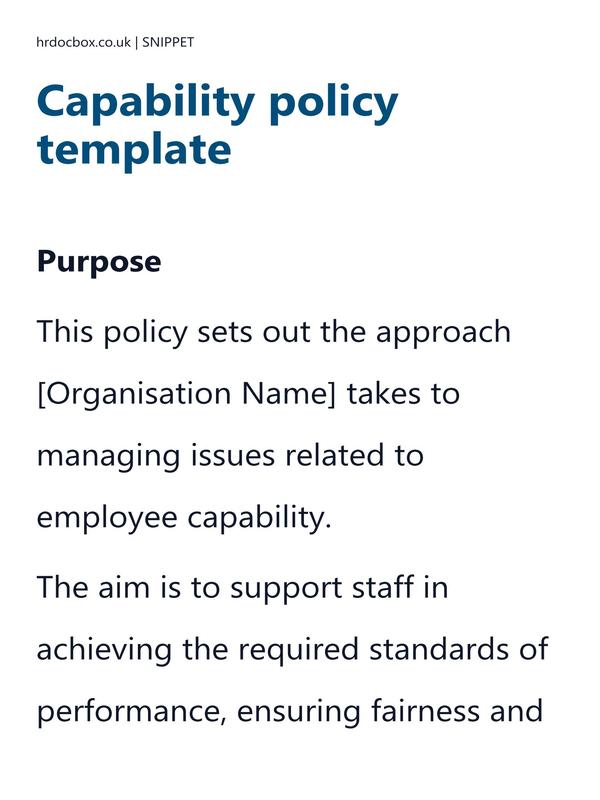
Capability policy template preview

Capability concerns arise when an employee is unable to perform their role to the required standard, despite having the opportunity and appropriate support to do so. A fair capability process should focus on helping the employee understand the required standard, identifying the reasons for the shortfall and providing reasonable opportunities to improve before formal action is considered.

Understanding capability

Capability concerns can arise from a lack of skills, knowledge, experience or ability to perform the requirements of a role. They can also arise from ill health or disability. Capability should be distinguished from misconduct, where the employee is considered capable of meeting the required standard but fails to do so through conduct or unwillingness.

Supporting improvement

Managers should normally address performance concerns at an early stage through discussion, clarification of expectations, coaching, training, mentoring or other appropriate support. Employees should understand what is expected and have access to the resources reasonably required to perform their role.

Setting measurable objectives

Where performance needs to improve, the organisation should set clear and realistic objectives and explain how improvement will be assessed. A performance improvement plan can be used to document the required standards, support available, review dates and consequences of insufficient improvement.

Ill-health capability and disability

Where capability concerns arise because of health, the organisation should consider relevant medical or occupational health information and whether reasonable adjustments may help the employee remain in work. Dismissal on capability grounds should be a last resort and should only be considered after appropriate support, adjustments and other reasonable options have been explored.

Formal capability action

Where informal support does not achieve the required improvement, the organisation may move to a formal capability process. The employee should be informed of the concerns, given a reasonable opportunity to respond, allowed appropriate representation and given a fair opportunity to improve before dismissal is considered.

Example

An employee has been in their role for more than a year but their work continues to contain a significant number of errors. Their manager discusses the concerns with them and identifies that the employee has not fully understood part of the process introduced several months earlier.

The manager provides additional training, arranges coaching with an experienced colleague and agrees a number of specific performance objectives. The employee is given regular feedback over the following six weeks and their progress is documented.

Although some improvement is achieved, the employee's performance remains below the standard required for the role. The organisation begins its formal capability process and provides a written summary of the concerns, the standards required, the support already provided and the further improvement expected.

A formal capability meeting is held and the employee is given an opportunity to explain the difficulties they have experienced. A further review period is agreed, with measurable objectives and regular review meetings.

At the end of the review period, the employee has made further progress but remains materially below the required standard. The organisation considers whether additional support, alternative duties or another suitable role are available before deciding whether further formal action is appropriate.

Implementation guidance

Use these best practice actions, recommended timescales and process stages to understand when and how the Capability policy should be used, helping ensure each step is handled consistently and appropriately documented.

Step Description Responsibility Timing
1 Identify the capability concern, establish the required standard and discuss the issue with the employee, giving them an opportunity to explain any underlying reasons. Manager As soon as concerns arise
2 Provide appropriate support such as training, coaching, mentoring, clearer guidance, additional resources or reasonable adjustments where applicable. Manager / HR Within 1–2 weeks of identifying the issue
3 Where improvement is required, agree measurable objectives and a reasonable review period, documenting the support and standards expected. Manager / Employee Normally 4–12 weeks depending on the role
4 If performance remains below the required standard, consider formal capability action, providing the employee with an opportunity to respond and a further reasonable opportunity to improve where appropriate. Manager / HR Following review of improvement
5 Where sufficient improvement has not been achieved after a fair process, consider whether further support, alternative employment or other options are available before making a final capability decision. Senior Manager / HR At the end of the formal process
Premium content

To continue reading, purchase this item or a parent toolkit, library or our full library.

Common mistakes

Understand the common mistakes to avoid when using this HR template, helping you reduce risk, prevent unnecessary costs and ensure the process is handled correctly.

  • Moving to formal action without first understanding why performance is below the required standard
  • Setting vague or unrealistic improvement objectives
  • Failing to provide appropriate training, resources or support
  • Failing to consider disability, ill health or reasonable adjustments
  • Allowing capability concerns to continue without clear review dates or documented expectations
  • Moving to dismissal without properly considering alternative work or other reasonable options
Premium content

To continue reading, purchase this item or a parent toolkit, library or our full library.

HR considerations

UK employment law and best practice

This template is designed to support the process, but the document should be used alongside the relevant HR procedure and applied to the circumstances of the individual case.

Capability as a fair reason for dismissal

Capability is one of the potentially fair reasons for dismissal. However, having a potentially fair reason is not sufficient on its own. The employer must also act reasonably and follow a fair procedure. Employers should establish the performance or capability concern, investigate where appropriate, give the employee an opportunity to respond and consider whether further support or improvement is reasonably possible. https://www.gov.uk/dismiss-staff/fair-dismissals

Support before formal action

Acas recommends that employers support employees to improve capability before moving to formal action. Appropriate support may include training, coaching, mentoring, additional resources or a performance improvement plan. Employers should provide adequate resources to enable employees to perform their roles. https://www.acas.org.uk/performance-management/problems-with-an-employees-performance

Performance improvement plans

A performance improvement plan can be used to establish specific objectives, reasonable timescales and the support required to achieve the expected standard. The employee should understand what improvement is required and how their performance will be assessed. Where improvement is partial, the employer should consider whether the review period or support should be adjusted rather than automatically moving to dismissal. https://www.acas.org.uk/performance-management/problems-with-an-employees-performance

Acas Code and formal capability procedures

Where an employer operates a separate capability procedure, the basic principles of fairness in the Acas Code of Practice on disciplinary and grievance procedures should still be followed. This includes informing the employee of the concerns, giving them an opportunity to respond, allowing appropriate accompaniment and providing an opportunity to appeal a formal decision. https://www.acas.org.uk/acas-code-of-practice-on-disciplinary-and-grievance-procedures/html

Ill health and disability

Where capability concerns arise because of illness or disability, employers should consider appropriate medical or occupational health information and explore ways of supporting the employee before dismissal is considered. Dismissal because of ill health should be a last resort. Where an employee is disabled under the Equality Act 2010, the employer must consider reasonable adjustments and must not discriminate because of the disability. https://www.gov.uk/dismiss-staff/dismissals-due-to-illness https://www.acas.org.uk/supporting-disabled-people/capability-and-performance-when-someone-is-disabled

Reasonable adjustments

Reasonable adjustments may sometimes resolve or reduce a capability concern. Depending on the circumstances, adjustments could include changes to duties, working hours, targets, equipment, working methods or additional support. The organisation should consider the employee's individual circumstances rather than assuming that the existing way of working is the only appropriate method of achieving the required outcome. https://www.gov.uk/reasonable-adjustments-for-disabled-workers

Alternative employment

Where an employee is unable to meet the requirements of their current role despite appropriate support, the organisation should consider whether there is suitable alternative work where this is reasonably available. Any change to duties or role should be discussed with the employee and managed appropriately. https://www.acas.org.uk/dismissals-and-notice-periods/dismissals/how-to-dismiss-someone-fairly

Dismissal as a last resort

Where performance or capability has not improved sufficiently despite appropriate support and a fair process, dismissal may ultimately be considered. Before reaching that decision, the organisation should consider the evidence of capability concerns, the support provided, the employee's explanations, reasonable adjustments where relevant, alternative employment and whether further improvement is reasonably likely. https://www.acas.org.uk/performance-management/dismissals-for-capability-or-conduct

You may also need these resources

FAQs

What is a capability issue?

A capability issue concerns an employee's ability to perform their job to the required standard. It can relate to skills, knowledge, experience, aptitude or health. This is different from misconduct, where the employee is considered capable of meeting the required standard but fails to do so through their behaviour or unwillingness.

Does an employee have to be given a performance improvement plan?

There is no general legal requirement to use a document specifically called a performance improvement plan. However, a clear written plan can be useful because it records the standards required, objectives, support, review dates and potential consequences if sufficient improvement is not achieved.

How long should a capability review period last?

There is no single statutory period. The timescale should be reasonable in the circumstances and should take account of the role, the nature of the performance concern, the support being provided and how long it would reasonably take to demonstrate sustainable improvement.

Can an employee be dismissed for poor performance?

Potentially, yes. Capability is a potentially fair reason for dismissal, but dismissal should normally be a last resort. The employer should have evidence of the performance concerns, provide appropriate support and a reasonable opportunity to improve, follow a fair procedure and consider whether further support or alternative employment is appropriate.

What if poor performance is related to a disability?

The organisation should consider whether the employee is disabled under the Equality Act 2010 and, where applicable, what reasonable adjustments could remove or reduce the disadvantage. Performance should then be assessed in light of any appropriate adjustments. Specialist advice, including occupational health input, may be appropriate.

Why use HRDocBox rather than AI?

HRDocBox policies are designed specifically for UK employers and combine practical HR experience with employment law, Acas guidance and established HR practice. This capability framework provides a structured process covering support, improvement, formal action, disability considerations and potential dismissal rather than relying on a generic AI-generated procedure.

Customer reviews

What people are saying

Back to product

Useful when time was tight for keeping things consistent

george • 14 Jun 2026

The policy gave us a useful basis for keeping our approach consistent. It helped us make the position much clearer internally.

No complaints from us for keeping the admin under control

andrew roberts • 27 Apr 2026

The main expectations were easy to find without wading through unnecessary wording. It helped us tighten up a process that had previously been a little too dependent on individual judgement. It was clear enough to use as an actual workplace document.

Easy to pick up and use

Omar Hassan • 12 Mar 2026

We made a handful of changes for our own terminology and were then happy with the result. The Capability policy gave us a useful framework to review against our own arrangements. Having the framework already laid out was particularly useful.

A welcome improvement when we needed to get it right

AMIR HUSSAIN • 16 Dec 2025

The wording was practical enough to work alongside the processes we already have. We appreciated the practical emphasis rather than just a list of principles.

It gave us a clearer route through the process for the next stage

Peter • 17 Oct 2025

It gave managers something concrete to refer to when questions came up. The structure made it easier to spot anything we wanted to add for our own workplace. It was straightforward to explain to managers who were not HR specialists.

Good to have one ready for a fairly routine process

sophie brown • 11 Apr 2025

The policy gave us a clear framework to work from. The document gave us a sensible basis for checking our existing arrangements.

How this content is developed and reviewed

The Capability policy template is developed using a practical HR methodology that considers current UK employment legislation, ACAS guidance, CIPD good practice and the real-world HR process it supports. Templates and supporting information are regularly reviewed and updated, with additional reviews triggered by significant changes to legislation, guidance or established HR practice, helping ensure each document remains practical, relevant and suitable for UK employers.

About the author

Darryl Horn, Chartered HR Director

Darryl is a Chartered HR professional with over 25 years' experience in senior HR and employee relations roles.

He has extensive practical experience of managing conduct HR processes and founded hrdocbox to provide businesses with practical, professionally developed HR resources grounded in UK employment law and best practice.

HRDocBox has been creating practical UK HR documents since 2009.

Executive recommendation

"Darryl provides support and advice with excellent judgement, and has a strong understanding of people, policies and UK employment legislation."

"He is someone I trust; consistent, dependable, and committed to doing things properly."

RB
Ruth Brock Chief Executive Officer The Hygiene Bank
Get started today

HR confidence starts here

Whether you employ 5 people or 50, hrdocbox gives you the structure, documents and expertise needed to manage employees professionally and legally.

Download your FREE UK employment contract template

Professionally written and fully compliant with UK employment law

Download FREE contract
Free UK employment contract template