Capability dismissal letter template

Preview , or scroll for more content and supporting information
£2.99
UK-specific Editable Instant download 12 months' updates Calculator

This Capability Dismissal Letter confirms the outcome of a formal capability process where an employee’s performance has not reached the required standard despite appropriate support, guidance and opportunities to improve. It provides a clear written record of the decision, reasons for dismissal, notice arrangements and right of appeal.

Use this template to:
  • Confirm a dismissal following a capability or performance process
  • Summarise the performance concerns and previous support provided
  • Explain why the required improvement has not been achieved
  • Confirm the dismissal date and notice arrangements
  • Explain final pay, outstanding holiday and other leaving arrangements
  • Set out the employee’s right to appeal the decision
Capability dismissal letter template
2026 Reviewed
Get the complete resource

Don't just buy one template — get the complete Capability process toolkit

<p>If you are managing employee capability concerns, the toolkit brings together practical HR templates covering assessment, support, review, improvement and outcomes.</p>

8 templates • £19.99 • 12 months' access & updates
View the process toolkit

What's included in this template?

This template brings together the key information, sections and considerations you need to create a clear, comprehensive and professional HR document. Preview the document below.

  • Confirmation of the capability dismissal decision
  • Summary of performance concerns and required standards
  • Record of support, training and performance reviews
  • Explanation of why the required improvement was not achieved
  • Notice, final pay and leaving arrangements
  • Right of appeal and appeal deadline
Template

Download .doc

Copy [to paste]

Email

[Sender name]

[Sender address]

[date]

[Recipient name]

[Recipient address]


Dear [Recipient first name],

Outcome of Capability Process

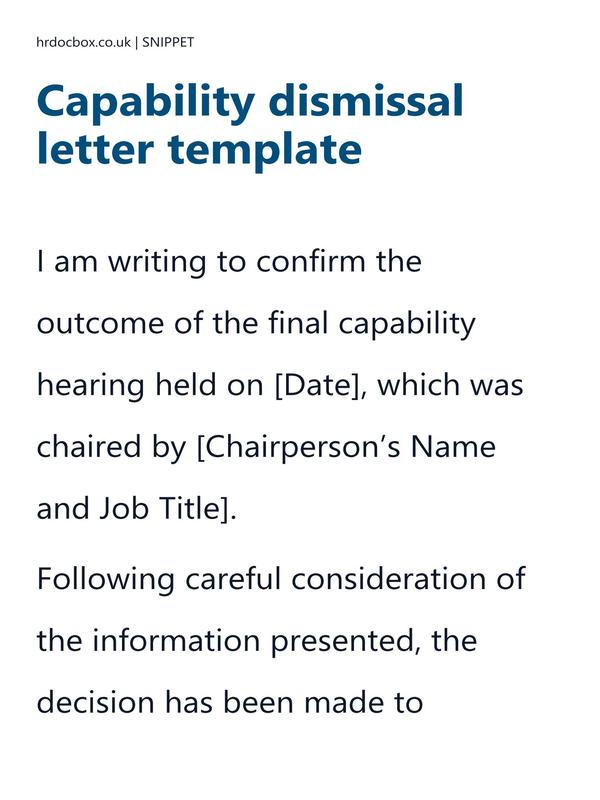
I am writing to confirm the outcome of the formal capability process concerning your performance in the role of [Job Title].

Following the capability hearing held on [Date], at which you were given the opportunity to respond to the concerns regarding your performance, I have carefully considered the information and evidence available, your response and the circumstances of your case.

I have concluded that your performance has not reached the standard required for your role and that, having considered the steps taken to support you, dismissal on capability grounds is appropriate.

Performance concerns

The concerns regarding your performance have been discussed with you on a number of occasions.

The areas where your performance has not reached the required standard include:

  • [Performance issue / required standard]
  • [Performance issue / required standard]
  • [Performance issue / required standard]

The required standard was explained to you through [performance meetings / objectives / performance improvement plan / written warnings / other process].

Support and opportunity to improve

During the capability process, the organisation has taken steps to support you in achieving the required

PREVIEW ENDS HERE

This is the end of the preview

You've seen 20% of how the Capability dismissal letter template is structured. Get the complete editable template instantly and customise it for your organisation.

£2.99
Specifications
Access 12 months, with updates
Length 3 pages • 897 words
Jurisdiction England, Wales, Scotland
Based on UK law, ACAS guidance
Last update 02/10/2026
Update reason Content update.
Next review 02/04/2027
Delivery & Format Instant digital delivery, .doc · .txt · email

What is a capability dismissal letter?

Capability dismissal letter template preview

This letter provides a formal written record of a dismissal following a capability or performance process. It is designed for circumstances where an employee has been given a reasonable opportunity to improve but has not achieved the required standard, and dismissal has been considered only after appropriate support and a fair process.

Confirming the capability decision

The letter clearly distinguishes capability from misconduct by explaining that the decision concerns the employee’s ability to meet the required performance standard rather than an allegation of deliberate wrongdoing.

Recording the performance history

A concise summary of the performance concerns, standards required, previous meetings, objectives and review periods provides a clear explanation of how the decision was reached.

Demonstrating support and opportunity to improve

The letter records relevant training, coaching, supervision, reasonable adjustments where applicable and other support provided. It can also refer to performance improvement plans and previous warnings or formal capability outcomes.

Explaining why dismissal was necessary

The decision should explain why the required improvement has not been achieved and why the organisation considers dismissal to be the appropriate outcome after considering the circumstances and any alternatives.

Confirming the practical arrangements

The letter confirms the effective date of termination, notice arrangements, final pay, outstanding holiday and other relevant leaving arrangements, together with the employee’s right to appeal.

Best in class example

An employee has been experiencing ongoing performance difficulties in their role. The organisation has raised the concerns with them, provided additional training and coaching, and set clear performance objectives with reasonable review periods.

A formal capability process is subsequently commenced. The employee is given clear information about the required standards and is provided with a performance improvement plan. Progress is reviewed at regular intervals and the employee is given an opportunity to explain any difficulties affecting their performance.

Despite the support provided and additional opportunities to improve, the employee continues to fall materially below the required standard in several key areas. A formal capability hearing is held, at which the employee has the opportunity to respond to the concerns and provide any relevant information before a decision is made.

After considering the evidence, the employee’s representations, the support provided and the overall circumstances, the decision-maker concludes that the required improvement has not been achieved and that there is insufficient prospect of the employee reaching the required standard within a reasonable further period. Dismissal on capability grounds is therefore confirmed.

The employee is issued with written confirmation of the decision, including their notice arrangements and right to appeal.

Implementation guidance

Use these best practice actions, recommended timescales and process stages to understand when and how the Capability dismissal letter should be used, helping ensure each step is handled consistently and appropriately documented.

Step Description Responsibility Timing
1 Review the capability evidence, including performance concerns, objectives, reviews, support, training and any relevant adjustments or alternative options considered. Decision-maker / HR Before dismissal decision
2 Hold the formal capability hearing and give the employee a reasonable opportunity to respond to the concerns and provide relevant information. Decision-maker / Employee After reasonable notice
3 Consider the evidence, employee’s response, support provided, prospects of improvement and any alternatives before reaching a decision. Decision-maker Normally within 2–5 working days after hearing
4 Issue the written dismissal outcome confirming the reason, termination date, notice arrangements and right of appeal. Decision-maker / HR As soon as reasonably possible after decision
5 Process final pay and leaving arrangements and manage any appeal in accordance with the organisation’s procedure. HR / Payroll / Appeal manager By termination date / within appeal timescale
Premium content

To continue reading, purchase this item or a parent toolkit, library or our full library.

Common mistakes

Understand the common mistakes to avoid when using this HR template, helping you reduce risk, prevent unnecessary costs and ensure the process is handled correctly.

  • Describing a capability dismissal as misconduct without explaining the distinction
  • Failing to demonstrate that the employee was given reasonable support and a genuine opportunity to improve
  • Relying on vague statements about poor performance instead of specific evidence
  • Failing to consider disability, reasonable adjustments or health-related factors where relevant
  • Making the dismissal decision before properly considering the employee’s response at the hearing
  • Failing to provide a clear right of appeal
Premium content

To continue reading, purchase this item or a parent toolkit, library or our full library.

HR considerations

UK employment law and best practice

This template is designed to support the process, but the document should be used alongside the relevant HR procedure and applied to the circumstances of the individual case.

Capability as a potentially fair reason for dismissal

Capability is a potentially fair reason for dismissal under the Employment Rights Act 1996. Capability can relate to an employee’s ability to perform the work to the required standard or, in some circumstances, their qualifications or other ability to carry out the role.

https://www.acas.org.uk/dismissals/types-of-dismissal

https://www.gov.uk/dismiss-staff/fair-dismissals

Support and opportunity to improve

Where the issue is capability, employers should normally take reasonable steps to support the employee before considering dismissal. This can include training, coaching, mentoring, clearer objectives, additional supervision and a reasonable period in which to improve. Dismissal should be a last resort.

https://www.acas.org.uk/performance-management/problems-with-an-employees-performance

https://www.acas.org.uk/performance-management/dismissals-for-capability-or-conduct

Evidence of capability concerns

The employer should have evidence of the performance concerns and the steps taken to support improvement. Relevant evidence may include performance reviews, agreed objectives, performance improvement plans, records of meetings, training and feedback.

https://www.acas.org.uk/performance-management/dismissals-for-capability-or-conduct

Fair procedure

A capability dismissal must be handled fairly. Where a formal capability procedure is used, the employer should follow its own procedure and the basic principles of the Acas Code of Practice on disciplinary and grievance procedures. The employee should understand the concerns, have a reasonable opportunity to respond and be given the right to appeal.

https://www.acas.org.uk/acas-code-of-practice-on-disciplinary-and-grievance-procedures

https://www.acas.org.uk/dismissals/following-a-fair-procedure

Disability and reasonable adjustments

Where performance difficulties may be connected to a disability, the employer must consider its obligations under the Equality Act 2010, including whether reasonable adjustments could remove or reduce the disadvantage experienced by the employee. Dismissal should not be based simply on the fact that an employee is disabled.

https://www.acas.org.uk/supporting-disabled-people/capability-and-performance-when-someone-is-disabled

https://www.gov.uk/reasonable-adjustments-for-disabled-workers

Alternative options

Before dismissing for capability, employers should consider whether there are reasonable alternatives where appropriate. Depending on the circumstances, this could include changes to duties, additional support, further training or a suitable alternative role.

https://www.acas.org.uk/performance-management/dismissals-for-capability-or-conduct

Notice and termination

Unless the circumstances justify dismissal without notice under a separate legal basis, an employee dismissed for capability will normally be entitled to the contractual or statutory notice that applies to their employment. The dismissal letter should clearly confirm the effective date of termination and any payment in lieu of notice where applicable.

https://www.gov.uk/dismiss-staff/handing-in-notice

https://www.gov.uk/dismiss-staff/notice-periods

Right of appeal

The employee should be given a reasonable opportunity to appeal the dismissal. The appeal should, wherever possible, be handled impartially by someone who was not previously involved in the decision and who has appropriate authority to make the final decision.

https://www.acas.org.uk/appealing-a-disciplinary-or-grievance-outcome

https://www.acas.org.uk/appealing-a-disciplinary-or-grievance-outcome/how-to-appeal

Written reasons for dismissal

Employers should provide the employee with the reason for dismissal, the date employment will end, the applicable notice arrangements and the right of appeal. Employees with the relevant statutory entitlement can also request a written statement of reasons for dismissal.

https://www.acas.org.uk/dismissals

You may also need these resources

FAQs

Is capability dismissal the same as disciplinary dismissal?

Capability concerns relate to an employee’s ability to perform their role to the required standard, whereas misconduct concerns inappropriate or unacceptable behaviour. A capability process may be separate from the organisation’s disciplinary procedure, but the basic principles of procedural fairness still apply.

Does an employee have to receive a final written warning before capability dismissal?

Not necessarily in every circumstance. The appropriate process depends on the organisation’s procedure and the facts of the case. However, the employee should normally have been given a clear understanding of the required standard, appropriate support and a reasonable opportunity to improve before dismissal is considered.

What should the dismissal letter say about performance?

It should explain the key performance concerns and the required standard, refer to the support and opportunities provided, confirm the employee’s response at the final hearing and explain why the decision-maker concluded that dismissal was appropriate.

Can an employee be dismissed for capability if they have a disability?

Potentially, but this is a particularly sensitive area. The employer must consider whether the employee is disabled, whether reasonable adjustments are required, whether the performance issue is disability-related and whether other reasonable options have been considered. Specialist advice may be appropriate before dismissal.

Does the employee have a right to appeal a capability dismissal?

Employees should be given the opportunity to appeal a dismissal. The appeal should normally be heard by someone who was not previously involved in the decision and should be handled impartially.

Why use HRDocBox rather than AI?

HRDocBox templates provide a structured starting point based on UK HR practice and employment requirements. They help ensure that important elements such as the capability history, support provided, dismissal rationale, notice and appeal are addressed, while allowing the employer to tailor the letter to the individual circumstances.

How this content is developed and reviewed

The Capability dismissal letter template is developed using a practical HR methodology that considers current UK employment legislation, ACAS guidance, CIPD good practice and the real-world HR process it supports. Templates and supporting information are regularly reviewed and updated, with additional reviews triggered by significant changes to legislation, guidance or established HR practice, helping ensure each document remains practical, relevant and suitable for UK employers.

About the author

Darryl Horn, Chartered HR Director

Darryl is a Chartered HR professional with over 25 years' experience in senior HR and employee relations roles.

He has extensive practical experience of managing capability HR processes and founded hrdocbox to provide businesses with practical, professionally developed HR resources grounded in UK employment law and best practice.

HRDocBox has been creating practical UK HR documents since 2009.

Executive recommendation

"Darryl provides support and advice with excellent judgement, and has a strong understanding of people, policies and UK employment legislation."

"He is someone I trust; consistent, dependable, and committed to doing things properly."

RB
Ruth Brock Chief Executive Officer The Hygiene Bank
Get started today

HR confidence starts here

Whether you employ 5 people or 50, hrdocbox gives you the structure, documents and expertise needed to manage employees professionally and legally.

Download your FREE UK employment contract template

Professionally written and fully compliant with UK employment law

Download FREE contract
Free UK employment contract template