Deduction from salary form template

£12.99
Editable template
Instant download
UK-specific & legally compliant
12 months updates included
2026 Reviewed

Use this Deduction from Salary Form to request, review and record a proposed deduction from an employee's pay. Designed for UK employers, it helps HR, managers and payroll check the reason, amount, supporting evidence and required authorisation before processing a deduction.

Use this template to:
  • Record the reason for a proposed salary deduction and identify the employee concerned.
  • Calculate the amount to be deducted and document how it was worked out.
  • Record the legal, contractual or other applicable basis for the deduction.
  • Check whether an employee agreement or consent is required and has been obtained.
  • Obtain the necessary management, HR and payroll approvals.
  • Track the deduction through payroll and retain an audit record.
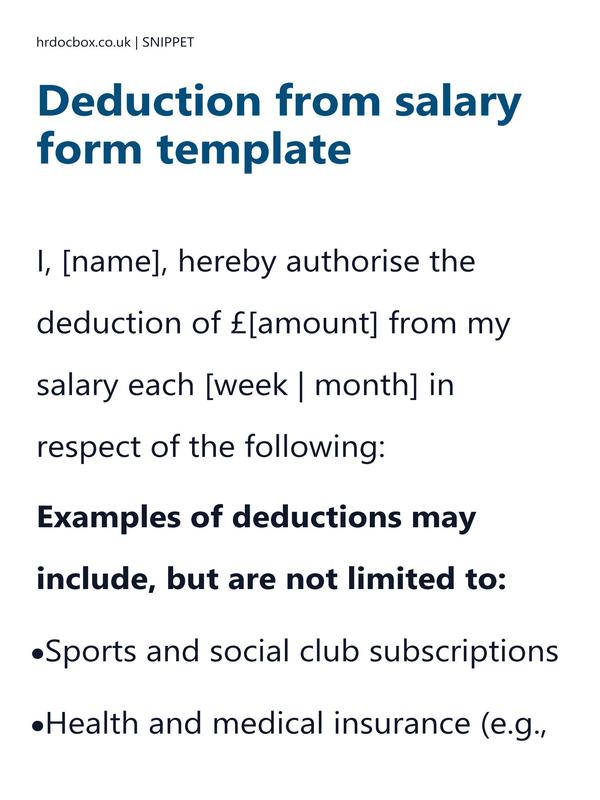
Deduction from salary form template preview

What you get with your purchase - much more than just a template!

Best practice example See what good looks like
Wider HR process Understand the bigger picture
Implementation guide Practical steps to follow
Common mistakes Know what to avoid
Get the complete resource

Don't just buy one template — get the complete Pay and benefits process toolkit

<p>If you are managing employee pay and benefits, the toolkit brings together practical HR templates covering reviews, decisions, communication, implementation and ongoing administration.</p>

35 templates • £29.99 • 12 months' access & updates
View the process toolkit

What's in this template?

  • Employee, department and payroll details.
  • Category and explanation of the proposed deduction.
  • Calculation of the amount and supporting evidence checklist.
  • Record of the legal, contractual or statutory basis for the deduction.
  • Employee notification and separate agreement or consent status.
  • HR, management and payroll approval fields.
  • Payroll processing, payslip and completion checks.
Template

Download .doc

Edit .xls

Copy [to paste]

Email

Deduction from salary

Internal HR and Payroll Use

Purpose: To record, check and authorise a proposed salary deduction before payroll processing. Use a separate Deduction from Salary Agreement where required.

1. Employee details

Field Details
Employee name  
Employee / payroll number  
Job title  
Department  
Line manager  
Normal pay frequency [ ] Weekly   [ ] Fortnightly   [ ] Monthly   [ ] Other: __________

2. Details of proposed deduction

Reason for deduction:

[ ] Accidental wage overpayment

[ ] Salary advance or loan repayment

[ ] Training costs

[ ] Damage, loss or other cost

[ ] Retail till shortage or stock shortfall

[ ] Salary sacrifice arrangement

[ ] Other: ____________________________________________

Description and

PREVIEW ENDS HERE

This is the end of the preview

You've seen 20% of how the Deduction from salary form template is structured. Get the complete editable template instantly and customise it for your organisation.

£12.99
Specifications
Access 12 months, with updates
Length 2 pages • 703 words
Jurisdiction England, Wales, Scotland
Based on UK law, ACAS guidance
Last update 13/10/2026
Update reason Additional guidance.
Next review 13/04/2027
Delivery & Format Instant digital delivery, .doc · .xls · .txt · email

What is a deduction from salary form?

Deduction from salary form template

Before making a deduction from salary, an employer needs to establish why the deduction is being proposed, how much is involved and whether there is a lawful basis for making it. A clear administrative record helps prevent payroll errors, unsupported deductions and confusion over who approved the request.

This form is designed as an internal HR and payroll control. It records the details of a proposed deduction and the checks completed before processing. It is different from a Deduction from Salary Agreement: the form manages the request and approval process, while the agreement records the specific terms accepted by the employee where an agreement is needed.

Use the form to assess the request

Record the employee's details, the reason for the proposed deduction, the amount and how it has been calculated. Identify the relevant supporting documents, such as an overpayment calculation, loan record or applicable contractual clause. If the amount is disputed or the evidence is incomplete, pause the request until the issue has been investigated.

Confirm the legal basis before approval

Identify whether the deduction is authorised by legislation, an applicable contractual provision, prior written employee agreement or another recognised legal basis. Do not assume that a manager's approval or a completed internal form is sufficient. If the deduction relies on employee consent, check that the appropriate agreement or consent has been obtained before the deduction is made.

Coordinate HR and payroll

Use the approval fields to record who has checked the request and whether payroll can proceed. Confirm the amount, the intended pay date, whether the deduction is one-off or recurring and any instalment schedule. Check the National Minimum Wage implications and any special restrictions relevant to the type of deduction.

Keep an auditable record

Retain the completed form with the supporting evidence and any separate employee agreement. Payroll should record the deduction accurately on the payslip and reconcile any outstanding balance. If the amount, reason or schedule changes, document the change and complete any necessary legal and consent checks before implementing it.

Best in class example

A payroll review identifies that an employee has received an accidental overpayment of £450. HR opens a Deduction from Salary Form, records the employee's details, identifies the affected pay periods and attaches the calculation showing how the balance was established.

HR checks the legal basis for recovering the overpayment and contacts the employee to explain the position. The employee asks to repay the balance in three monthly instalments rather than in one deduction, and the employer agrees to consider that schedule.

The form records the proposed instalments, the intended first deduction date and the status of the separate repayment agreement. The responsible manager and HR complete their checks, and payroll confirms the instructions and relevant minimum wage treatment before the request is approved for processing.

Payroll processes the authorised instalments, records each deduction on the relevant payslip and checks the outstanding balance. The completed form, calculation and any separate agreement are retained together. If the employee's circumstances or the repayment schedule changes, the employer reviews and documents the revised arrangement before making changes to payroll.

The wider HR process

Related HR resources and workflow

Explore the HR resources that may be relevant before and / or after using the Deduction from salary form, helping you understand the wider process, maintain appropriate documentation and follow a consistent approach.

Previous
Policies
Pay or salary payment arrangements policy

Our pay or salary payment arrangements policy template provides information regarding pay or salary payment arrangements.

This
Deduction from salary form
Premium content

To continue reading, purchase this item or a parent toolkit, library or our full library.

Implementation guidance

Use these best practice actions, recommended timescales and process stages to understand when and how the Deduction from salary form should be used, helping ensure each step is handled consistently and appropriately documented.

Step Description Responsibility Timing (Days from Issue)
1 Complete the employee details, describe the proposed deduction, identify the reason and calculate the amount. Attach the supporting evidence. Requesting Manager / HR Day 0, when the request is raised.
2 Check the legal, contractual or statutory basis for the deduction. Confirm whether prior written employee agreement or consent is required and check the National Minimum Wage implications. HR / Payroll Day +1 to Day +2, before approval.
3 Explain the proposed deduction to the employee, provide the calculation and obtain any required separate agreement or written consent before processing. HR / Line Manager Day +2 to Day +4, allowing time for questions and agreement.
4 Complete the approval fields, confirm the amount and intended pay date, and send the authorised request and supporting documents to payroll. Authorised Manager / HR / Payroll Day +3 to Day +5, before the relevant payroll cut-off.
5 Verify the deduction on the payslip, update the outstanding balance where applicable and retain the completed form with the supporting evidence and any separate agreement. Payroll / HR After the first deduction and after each subsequent payroll until the request is closed.
Premium content

To continue reading, purchase this item or a parent toolkit, library or our full library.

Common mistakes

Understand the common mistakes to avoid when using this HR template, helping you reduce risk, prevent unnecessary costs and ensure the process is handled correctly.

  • Treating the completed form or a manager's approval as sufficient legal authority to deduct wages.
  • Failing to identify and document the legal, contractual or statutory basis for the deduction.
  • Using an unsupported calculation or failing to attach relevant evidence.
  • Proceeding without obtaining separate written agreement or consent where required.
  • Failing to check National Minimum Wage requirements or special restrictions for the type of deduction.
  • Failing to reconcile payroll deductions, update outstanding balances or retain an audit trail.
Premium content

To continue reading, purchase this item or a parent toolkit, library or our full library.

HR considerations

UK employment law and best practice

This template is designed to support the process, but the document should be used alongside the relevant HR procedure and applied to the circumstances of the individual case.

This form is an internal control document, not independent legal authority to deduct wages. Employers should complete the legal-basis check before authorising a deduction and retain the supporting evidence and any required employee agreement.

Employment Rights Act 1996

Section 13 of the Employment Rights Act 1996 generally prohibits unauthorised deductions from wages. A deduction may be permitted where it is required or authorised by statute, authorised by a relevant contractual provision that meets the statutory requirements, or covered by the worker's prior written agreement or consent. Section 14 provides specific exceptions, including certain overpayments. The correct basis depends on the circumstances. See https://www.legislation.gov.uk/ukpga/1996/18/section/13 and https://www.legislation.gov.uk/ukpga/1996/18/section/14

ACAS guidance

ACAS explains that deductions are permitted only in specified circumstances and advises employers to tell workers about unexpected deductions as soon as possible. For overpayments, employers should contact the worker, explain the mistake and discuss how repayment will be managed. A repayment plan may be appropriate where the amount is substantial or the overpayment has continued over time. See https://www.acas.org.uk/deductions-from-pay-and-wages and https://www.acas.org.uk/deductions-from-pay-and-wages/handling-overpayments

National Minimum Wage

A deduction that is permitted under employment law can still affect National Minimum Wage calculations. The treatment depends on the purpose of the deduction and the applicable rules. For example, certain deductions for accidental wage overpayments and repayments of wage advances or loans receive different treatment from deductions for other costs. Payroll should assess the specific deduction rather than relying solely on the employee's consent or the amount of net pay remaining. See https://www.gov.uk/guidance/calculating-the-minimum-wage/calculating-the-minimum-wage

Specific types of deduction

Additional restrictions may apply to particular deductions. For example, deductions for retail till shortages or stock shortfalls are subject to specific conditions and limits. Salary sacrifice arrangements require appropriate agreement and must comply with minimum wage requirements. Mandatory training costs, damage, losses and deductions from final pay also need to be assessed against the relevant contract and statutory rules. Do not treat these categories as interchangeable.

Employee notification and payroll records

Explain the proposed deduction to the employee and provide a clear calculation. Where prior written agreement or consent is relied on, obtain it before the deduction is made and ensure it covers the particular deduction. A general internal approval form is not a substitute for employee consent. Ensure deductions are accurately reflected on payslips and retain the form, supporting evidence and any separate agreement securely.

Important: The form should be approved only once the appropriate legal basis has been identified and the necessary checks completed. Where the legal position is unclear, the employee disputes the amount or the deduction may affect minimum wage compliance, seek appropriate HR or legal advice before proceeding.

You may also need these resources

FAQs

What is a Deduction from Salary Form used for?

It is an internal administrative form for recording a proposed salary deduction, its reason, calculation, legal basis, approvals and payroll instructions. It helps HR and payroll check the request before a deduction is processed.

How is the form different from a Deduction from Salary Agreement?

The form records and controls the request internally. The agreement records the specific terms accepted by the employee where an agreement is required, such as the amount to be repaid, instalment amounts and deduction dates. Depending on the circumstances, an employer may need both documents. Completing the form does not replace required employee consent.

Can a manager authorise a deduction without the employee's consent?

Managerial approval alone is not enough. The employer must establish a lawful basis, which may include statutory authority, a qualifying contractual provision, prior written agreement or a specific statutory exception. If written consent is the basis, it must be obtained before the deduction is made.

Should payroll process a deduction before the form is approved?

No. As an internal control, the request should be checked and authorised before processing. Payroll should confirm the amount, timing, legal-basis checks and any required employee agreement. If supporting evidence or authorisation is missing, the request should be held until the issue is resolved.

Why use HRDocBox?

HRDocBox provides practical HR templates designed to help UK employers manage workplace processes consistently. This form provides a structured record of a proposed deduction and the checks needed before payroll processing, reducing reliance on informal emails and incomplete instructions.

Why use HRDocBox rather than asking AI?

AI can help draft an administrative form, but it may confuse internal approval with legal authority or employee consent. This template separates the request, compliance checks and payroll approval from any separate agreement that may be required. Employers should still verify the circumstances and applicable law before authorising a deduction.

How this content is developed and reviewed

The Deduction from salary form template is developed using a practical HR methodology that considers current UK employment legislation, ACAS guidance, CIPD good practice and the real-world HR process it supports. Templates and supporting information are regularly reviewed and updated, with additional reviews triggered by significant changes to legislation, guidance or established HR practice, helping ensure each document remains practical, relevant and suitable for UK employers.

About the author

Darryl Horn, Chartered HR Director

Darryl is a Chartered HR professional with over 25 years' experience in senior HR and employee relations roles.

He has extensive practical experience of managing pay and benefits HR processes and founded hrdocbox to provide businesses with practical, professionally developed HR resources grounded in UK employment law and best practice.

HRDocBox has been creating practical UK HR documents since 2009.

Executive recommendation

"Darryl provides support and advice with excellent judgement, and has a strong understanding of people, policies and UK employment legislation."

"He is someone I trust; consistent, dependable, and committed to doing things properly."

RB
Ruth Brock Chief Executive Officer The Hygiene Bank
Get started today

HR confidence starts here

Whether you employ 5 people or 50, hrdocbox gives you the structure, documents and expertise needed to manage employees professionally and legally.

Download your FREE UK employment contract template

Professionally written and fully compliant with UK employment law
Download FREE contract
Free UK employment contract template