Libraries
780+ HR templates
Everything your business needs to stay compliant
Policies, contracts, letters, guidance and HR support tools for UK employers.
View full libraryPolicies, contracts, letters, guidance and HR support tools for UK employers.
View full libraryUse this Deduction from Salary Agreement to record an employee's written agreement to a specific deduction from their pay. It helps UK employers document the reason, amount, repayment arrangements and timing before the deduction is made.
Use this template to:

If you are managing employee pay and benefits, the toolkit brings together practical HR templates covering reviews, decisions, communication, implementation and ongoing administration.
This template brings together the key information, sections and considerations you need to create a clear, comprehensive and professional HR document. Preview the document below.
Date of agreement: [Date]
Employer: [Company Name]
Employee name: [Employee Name]
Job title: [Job Title]
Payroll / employee reference: [Reference, if applicable]
1. Purpose of this agreement
This agreement records the proposed deduction from your salary in respect of the amount and reason set out below. The deduction will only be processed where it is lawful and in accordance with the applicable contractual and statutory requirements.
2. Reason for the deduction
The deduction relates to:
[Describe the reason for the deduction, for example an accidental wage overpayment, salary advance, loan repayment or another specifically agreed amount.]
Supporting details and calculation:
| Description | Details / Amount |
| Original amount owed or overpaid | |
| Amount already repaid, |
You've seen 20% of how the Deduction from salary agreement template is structured. Get the complete editable template instantly and customise it for your organisation.
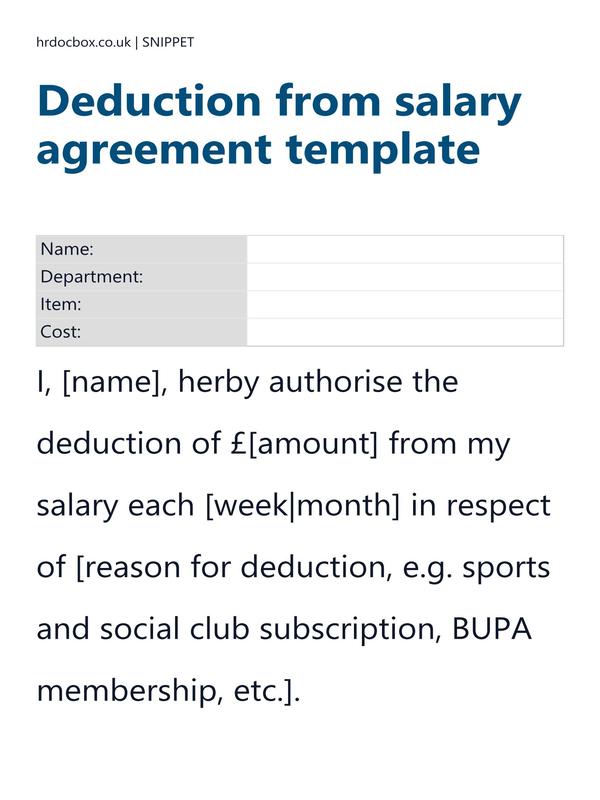
Employers sometimes need to recover money from an employee's salary, for example following an accidental overpayment, a salary advance or a separately agreed repayment arrangement. A written agreement helps clarify what is being recovered, why the deduction is proposed and how it will be applied through payroll.
This Deduction from Salary Agreement provides a record of the employee's agreement to a defined deduction. It can be adapted for a one-off deduction or repayments over several pay periods. It should only be used where the proposed deduction is lawful and the agreement accurately reflects the arrangement reached with the employee.
Explain what the deduction relates to and show how the amount has been calculated. For a repayment of an overpayment, for example, identify the relevant pay period and amount overpaid. For a salary advance or another debt, specify the original amount and the outstanding balance. Give the employee an opportunity to check the figures and ask questions before agreeing.
State whether the deduction will be made once or in instalments. Specify the amount of each deduction, the pay date or frequency, the first deduction date and the expected final payment. Where the amount is to be repaid over time, consider whether the proposed schedule is affordable and whether a different arrangement should be agreed.
Written consent is one potential legal basis for a deduction, but it is not the only one and does not automatically make every deduction lawful. Check whether the employment contract or legislation already authorises the deduction, whether the employee's consent is sufficiently clear and whether National Minimum Wage rules apply. Different rules can apply depending on the purpose of the deduction.
Give the employee a copy of the signed agreement and provide payroll with clear instructions. Ensure deductions are correctly processed and shown on the employee's payslip. Retain the agreement and the supporting calculation in accordance with the organisation's record-keeping arrangements. Do not use a general agreement as blanket permission for unrelated or unspecified future deductions.
Related HR resources and workflow
Explore the HR resources that may be relevant before and / or after using the Deduction from salary agreement, helping you understand the wider process, maintain appropriate documentation and follow a consistent approach.

Our pay or salary payment arrangements policy template provides information regarding pay or salary payment arrangements.
Use these best practice actions, recommended timescales and process stages to understand when and how the Deduction from salary agreement should be used, helping ensure each step is handled consistently and appropriately documented.
Understand the common mistakes to avoid when using this HR template, helping you reduce risk, prevent unnecessary costs and ensure the process is handled correctly.
An employer may make a deduction where it is required by law, authorised by a relevant contractual term, covered by the employee's prior written agreement or permitted under another applicable statutory exception. The correct basis depends on the reason for the deduction. Check the Employment Rights Act 1996 and ACAS guidance before proceeding.
Not in every situation. Some deductions may already be authorised by legislation or the employment contract, while others require prior written agreement or consent. Where written consent is the basis, obtain it before making the deduction and ensure the agreement clearly identifies what the employee is consenting to.
Employers can generally recover genuine accidental wage overpayments, but they should explain the mistake and discuss repayment with the employee. Agreeing a reasonable repayment schedule can help avoid unnecessary financial hardship. Keep a record of the calculation and the arrangements made.
Some deductions can affect minimum wage calculations, and the general rule is that deductions connected with the employment reduce pay for National Minimum Wage purposes. There are specific exceptions, including certain repayments of wage advances or loans and accidental wage overpayments. Check the rules for the particular deduction before processing it.
Only where the deduction is legally permitted, for example under an applicable contractual term or a valid prior written agreement, or another statutory exception. Do not assume that an outstanding balance can automatically be taken from final pay. Check the wording of the agreement, the employment contract and any applicable minimum wage requirements.
HRDocBox provides practical HR templates for UK employers, helping businesses document workplace arrangements consistently. This agreement provides a structured way to record the reason for a deduction, the repayment terms and the employee's consent where required. It should be tailored to the circumstances and checked against the relevant legal requirements.
AI can help draft wording, but a deduction agreement needs to distinguish between written consent, contractual authority and statutory exceptions. It must also account for minimum wage rules and the particular purpose of the deduction. This template gives you a reusable starting point, but you should verify the legal basis and details before using it.
How this content is developed and reviewed
The Deduction from salary agreement template is developed using a practical HR methodology that considers current UK employment legislation, ACAS guidance, CIPD good practice and the real-world HR process it supports. Templates and supporting information are regularly reviewed and updated, with additional reviews triggered by significant changes to legislation, guidance or established HR practice, helping ensure each document remains practical, relevant and suitable for UK employers.
Darryl Horn, Chartered HR Director
Darryl is a Chartered HR professional with over 25 years' experience in senior HR and employee relations roles.
He has extensive practical experience of managing pay and benefits HR processes and founded hrdocbox to provide businesses with practical, professionally developed HR resources grounded in UK employment law and best practice.
HRDocBox has been creating practical UK HR documents since 2009.
"Darryl provides support and advice with excellent judgement, and has a strong understanding of people, policies and UK employment legislation."
"He is someone I trust; consistent, dependable, and committed to doing things properly."




















Whether you employ 5 people or 50, hrdocbox gives you the structure, documents and expertise needed to manage employees professionally and legally.
Professionally written and fully compliant with UK employment law

Access a free contract template instantly - or save 10% on any document today.
Use this code at checkout for 10% off anything!
Includes instant download, updates, and full access to your HR templates.