Libraries
780+ HR templates
Everything your business needs to stay compliant
Policies, contracts, letters, guidance and HR support tools for UK employers.
View full libraryPolicies, contracts, letters, guidance and HR support tools for UK employers.
View full libraryThe Pay or Salary Increase Notification Letter Template provides a professional way to confirm an employee's pay increase in writing. It clearly sets out the employee's current and new salary or hourly rate, the effective date and the reason for the increase, while recognising the employee's contribution and providing a clear record for HR and payroll.
Use this template to:
<p>If you are managing employee pay and benefits, the toolkit brings together practical HR templates covering reviews, decisions, communication, implementation and ongoing administration.</p>
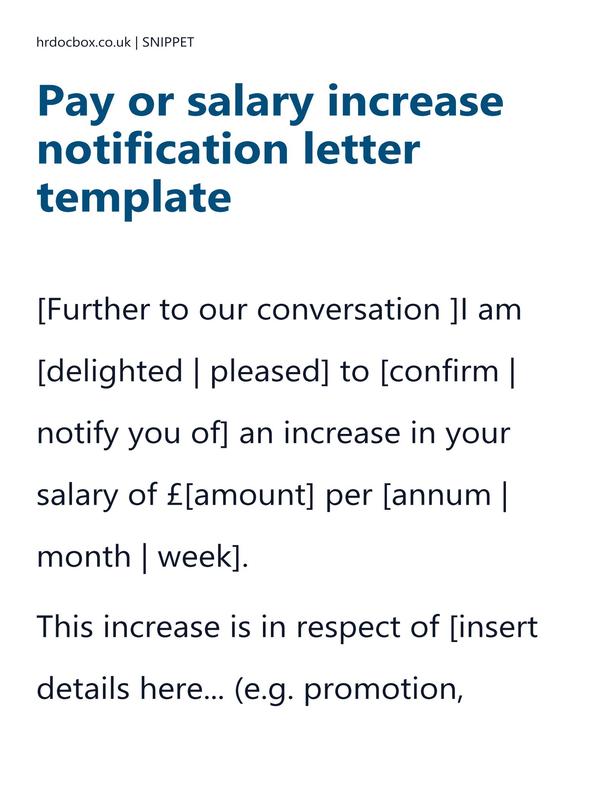
This template brings together the key information, sections and considerations you need to create a clear, comprehensive and professional HR document. Preview the document below.
[Sender name]
[Sender address]
[date]
[Recipient name]
[Recipient address]
Dear [Recipient first name],
Notice of [pay | salary] increase
I am pleased to confirm that, following a review of your role and contribution to the business, your pay will increase with effect from [effective date].
Your current [annual salary /
You've seen 20% of how the Pay or salary increase notification letter template is structured. Get the complete editable template instantly and customise it for your organisation.

A pay or salary increase notification letter is used to formally confirm a change to an employee's remuneration. It records the employee's existing and new rate of pay, when the change takes effect and, where appropriate, the reason for the increase.
The letter provides the employee with a clear written record of an agreed or employer-determined pay change and can be retained alongside the employee's HR and payroll records.
The template can be used for a range of pay increases, including annual salary reviews, performance-related increases, market adjustments, increases following a promotion or changes to an employee's responsibilities.
It can be adapted for salaried employees or employees paid by the hour, allowing the employer to explain the change clearly without unnecessarily complicating the communication.
The letter is suitable for HR professionals, managers and business owners responsible for communicating changes to employee pay. It is particularly useful where the organisation wants a consistent written approach to salary and pay reviews.
The letter should normally be issued once the pay increase has been approved and the effective date has been confirmed. Providing written confirmation before the change appears in payroll gives the employee clarity about what is changing and when.
Related HR resources and workflow
Explore the HR resources that may be relevant before and / or after using the Pay or salary increase notification letter, helping you understand the wider process, maintain appropriate documentation and follow a consistent approach.

Our pay or salary payment arrangements policy template provides information regarding pay or salary payment arrangements.

Our Pay Increase Notification Script Template informs employees of salary adjustments, fostering transparency and appreciation for their contributions.
Use these best practice actions, recommended timescales and process stages to understand when and how the Pay or salary increase notification letter should be used, helping ensure each step is handled consistently and appropriately documented.
Understand the common mistakes to avoid when using this HR template, helping you reduce risk, prevent unnecessary costs and ensure the process is handled correctly.
There is not a general requirement for every pay increase to be communicated using a specific letter, but written confirmation is good HR practice. It provides a clear record of the new rate and effective date and can help ensure the employee, HR and payroll have the same information.
It can. Where salary is a contractual term, a permanent change to the employee's remuneration should be reflected appropriately in the employee's written employment records and contractual documentation.
Yes. The template can be adapted to confirm either an annual salary or an hourly rate, including the effective date and the reason for the increase.
HRDocBox combines deep HR knowledge, practical application and years of experience with UK employment practices. The template provides a structured way to communicate a pay change clearly while leaving the employer to apply its own pay-review approach and decision-making.
AI can produce a basic salary increase letter, but HR documentation needs to fit the underlying employment arrangements and payroll process. HRDocBox provides purpose-built HR resources informed by employment-law knowledge, practical application and years of experience rather than simply generating generic wording.
Yes. The template is designed to be adapted to the reason for the increase, whether it relates to performance, promotion, additional responsibilities, market rates or an annual pay review.
How this content is developed and reviewed
The Pay or salary increase notification letter template is developed using a practical HR methodology that considers current UK employment legislation, ACAS guidance, CIPD good practice and the real-world HR process it supports. Templates and supporting information are regularly reviewed and updated, with additional reviews triggered by significant changes to legislation, guidance or established HR practice, helping ensure each document remains practical, relevant and suitable for UK employers.
Darryl Horn, Chartered HR Director
Darryl is a Chartered HR professional with over 25 years' experience in senior HR and employee relations roles.
He has extensive practical experience of managing pay and benefits HR processes and founded hrdocbox to provide businesses with practical, professionally developed HR resources grounded in UK employment law and best practice.
HRDocBox has been creating practical UK HR documents since 2009.
"Darryl provides support and advice with excellent judgement, and has a strong understanding of people, policies and UK employment legislation."
"He is someone I trust; consistent, dependable, and committed to doing things properly."

















Whether you employ 5 people or 50, hrdocbox gives you the structure, documents and expertise needed to manage employees professionally and legally.
Professionally written and fully compliant with UK employment law
Access a free contract template instantly - or save 10% on any document today.
Use this code at checkout for 10% off anything!
Includes instant download, updates, and full access to your HR templates.