Libraries
780+ HR templates
Everything your business needs to stay compliant
Policies, contracts, letters, guidance and HR support tools for UK employers.
View full libraryPolicies, contracts, letters, guidance and HR support tools for UK employers.
View full libraryThis guide provides an overview of employee benefits and current trends, including the emerging popularity of flexible benefits which are designed to provide employees with individual choice.
<p>If you are managing employee pay and benefits, the toolkit brings together practical HR templates covering reviews, decisions, communication, implementation and ongoing administration.</p>
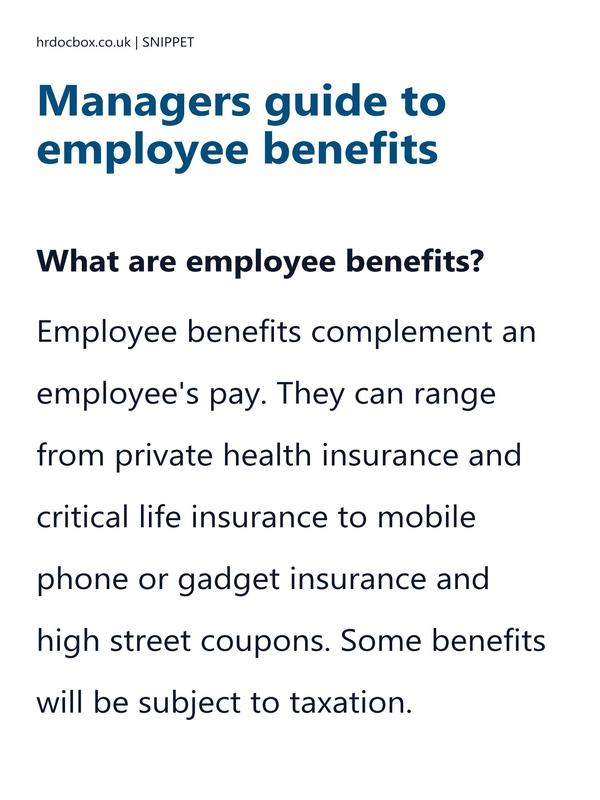
What are employee benefits?
Employee benefits complement an employee's pay. They can range from private health insurance and critical life insurance to mobile phone or gadget insurance and high street coupons. Some benefits will be subject to taxation.
Benefits could be, but are not limited to:
Why are employee benefits important?
In the short term, not providing benefits helps with reducing expenses for your company, but in the long run, you may be impeding rather than facilitating progress. By providing adequate employee benefits, you will recruit talented employees and help retain those you already have. You will also develop an appealing employer brand and the image of a powerful, caring, and invested employer.
Without employee benefits, you risk increased staff turnover, higher recruiting expenses, and a narrower talent pool to choose from when you do recruit. It may be expensive to replace an employee, not just in terms of recruiting, but also in terms of training and bringing new staff up to full production, and the expenses can add up quickly. Do you really want to limit your alternatives and pay those extra expenditures as a small business attempting to develop because you don't provide gym membership or health insurance?
Recruiting talent
It can be difficult to recruit the right employees for your company in the first place, and if you're a small business, providing a large salary may not be an option. While salary is still an essential factor, employees place benefits as one of the top three factors when looking for a job.
Employees also value flexible working hours, a decent work/life balance, and prospects for promotion.
Retention of employees
Staff recruiting and retention are two of the most expensive aspects of any organisation. Every employee who leaves your company is estimated to cost more than £30,000 in terms of both finding a replacement and lost productivity. If you have a low retention rate or are having difficulty attracting great employees to your company, employee benefits might be the solution.
Employee engagement
Recruiting competent personnel is one thing; keeping them motivated and satisfied is another. Even after they have signed their job contract, you must work hard to keep them. Attractive employee benefits, such as flexible working, free refreshments, reward and recognition, business away days, and
You've seen 20% of how the Managers guide to employee benefits is structured. Get the complete editable template instantly and customise it for your organisation.

An employer's guide to employee benefits is a document that provides information and guidance to employers on the different types of benefits that they can offer to their employees. Employee benefits are additional perks or advantages that employers offer beyond the basic salary or wages, and can include things like health insurance, retirement plans, paid time off, and other forms of compensation.
The guide outlines the various types of employee benefits that are available, and provides guidance on how to select and implement the most appropriate benefits package for the organisation and its employees. It may also include information on the legal requirements for providing certain benefits, such as pensions and maternity leave.
An employer's guide to employee benefits can be a valuable resource for employers who want to attract and retain top talent, and ensure that their employees feel valued and supported in the workplace. By providing a comprehensive and competitive benefits package, employers can help to create a positive and productive work environment that benefits both employees and the organisation as a whole.
Yes. This template has been designed for organisations of all sizes, including small businesses, charities and growing employers. It follows UK employment law best practice and can be adapted to suit your organisation.
Our templates are developed with UK employment legislation, Acas guidance and HR best practice in mind and are reviewed and updated as relevant requirements change. However, every employment situation is different, so the template should be adapted to the circumstances and checked against the employee's contract and your organisation's procedures before use.
Yes, we highlight the areas of the document that you need to update with your own details, and where you need to make decisions to suit your situation. This saves you time and ensures that you meet best practice.
Yes. Once purchased, you'll be able to download it instantly. Templates are provided in editable format (such as .doc or .xls) so you can customise them easily, and in PDF format for easy sharing.
If you're looking for broader support, we also offer toolkits and library bundles that include the Managers guide to employee benefits, along with other HR templates and policies for fully managing your situation. These may be more cost-effective if you need deeper advice.
AI can produce a document quickly, but effective HR documentation needs to be more than well-written words. It needs to reflect relevant UK employment law, HR best practice, practical considerations and the circumstances in which it will be used. These resources have been professionally developed around that wider HR context, drawing on extensive practical experience, rather than simply generating a generic document from a prompt.
How this content is developed and reviewed
The Managers guide to employee benefits is developed using a practical HR methodology that considers current UK employment legislation, ACAS guidance, CIPD good practice and the real-world HR process it supports. Templates and supporting information are regularly reviewed and updated, with additional reviews triggered by significant changes to legislation, guidance or established HR practice, helping ensure each document remains practical, relevant and suitable for UK employers.
Darryl Horn, Chartered HR Director
Darryl is a Chartered HR professional with over 25 years' experience in senior HR and employee relations roles.
He has extensive practical experience of managing pay and benefits HR processes and founded hrdocbox to provide businesses with practical, professionally developed HR resources grounded in UK employment law and best practice.
HRDocBox has been creating practical UK HR documents since 2009.
"Darryl provides support and advice with excellent judgement, and has a strong understanding of people, policies and UK employment legislation."
"He is someone I trust; consistent, dependable, and committed to doing things properly."








Whether you employ 5 people or 50, hrdocbox gives you the structure, documents and expertise needed to manage employees professionally and legally.
Professionally written and fully compliant with UK employment law
Access a free contract template instantly - or save 10% on any document today.
Use this code at checkout for 10% off anything!
Includes instant download, updates, and full access to your HR templates.