Libraries
780+ HR templates
Everything your business needs to stay compliant
Policies, contracts, letters, guidance and HR support tools for UK employers.
View full libraryPolicies, contracts, letters, guidance and HR support tools for UK employers.
View full libraryA practical HR compliance check template to help employers review their HR policies, employment practices, people management processes and legal obligations. Use it to identify gaps, assess risks, assign actions and build a structured programme of ongoing HR compliance.
Use this template to:
<p>If you are developing an HR strategy or project, the toolkit brings together practical HR templates covering priorities, planning, delivery, monitoring and evaluation.</p>
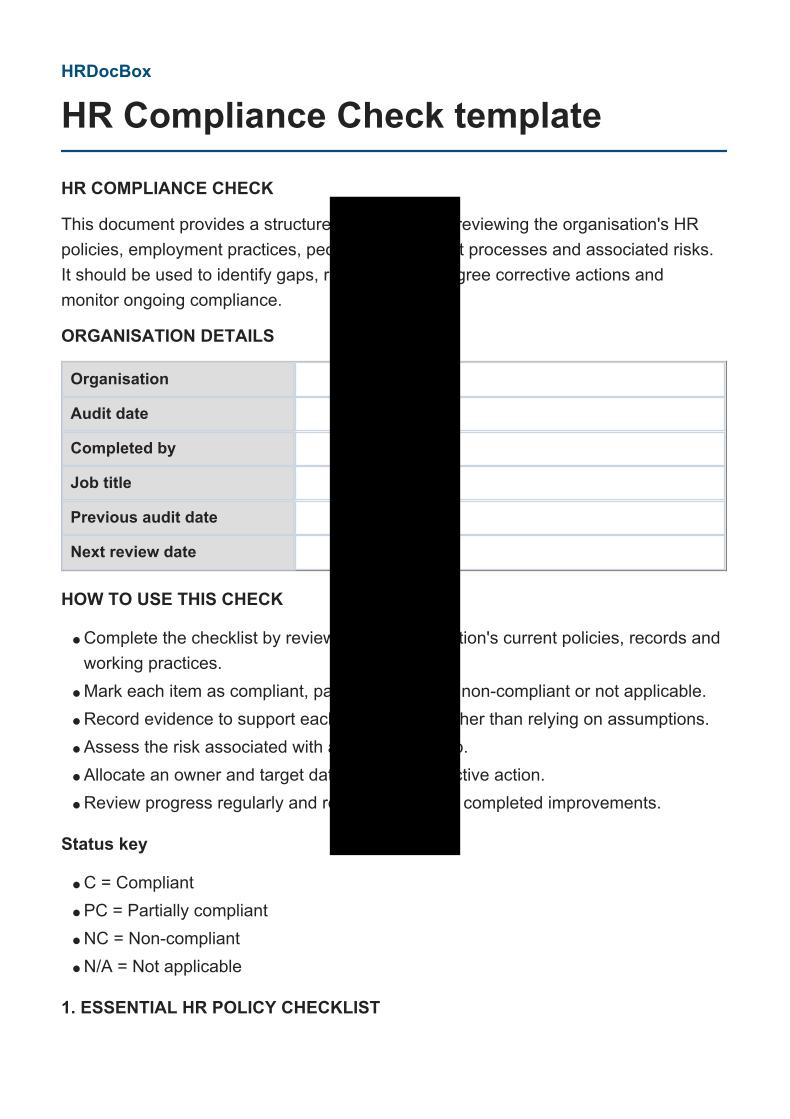
HR COMPLIANCE CHECK
This document provides a structured framework for reviewing the organisation's HR policies, employment practices, people management processes and associated risks. It should be used to identify gaps, record findings, agree corrective actions and monitor ongoing compliance.
ORGANISATION DETAILS
| Organisation | |
| Audit date | |
| Completed by | |
| Job title | |
| Previous audit date | |
| Next review date |
HOW TO USE THIS CHECK
Status key
1. ESSENTIAL HR POLICY CHECKLIST
Review whether the organisation has appropriate policies in place, whether they reflect current legislation and working arrangements, and whether employees and managers know where to find them.
| Policy / Document | In Place? | Up to Date? | Communicated? | Action Required |
| Core policies | ||||
| Disciplinary policy and procedure | ||||
| Grievance policy and procedure | ||||
| Health and safety policy | ||||
| Data protection and GDPR policy | ||||
| Equal opportunities / EDI policy | ||||
| Flexible working policy | ||||
| Maternity, paternity, adoption and shared parental leave policies | ||||
| Operational policies | ||||
| Sickness absence management policy | ||||
| Annual leave policy | ||||
| Remote and hybrid working policy | ||||
| Performance management policy | ||||
| Probation policy | ||||
| Whistleblowing policy | ||||
| Behaviour and culture policies | ||||
| Code of conduct | ||||
| Anti-harassment and bullying policy | ||||
| Social media policy | ||||
| Diversity, equity and inclusion statement | ||||
| Good practice additions | ||||
| Menopause policy or guidance | ||||
| Mental health and wellbeing policy or guidance | ||||
| Learning and development policy | ||||
| Expenses policy |
2. HR RISK ASSESSMENT
Assess each area below. Record the current position, supporting evidence, risk level and any action required. Where an issue is not applicable, record the reason.
Risk rating guide
| Risk area | Checklist item | Status | Risk level | Evidence / action required | Owner | Review date |
| Legal and compliance | All core HR policies are in place and up to date. | |||||
| Written employment particulars are issued on or before the first day of employment, where required. | ||||||
| Right to work checks are completed and appropriate evidence retained. | ||||||
| Working time, rest breaks and holiday entitlement arrangements are compliant. | ||||||
| Pay arrangements meet applicable minimum wage and contractual requirements. | ||||||
| Employee records are accurate, secure and appropriately retained. | ||||||
| Employment changes are documented and communicated correctly. | ||||||
| Employee relations | Managers understand disciplinary and grievance procedures. | |||||
| Employee issues are handled consistently and fairly. | ||||||
| Formal cases are investigated and documented appropriately. | ||||||
| Employees know how to raise concerns or grievances. | ||||||
| The right to be accompanied is respected at qualifying formal meetings. | ||||||
| Absence and wellbeing | Absence is recorded and monitored consistently. | |||||
| Return-to-work discussions are conducted where appropriate. | ||||||
| Absence triggers are used appropriately and fairly. | ||||||
| Occupational health, employee assistance or other support is available where appropriate. | ||||||
| Reasonable adjustments and workplace support are considered where required. | ||||||
| Performance management | Clear objectives and performance expectations are established. | |||||
| Probation periods are actively managed and reviewed. | ||||||
| Underperformance is addressed in a timely and consistent manner. | ||||||
| Managers are equipped to conduct performance conversations. | ||||||
| Recruitment and onboarding | Structured and fair recruitment processes are used. | |||||
| Job descriptions and person specifications are accurate and current. | ||||||
| Interview questions and selection criteria are relevant and consistently applied. | ||||||
| References and other appropriate screening checks are completed. | ||||||
| Onboarding arrangements are consistent and documented. | ||||||
| Equality, diversity and inclusion | Equal opportunities arrangements are in place and communicated. | |||||
| Recruitment and promotion decisions are supported by objective criteria. | ||||||
| Potential discrimination and harassment concerns are addressed appropriately. | ||||||
| Reasonable adjustments are considered and implemented where required. | ||||||
| Health and safety | Health and safety policy and arrangements are current. | |||||
| Suitable risk assessments are completed and reviewed. | ||||||
| Employees receive appropriate safety information, instruction and training. | ||||||
| Accidents, incidents and relevant statutory reporting obligations are managed appropriately. | ||||||
| Offboarding | Leavers are managed through a consistent process. | |||||
| Final pay and holiday calculations are accurate. | ||||||
| Company property is returned and system access is removed promptly. | ||||||
| Exit feedback is considered where collected. |
3. RECRUITMENT COMPLIANCE AND FAIR HIRING STANDARDS
Review the organisation's recruitment arrangements to ensure that candidates are treated fairly, selection decisions are evidence-based and required checks are completed.
| Check | Status | Evidence / action required |
| Job descriptions and person specifications are reviewed before vacancies are advertised. | ||
| Job adverts use inclusive language and avoid discriminatory requirements. | ||
| Selection criteria are agreed before interviews take place. | ||
| Structured interview questions and scoring methods are used where appropriate. | ||
| Interview and selection decisions are recorded and supported by evidence. | ||
| Right to work checks are completed in accordance with the applicable requirements. | ||
| References and other relevant checks are completed where appropriate. | ||
| Recruitment information is handled in accordance with data protection requirements. | ||
| Successful candidates receive appropriate offers and written employment particulars. |
4. EMPLOYEE MANAGEMENT REVIEW
Review how employees are managed throughout the employment lifecycle, from joining the organisation through to ongoing performance, absence and exit arrangements.
| Area | Review points | Status | Action required |
| Recruitment and onboarding | Structured job descriptions, fair selection, right to work checks, written particulars and induction arrangements. | ||
| Day-to-day management | Clear expectations, regular one-to-one meetings, documented conversations and early intervention where issues arise. | ||
| Performance management | Effective probation reviews, measurable objectives, feedback and appropriate action where performance falls below expectations. | ||
| Absence management | Consistent absence recording, return-to-work discussions, identification of patterns and appropriate support. | ||
| Employee relations | Fair procedures, appropriate investigations, the right to be accompanied where applicable and accurate records of formal action. | ||
| Offboarding | Exit arrangements, final pay and holiday calculations, return of property and removal of system access. |
5. WORKPLACE WELLBEING AND DUTY OF CARE
Assess whether the organisation has appropriate arrangements to support employee wellbeing and identify workplace risks that could affect health, safety or welfare.
| Check | Status | Evidence / action required |
| Employees know how to access support when experiencing personal or work-related difficulties. | ||
| Managers know how to identify and respond to wellbeing concerns. | ||
| Reasonable adjustments are considered where appropriate. | ||
| Stress, workload and workplace pressures are monitored. | ||
| Early intervention is encouraged when concerns arise. | ||
| Relevant health and safety risks are assessed and controlled. |
6. MANAGER CAPABILITY AND ACCOUNTABILITY
Check that managers understand their responsibilities and have the knowledge and support needed to manage employees consistently.
| Check | Status | Evidence / action required |
| Managers understand the organisation's core HR policies and procedures. | ||
| Clear escalation routes to HR or senior management are understood. | ||
| Managers are equipped to manage performance and absence. | ||
| Managers understand how to respond to conduct, grievance and employee relations issues. | ||
| HR is involved early in complex or potentially high-risk situations. | ||
| Appropriate management training and development is provided. |
7. DATA PROTECTION AND HR SYSTEMS GOVERNANCE
Review how employee information is collected, stored, accessed, used and retained across HR systems and records.
| Check | Status | Evidence / action required |
| Employee data is stored securely and access is restricted appropriately. | ||
| Privacy information is provided to employees and candidates as appropriate. | ||
| Lawful bases for processing personal data have been identified. | ||
| Retention periods are defined and followed. | ||
| Subject access requests are recognised and handled within applicable timescales. | ||
| Leaver data and system access are managed appropriately. | ||
| Data breaches and potential security incidents can be reported and managed. | ||
| HR systems have appropriate access controls and user permissions. |
8. HR REPORTING AND METRICS
Review whether the organisation collects and uses appropriate people information to monitor trends, support decisions and identify potential workforce risks.
| Metric / report | Currently monitored? | Reporting frequency | Action required |
| Employee headcount and workforce changes | |||
| Sickness absence and absence trends | |||
| Employee turnover and retention | |||
| Recruitment activity and time to hire | |||
| Probation and performance review completion | |||
| Employee relations cases and trends | |||
| Training and mandatory compliance completion |
9. POLICY GOVERNANCE AND REVIEW FRAMEWORK
Check that policies are owned, maintained and reviewed through a consistent governance process.
| Check | Status | Evidence / action required |
| Policies have a named owner responsible for their maintenance. | ||
| Policies are reviewed periodically and when relevant legal or operational changes occur. | ||
| Version numbers and review dates are maintained. | ||
| Policy changes are approved by the appropriate person. | ||
| Employees and managers are informed of relevant changes. | ||
| Superseded policies are withdrawn from circulation. |
10. HR COMPLIANCE ACTION PLAN
Transfer all identified gaps and improvement opportunities into the action plan below. Prioritise actions according to their potential impact and risk. High-risk issues should be escalated and addressed promptly.
| Ref. | Finding / issue identified | Risk level | Corrective action required | Responsible owner | Target date | Status | Completion date |
| 1 | |||||||
| 2 | |||||||
| 3 | |||||||
| 4 | |||||||
| 5 | |||||||
| 6 | |||||||
| 7 | |||||||
| 8 |
11. OVERALL AUDIT SUMMARY
Summarise the overall findings of the compliance check, highlighting significant risks, areas of good practice and the main priorities for improvement.
| Summary area | Findings |
| Key areas of compliance | |
| Significant compliance gaps or risks | |
| Immediate priorities | |
| Areas requiring management attention | |
| Recommended improvements |
12. REVIEW AND APPROVAL
The completed HR compliance check and action plan should be reviewed with the appropriate senior manager or business owner. Significant risks and overdue actions should be escalated through the organisation's normal management arrangements.
| Completed by | |
| Job title | |
| Date completed | |
| Reviewed by | |
| Job title | |
| Date reviewed | |
| Next scheduled review |
REVIEW CYCLE
This HR compliance check should be completed at least annually, with progress against the action plan reviewed quarterly. Additional reviews should be considered following significant organisational changes, changes in employment legislation or the identification of serious compliance concerns.
Important: This template is a management and audit aid. It does not replace legal advice or a detailed assessment of the organisation's individual legal obligations. Each finding should be assessed in the context of the organisation's activities, workforce and applicable legislation.

HR compliance is not simply about having a collection of policies. Employers need to ensure that their policies are current, employment processes are followed consistently, managers understand their responsibilities and appropriate records are maintained. This HR Compliance Check template provides a structured way to review these arrangements and identify areas requiring attention.
Use the checklist to assess whether essential HR policies are in place, up to date and communicated to employees. It covers key areas including disciplinary and grievance procedures, health and safety, data protection, equality, flexible working and family leave, alongside operational policies for absence, annual leave, performance and probation.
The risk assessment helps you review important aspects of the employee lifecycle, from recruitment and onboarding through to employee relations, absence management, performance and offboarding. Record whether each requirement is being met, assess the level of risk and identify any corrective action required.
HR compliance depends on managers understanding and applying the organisation's policies and procedures. The template includes checks covering manager training, escalation routes, performance management, employee relations, wellbeing and the consistent handling of employee issues.
Use the findings to prioritise actions, allocate ownership and set review dates. Retain supporting evidence and revisit outstanding issues as part of a quarterly or annual HR audit cycle. This helps move HR compliance away from a one-off exercise towards an ongoing process of risk management and continuous improvement.
Suitable for HR managers, business owners, senior managers and organisations without a dedicated HR department, this template provides a practical starting point for reviewing and strengthening HR governance.
Related HR resources and workflow
Explore the HR resources that may be relevant before and / or after using the HR Compliance Check, helping you understand the wider process, maintain appropriate documentation and follow a consistent approach.

This HR Audit Plan provides a structured framework for reviewing HR policies, processes, records and employment practices.
Use these best practice actions, recommended timescales and process stages to understand when and how the HR Compliance Check should be used, helping ensure each step is handled consistently and appropriately documented.
Understand the common mistakes to avoid when using this HR template, helping you reduce risk, prevent unnecessary costs and ensure the process is handled correctly.
A quarterly review can be useful for monitoring outstanding actions and emerging risks, with a more comprehensive audit completed annually. You should also consider an additional review following significant organisational changes, acquisitions, restructures or changes in employment legislation.
It is usually coordinated by the HR Manager or another person responsible for HR. In smaller businesses, this may be the business owner or an appointed manager. Department managers, payroll, finance and health and safety representatives may need to provide evidence or review areas within their responsibility.
Evidence may include current policies, employment contracts, right to work check records, training records, risk assessments, employee file checks, meeting records, HR system reports and completed action plans. Only retain personal information that is necessary and ensure it is stored securely with appropriate access restrictions.
Assess the issue promptly, consider whether immediate protective action is required and escalate it to the appropriate senior manager or specialist adviser. Record the issue, the potential impact, the action taken and the person responsible for resolving it. Do not wait for the next scheduled audit to address a significant risk.
HRDocBox provides practical, customisable HR templates, policies, letters, forms and process toolkits designed for UK employers. This HR Compliance Check gives you a structured starting point for reviewing your arrangements, identifying gaps and recording improvements, supported by resources you can use to address the issues you uncover.
AI can help explain HR requirements and suggest actions, but it does not automatically give you a structured, consistent audit record or a ready-to-use set of supporting HR documents. HRDocBox provides practical resources designed around UK employment practices, which you can adapt to your organisation and use alongside professional judgement and appropriate advice.
How this content is developed and reviewed
The HR Compliance Check template is developed using a practical HR methodology that considers current UK employment legislation, ACAS guidance, CIPD good practice and the real-world HR process it supports. Templates and supporting information are regularly reviewed and updated, with additional reviews triggered by significant changes to legislation, guidance or established HR practice, helping ensure each document remains practical, relevant and suitable for UK employers.
Darryl Horn, Chartered HR Director
Darryl is a Chartered HR professional with over 25 years' experience in senior HR and employee relations roles.
He has extensive practical experience of managing hr strategy and project HR processes and founded hrdocbox to provide businesses with practical, professionally developed HR resources grounded in UK employment law and best practice.
HRDocBox has been creating practical UK HR documents since 2009.
"Darryl provides support and advice with excellent judgement, and has a strong understanding of people, policies and UK employment legislation."
"He is someone I trust; consistent, dependable, and committed to doing things properly."


















Whether you employ 5 people or 50, hrdocbox gives you the structure, documents and expertise needed to manage employees professionally and legally.
Professionally written and fully compliant with UK employment law
Access a free contract template instantly - or save 10% on any document today.
Use this code at checkout for 10% off anything!
Includes instant download, updates, and full access to your HR templates.