Libraries
780+ HR templates
Everything your business needs to stay compliant
Policies, contracts, letters, guidance and HR support tools for UK employers.
View full libraryPolicies, contracts, letters, guidance and HR support tools for UK employers.
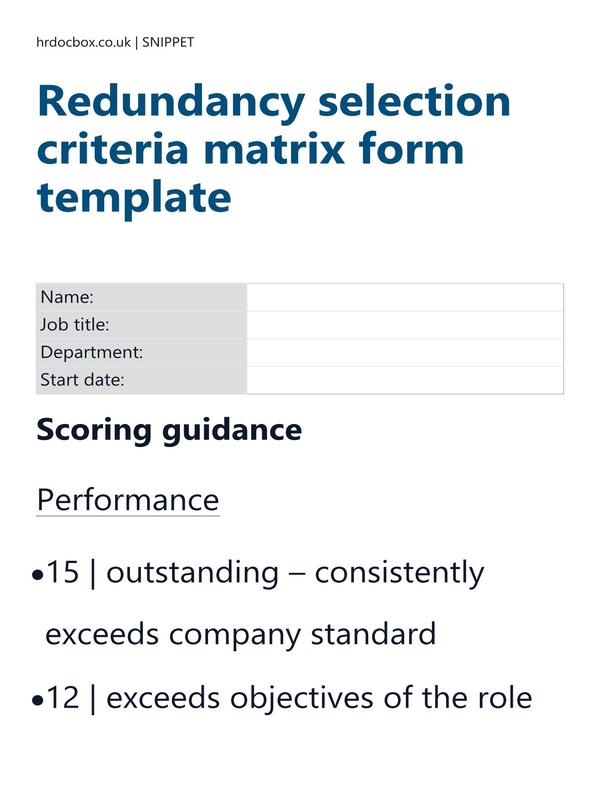
View full libraryA redundancy selection criteria matrix provides a structured and consistent way to assess employees against objective criteria when an employer needs to select roles for redundancy. Using clearly defined criteria and a scoring system can help employers make decisions based on relevant evidence rather than subjective judgements or informal opinions.
Use this template to:
<p>If you are managing a redundancy process, the toolkit brings together practical HR templates covering planning, consultation, selection, scoring, outcomes and termination.</p>
This matrix should be completed consistently for all employees within the agreed redundancy selection pool. Scores should be based on objective evidence and the agreed scoring criteria, rather than personal opinion or a predetermined outcome.
| Employee name: | |
| Job title: | |
| Department: | |
| Selection pool: | |
| Manager: | |
| Date assessment completed: |
Selection criteria
Performance
Skills, competence and experience
You've seen 20% of how the Redundancy selection criteria matrix form template is structured. Get the complete editable template instantly and customise it for your organisation.

A redundancy selection criteria matrix is a structured document used to assess employees within a redundancy selection pool against agreed criteria. Rather than relying on subjective judgement or making a decision based on a single factor, the matrix provides a consistent framework for comparing employees against the same criteria and recording the evidence behind the scores.
The criteria might include factors such as performance, skills and qualifications, attendance and disciplinary record, depending on the circumstances of the redundancy exercise. Criteria should be objective and measurable wherever possible, and the same scoring approach should normally be applied consistently to everyone within the relevant selection pool. Particular care is needed to ensure that criteria do not directly or indirectly discriminate or take account of protected absences or other legally protected circumstances.
A well-designed redundancy selection matrix can help HR and managers structure the selection process, explain how scores have been reached and retain a clear record of the decision-making process. It should, however, be treated as one part of the wider redundancy process rather than as a substitute for genuine consultation. Employees should have an opportunity to understand and challenge the proposed approach and raise relevant information before final decisions are made.
Using a structured matrix can help reduce the risk of inconsistent or subjective decision-making. It also provides managers and HR with a practical record of how employees were assessed and can make the selection process easier to explain during consultation.
The matrix should not be used simply to produce a ranking and automatically dismiss the employees with the lowest scores. The results should be reviewed carefully, supported by evidence and considered alongside consultation, individual circumstances and the wider redundancy process.
Related HR resources and workflow
Explore the HR resources that may be relevant before and / or after using the Redundancy selection criteria matrix form, helping you understand the wider process, maintain appropriate documentation and follow a consistent approach.

Our Redundancy Questionnaire Form template gathers essential information from employees, ensuring thorough understanding and compliance.

Use this first individual redundancy consultation meeting invitation letter to formally invite an employee to discuss a proposed redundancy situation affecting their role.
Use these best practice actions, recommended timescales and process stages to understand when and how the Redundancy selection criteria matrix form should be used, helping ensure each step is handled consistently and appropriately documented.
Understand the common mistakes to avoid when using this HR template, helping you reduce risk, prevent unnecessary costs and ensure the process is handled correctly.
No. UK employment law does not require employers to use a particular scoring matrix, but ACAS recommends fair, objective and measurable selection criteria. A properly documented matrix can help demonstrate that employees were assessed consistently and that decisions were based on evidence rather than personal opinion.
ACAS recommends that criteria are as objective and measurable as possible, based on facts and applied consistently to everyone in the selection pool. It also recommends written evidence against each criterion and consideration of discrimination risks when deciding how employees are scored.
Yes, but it needs careful handling. ACAS specifically states that attendance records must be accurate and should not include absences relating to disability, pregnancy or maternity. Other legally protected circumstances should also be considered before scoring.
Yes. Good redundancy practice requires genuine and meaningful consultation. If an employee identifies an error or provides relevant information about their score, the employer should consider it before finalising the selection decision.
HRDocBox templates are backed by deep HR knowledge, practical application and years of experience dealing with real workplace situations. This matrix brings together the structure, evidence and consistency expected from good redundancy practice, informed by ACAS guidance and UK employment law.
AI can produce a scoring table, but a useful HR document needs to reflect more than its layout. HRDocBox combines years of practical HR experience with employment-law knowledge and established best practice, helping you consider the issues that sit behind the document as well as the document itself.
How this content is developed and reviewed
The Redundancy selection criteria matrix form template is developed using a practical HR methodology that considers current UK employment legislation, ACAS guidance, CIPD good practice and the real-world HR process it supports. Templates and supporting information are regularly reviewed and updated, with additional reviews triggered by significant changes to legislation, guidance or established HR practice, helping ensure each document remains practical, relevant and suitable for UK employers.
Darryl Horn, Chartered HR Director
Darryl is a Chartered HR professional with over 25 years' experience in senior HR and employee relations roles.
He has extensive practical experience of managing redundancy HR processes and founded hrdocbox to provide businesses with practical, professionally developed HR resources grounded in UK employment law and best practice.
HRDocBox has been creating practical UK HR documents since 2009.
"Darryl provides support and advice with excellent judgement, and has a strong understanding of people, policies and UK employment legislation."
"He is someone I trust; consistent, dependable, and committed to doing things properly."




















Whether you employ 5 people or 50, hrdocbox gives you the structure, documents and expertise needed to manage employees professionally and legally.
Professionally written and fully compliant with UK employment law

Access a free contract template instantly - or save 10% on any document today.
Use this code at checkout for 10% off anything!
Includes instant download, updates, and full access to your HR templates.