Libraries
780+ HR templates
Everything your business needs to stay compliant
Policies, contracts, letters, guidance and HR support tools for UK employers.
View full libraryPolicies, contracts, letters, guidance and HR support tools for UK employers.
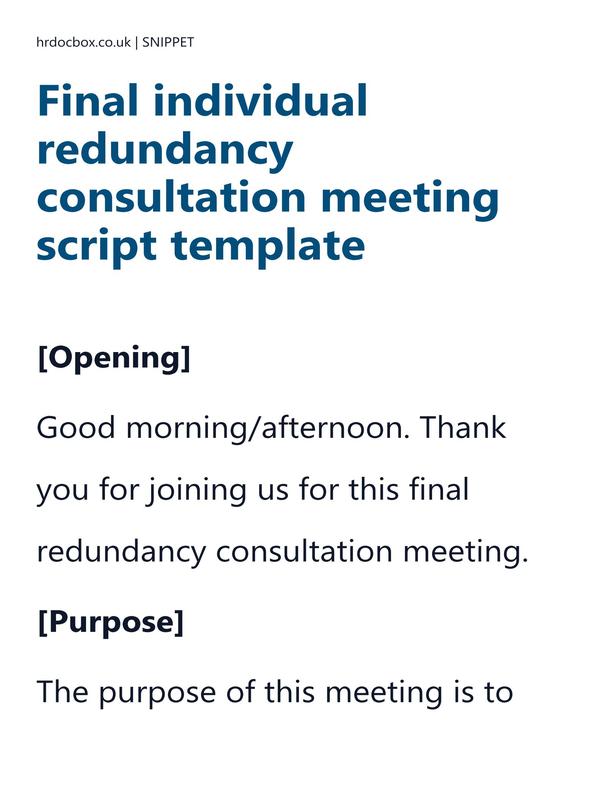
View full libraryThis Final Individual Redundancy Consultation Meeting Script provides a structured framework for the final stage of an individual redundancy consultation process. It helps managers conduct a genuine and meaningful discussion, consider the employee’s representations and alternatives, and ensure that no final redundancy decision is presented as predetermined.
Use this template to:
<p>If you are managing a redundancy process, the toolkit brings together practical HR templates covering planning, consultation, selection, scoring, outcomes and termination.</p>
This template brings together the key information, sections and considerations you need to create a clear, comprehensive and professional HR document. Preview the document below.
Meeting details
| Employee: | [Employee Name] |
| Job title: | [Job Title] |
| Department: | [Department] |
| Date: | [Date] |
| Time: | [Time] |
| Location / method: | [Location / Video Call / Other] |
| Manager / meeting lead: | [Name] |
| HR representative: | [Name / Not Applicable] |
| Employee companion: | [Name / Not Applicable] |
1. Opening the meeting
Thank you for attending this meeting.
We have reached what we expect to be the final stage of the individual consultation process concerning the proposal that your role may be made redundant.
I want to make clear that no final decision has been made at this stage. The purpose of today's meeting is to give you a further opportunity to raise any concerns, provide any additional information, challenge anything you believe is incorrect and put forward any further suggestions or alternatives that you would like us to consider before a final decision is reached.
We will listen carefully to what you have to say and will consider the points you raise before deciding how to proceed.
2.
You've seen 20% of how the Final individual redundancy consultation meeting script template is structured. Get the complete editable template instantly and customise it for your organisation.

This document provides a practical framework for conducting the final individual consultation meeting where an employee remains at risk of redundancy. The purpose is to give the employee a meaningful final opportunity to comment on the proposal, raise concerns, challenge information, suggest alternatives and provide any further relevant information before the employer reaches its final decision.
The meeting provides an opportunity to revisit why redundancy is being proposed, what has changed during the consultation process and whether the underlying business rationale remains valid. The manager should be prepared to explain the proposal clearly and answer reasonable questions.
The employee should have a genuine opportunity to raise any remaining concerns, challenge information or explain anything they believe should be taken into account before a decision is made. Any new information should be considered rather than dismissed simply because the consultation is at its final stage.
The discussion should consider whether redundancy can be avoided or reduced, including changes to working arrangements, alternative roles, vacancies, voluntary redundancy arrangements or other practical proposals that may be relevant to the circumstances.
Where appropriate, the employer should consider whether there are suitable alternative vacancies elsewhere in the organisation. Any potential role should be assessed in the context of the employee's circumstances, the requirements of the role and the applicable redundancy rules.
The meeting should make clear that the employer will consider everything raised before reaching its final decision. The meeting should not give the impression that the outcome has already been decided. Where a redundancy decision is subsequently made, it should be communicated separately and in writing, including the relevant notice, redundancy pay and appeal arrangements.
Related HR resources and workflow
Explore the HR resources that may be relevant before and / or after using the Final individual redundancy consultation meeting script, helping you understand the wider process, maintain appropriate documentation and follow a consistent approach.

This Final Individual Redundancy Consultation Meeting Invitation Letter invites an employee to the final stage of an individual redundancy consultation process.
This Redundancy Confirmation Letter provides formal written confirmation that an employee's employment will end by reason of redundancy following completion of the redundancy consultation and selection process.
Use these best practice actions, recommended timescales and process stages to understand when and how the Final individual redundancy consultation meeting script should be used, helping ensure each step is handled consistently and appropriately documented.
Understand the common mistakes to avoid when using this HR template, helping you reduce risk, prevent unnecessary costs and ensure the process is handled correctly.
Not necessarily. The purpose of a final consultation meeting is to give the employee a genuine final opportunity to make representations before the employer reaches its decision. If redundancy is subsequently confirmed, the decision should be communicated separately and in writing.
The meeting should cover any outstanding concerns, the employee's representations, proposed alternatives, potential suitable alternative employment, the selection process where relevant and anything new that the employee wants the employer to consider before a final decision.
Yes. Employees should be given the opportunity to suggest ways in which their redundancy could be avoided or reduced. The employer does not have to accept a proposal, but should genuinely consider it.
It is generally safer to avoid treating the outcome as predetermined. The employee should have a genuine opportunity to make representations, and the employer should consider those representations before reaching and communicating the final decision.
Not every vacancy will be suitable or available as an alternative to redundancy. However, employers should consider whether suitable alternative employment exists where appropriate and follow any specific legal requirements that apply to the circumstances.
HRDocBox templates are designed specifically for UK employers and structured around practical HR processes, employment law and recognised guidance. They provide a ready-to-use framework for a sensitive HR process while allowing employers to adapt the document to their own circumstances.
How this content is developed and reviewed
The Final individual redundancy consultation meeting script template is developed using a practical HR methodology that considers current UK employment legislation, ACAS guidance, CIPD good practice and the real-world HR process it supports. Templates and supporting information are regularly reviewed and updated, with additional reviews triggered by significant changes to legislation, guidance or established HR practice, helping ensure each document remains practical, relevant and suitable for UK employers.
Darryl Horn, Chartered HR Director
Darryl is a Chartered HR professional with over 25 years' experience in senior HR and employee relations roles.
He has extensive practical experience of managing redundancy HR processes and founded hrdocbox to provide businesses with practical, professionally developed HR resources grounded in UK employment law and best practice.
HRDocBox has been creating practical UK HR documents since 2009.
"Darryl provides support and advice with excellent judgement, and has a strong understanding of people, policies and UK employment legislation."
"He is someone I trust; consistent, dependable, and committed to doing things properly."



















Whether you employ 5 people or 50, hrdocbox gives you the structure, documents and expertise needed to manage employees professionally and legally.
Professionally written and fully compliant with UK employment law
Access a free contract template instantly - or save 10% on any document today.
Use this code at checkout for 10% off anything!
Includes instant download, updates, and full access to your HR templates.