Offer of suitable alternative employment letter template

Preview , or scroll for more content and supporting information
£12.99
UK-specific Editable Instant download 12 months' updates

Use this Offer of Suitable Alternative Employment Letter to formally offer an alternative role to an employee whose current position is at risk of redundancy. It helps UK employers set out the new role, proposed terms and conditions, start date and statutory trial period, while supporting a fair and documented redundancy process.

Use this template to:

  • Make a written offer of suitable alternative employment to an employee at risk of redundancy.
  • Explain the main differences between the employee's current role and the proposed position.
  • Set out the proposed salary, hours, location, reporting line and other employment terms.
  • Confirm the proposed start date and explain the applicable trial period.
  • Give the employee a clear opportunity to consider the offer and raise questions.
  • Record the employee's response and identify when HR should review the outcome.
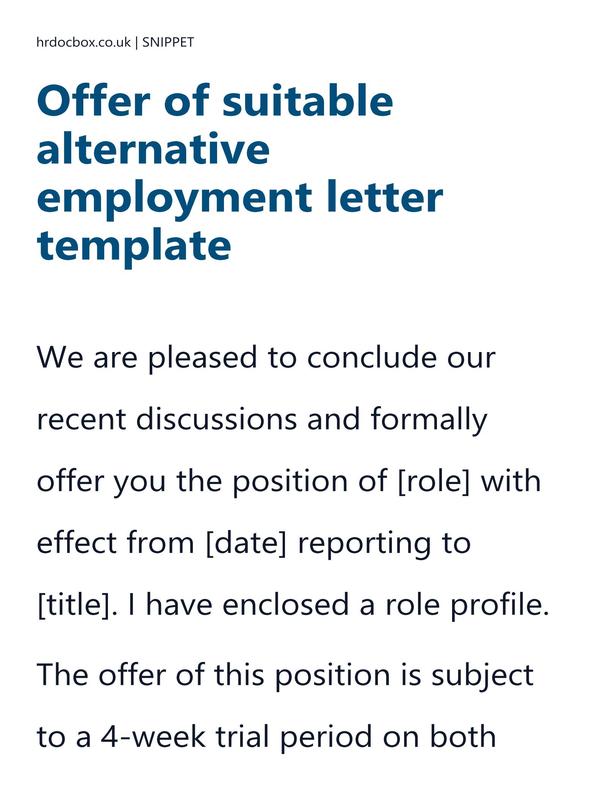
Offer of suitable alternative employment letter template
2026 Reviewed
Get the complete resource

Don't just buy one template — get the complete Redundancy process toolkit

If you are managing a redundancy process, the toolkit brings together practical HR templates covering planning, consultation, selection, scoring, outcomes and termination.

36 templates • £29.99 • 12 months' access & updates
View the process toolkit

What's included in this template?

This template brings together the key information, sections and considerations you need to create a clear, comprehensive and professional HR document. Preview the document below.

  • Reference to the redundancy process and the employee's current role.
  • Details of the alternative job, duties, reporting line and location.
  • A comparison of the current and proposed employment terms.
  • Salary, hours, benefits, holiday and proposed start date.
  • Information about the statutory four-week trial period and any agreed extension.
  • Instructions for accepting the offer or raising questions and concerns.
  • Confirmation of next steps and a record of the employee's response.
Template

Download .doc

Copy [to paste]

Email

[Sender name]

[Sender address]

[date]

[Recipient name]

[Recipient address]


Dear [Recipient first name],

Offer of Suitable Alternative Employment - [Proposed Job Title]

Private and Confidential

Further to our recent discussions regarding the proposed redundancy of your current role as [Current Job Title], we are pleased to offer you suitable alternative employment with [Company Name] in the position of [Proposed Job Title].

This offer is being made as part of our redundancy process and is intended to provide you with an opportunity to remain employed by the company in an alternative role.

Details of the proposed role

Job title [Proposed Job Title]
Department [Department]
Reporting to [Manager / Job Title]
Proposed start date [Date]
Work location [Location]
Working hours [Days and Hours]
Salary [Salary and Payment Frequency]
Holiday entitlement [Entitlement and Relevant

PREVIEW ENDS HERE

This is the end of the preview

You've seen 20% of how the Offer of suitable alternative employment letter template is structured. Get the complete editable template instantly and customise it for your organisation.
£12.99
Specifications
Access 12 months, with updates
Length 2 pages • 696 words
Jurisdiction England, Wales, Scotland
Based on UK law, ACAS guidance
Last update 14/10/2026
Update reason Enhanced template wording and description.
Next review 14/04/2027
Delivery & Format Instant digital delivery, .doc · .txt · email

What is an offer of suitable alternative employment letter?

Offer of suitable alternative employment letter template preview

When an employee's role is at risk of redundancy, an employer should actively consider whether suitable alternative employment is available. A written offer helps the employee understand the proposed role and decide whether it is appropriate for their skills, circumstances and employment needs. It also provides a clear record of the employer's proposal and the terms being offered.

This resource is intended for HR professionals, business owners and line managers managing redundancy situations. It should be used alongside the organisation's redundancy policy, consultation records, employment contracts and any applicable family-leave protections.

Assessing whether the alternative role is suitable

Suitability is assessed in the circumstances of the individual employee. Relevant factors include the duties, status, pay and benefits, working hours, location, contractual terms, skills and abilities required, and the employee's personal circumstances. A role should not be described as suitable solely because a vacancy exists or because the employee could perform some of its duties.

The offer should explain how the proposed role differs from the employee's existing position. Where there are material changes to responsibilities, hours, pay, location or benefits, these should be stated clearly so the employee can make an informed decision.

Making the offer and explaining the trial period

The offer should be made in writing before the employee's current contract ends. The proposed role must meet the relevant statutory timing requirements, including that it starts within four weeks of the existing role ending. The employer should clearly identify the proposed start date and the terms that will apply.

Where the statutory trial-period rules apply, the employee is generally entitled to a four-week trial period in the alternative role. A longer period can be agreed where additional training is required, but the extension must be agreed in writing and have a clear end date. HR should confirm the trial-period dates and explain what happens if either party concludes that the role is unsuitable.

Priority rights and fair treatment

Some employees have additional statutory protection during redundancy, including eligible employees who are pregnant or taking, or returning from, specified family leave. Where the legal priority rules apply, a suitable alternative vacancy must be offered to the protected employee in priority to other employees, even if another employee may appear better suited. The precise protection depends on the employee's circumstances and the applicable rules.

HR should check whether any priority protection applies before allocating a vacancy. The employer should not require a protected employee to compete or apply for a suitable alternative vacancy where the law requires it to be offered to them.

Recording the employee's decision

Give the employee a reasonable opportunity to consider the offer, ask questions and discuss any concerns. Record their response, any agreed changes and the final terms. If the employee declines the offer or the trial period is unsuccessful, HR should assess the reasons and explain the next steps, including any implications for the redundancy process and redundancy pay.

Do not assume that refusal automatically removes the employee's right to redundancy pay. Whether a refusal is unreasonable depends on the facts and the suitability of the role. Obtain HR or legal advice before making a decision about entitlement.

Best in class example

An employer is restructuring its customer service team and confirms that an employee's existing role is at risk of redundancy. During the process, HR identifies a suitable vacancy in a related team and assesses the duties, pay, hours, location and required skills against the employee's current position.

HR checks whether any priority protection applies, discusses the proposed role with the employee and confirms the main differences. The employer then issues a written offer before the current contract ends, setting out the new job title, reporting line, salary, hours, location, proposed start date and relevant contractual terms.

The letter explains the statutory trial period and invites the employee to raise questions before responding. HR confirms the dates in writing and records whether the employee accepts. If additional training is needed and both parties agree a longer trial period, the extension and its end date are documented before the trial begins.

If the employee accepts and the role proves suitable, the employer confirms the ongoing arrangements. If the employee declines or the trial is unsuccessful, HR reviews the reasons, the suitability assessment and the applicable redundancy rules before confirming the next steps and any redundancy pay position.

The wider HR process

Related HR resources and workflow

Explore the HR resources that may be relevant before and / or after using the Offer of suitable alternative employment letter, helping you understand the wider process, maintain appropriate documentation and follow a consistent approach.

Previous
Letters
Redundancy confirmation letter

This Redundancy Confirmation Letter provides formal written confirmation that an employee's employment will end by reason of redundancy following completion of the redundancy consultation and selection process.

This
Offer of suitable alternative employment letter
Next
Letters
Successful alternative employment trial period confirmation letter

A Successful Alternative Employment Trial Period Confirmation Letter is used to confirm that an employee has successfully completed a trial period in an alternative role and that the Company has agreed that they will continue in the position.

Premium content

To continue reading, purchase this item or a parent toolkit, library or our full library.

Implementation guidance

Use these best practice actions, recommended timescales and process stages to understand when and how the Offer of suitable alternative employment letter should be used, helping ensure each step is handled consistently and appropriately documented.

Step Description Responsibility Timing (Days from Issue)
1 Review the redundancy consultation records, identify available vacancies and assess whether the proposed role is suitable in light of the employee's duties, skills, pay, benefits, hours, location and circumstances. HR with the Hiring Manager Before issuing the offer
2 Check whether the employee has priority protection under the pregnancy and family-leave redundancy rules. Confirm the offer meets the required timing and contractual requirements. HR Before allocating the vacancy and issuing the offer
3 Prepare the written offer, clearly explaining the role, differences from current employment, terms, start date and applicable trial period. Obtain approval before issue. HR with the Authorised Manager Before the current contract ends, allowing reasonable time for consideration
4 Discuss the offer with the employee, answer questions, record acceptance or refusal and agree the trial-period dates. Put any agreed extension and its end date in writing before the trial begins. HR and Line Manager By the response date agreed with the employee; before the trial period starts
5 Monitor the trial period, document feedback and confirm the outcome. If the offer is refused or the trial is unsuccessful, review suitability, the reasons given and any redundancy pay implications before communicating the decision. Line Manager with HR Throughout the trial period and promptly after the outcome is known
Premium content

To continue reading, purchase this item or a parent toolkit, library or our full library.

Common mistakes

Understand the common mistakes to avoid when using this HR template, helping you reduce risk, prevent unnecessary costs and ensure the process is handled correctly.

  • Offering a vacancy without properly assessing whether it is suitable for the individual employee.
  • Failing to check whether the employee has priority protection because of pregnancy or family leave.
  • Leaving out key information about pay, hours, location, duties, benefits or changes to contractual terms.
  • Issuing the offer too late or setting a start date that does not meet the applicable statutory timing requirements.
  • Failing to explain or document the trial period, including a written agreement and clear end date for any extension.
  • Assuming that refusal automatically removes redundancy pay entitlement without assessing suitability and the employee's reasons.
Premium content

To continue reading, purchase this item or a parent toolkit, library or our full library.

HR considerations

UK employment law and best practice

This template is designed to support the process, but the document should be used alongside the relevant HR procedure and applied to the circumstances of the individual case.

This template supports a redundancy process in which an employer is offering alternative employment. It should not be used as a substitute for consultation, a suitable-vacancy assessment or an individual review of contractual and statutory rights.

Duty to consider suitable alternative employment

Employers should actively look for suitable alternative employment for employees at risk of redundancy. Where a suitable vacancy exists, it should be offered rather than requiring the employee to apply for it. Failure to offer suitable alternative employment where required may contribute to an unfair dismissal claim.

The offer should be in writing, made before the existing contract ends and explain how the new role differs from the current role. The alternative role must start within four weeks of the existing role ending to meet the relevant statutory requirement. Check the proposed dates and terms before issuing the letter.

ACAS guidance: https://www.acas.org.uk/manage-staff-redundancies/offer-alternative-employment

GOV.UK guidance: https://www.gov.uk/staff-redundant/avoiding-redundancies

Assessing suitability

Whether a role is suitable depends on the circumstances, including the nature of the work, the employee's skills and abilities, pay and benefits, status, hours, location and other terms and conditions. The employer should explain material differences from the existing role and give the employee a genuine opportunity to consider them.

Where the proposed terms differ from the existing contract, do not assume that the role is suitable simply because the employee could perform it. Record the assessment and involve HR where the position is uncertain.

ACAS guidance: https://www.acas.org.uk/manage-staff-redundancies/offer-alternative-employment

Statutory trial period

An employee who accepts an offer of alternative employment in circumstances covered by the statutory rules is generally entitled to a four-week trial period. The period normally begins after the employee's notice period has been worked and the previous contract has ended. If additional training is required, a longer period may be agreed in writing, with a clear end date.

Where an employee concludes that the role is unsuitable during the trial period, they should tell the employer within the applicable period. HR should record the concern and assess the consequences. The statutory rules may affect redundancy pay entitlement, so managers should not make assumptions about the outcome.

ACAS guidance: https://www.acas.org.uk/manage-staff-redundancies/offer-alternative-employment

Priority protection during pregnancy and family leave

Eligible employees who are pregnant or taking, or returning from, specified family leave may have priority rights to suitable alternative vacancies during redundancy. These protections can require the employer to offer a suitable vacancy to the protected employee ahead of other employees, without requiring them to compete for it. The duration and scope of the protection depend on the type of leave and the employee's circumstances.

Before allocating a vacancy, HR should identify whether any protected employees are eligible, check the applicable priority rules and record the decision. Failing to comply can expose the employer to claims, including automatic unfair dismissal and discrimination in relevant circumstances.

ACAS guidance: https://www.acas.org.uk/redundancy-protection-for-pregnancy-and-new-parents

GOV.UK guidance: https://www.gov.uk/redundancy-your-rights/suitable-alternative-employment

Refusal and redundancy pay

An employee may decline an alternative role if they do not consider it suitable. An employee who unreasonably refuses suitable alternative employment may lose entitlement to statutory redundancy pay, but the employer must be able to justify its position based on the facts. A reasonable refusal may preserve entitlement. Relevant circumstances can include changes in pay, duties, hours, location, travel and personal circumstances.

Do not state that redundancy pay will automatically be withheld if the employee refuses. Consider the employee's reasons, the suitability assessment and the relevant legal requirements, and obtain HR or legal advice before deciding entitlement.

ACAS guidance: https://www.acas.org.uk/your-rights-during-redundancy/taking-another-job-with-your-employer

Contractual terms and records

Check the employee's contract, any collective agreement, company policies and the proposed terms before issuing the offer. Clearly distinguish terms that will remain unchanged from those that will change. Do not treat a letter as having varied contractual terms until the applicable agreement and acceptance requirements have been addressed.

Keep the vacancy assessment, consultation records, offer letter, employee response, agreed trial-period dates and any trial outcome in accordance with the organisation's data protection and retention arrangements. Limit access to those who need the information.

You may also need these resources

FAQs

Does an employee have to apply for suitable alternative employment?

Where a suitable alternative vacancy must be offered, the employer should offer it directly rather than require the employee to apply. If several employees are interested, HR must check whether any priority protection applies and otherwise follow an appropriate fair process.

What makes an alternative role suitable?

Suitability depends on the employee's circumstances and the role's duties, status, pay and benefits, hours, location, contractual terms, skills and abilities required. Explain the differences from the existing role and record the assessment. A vacancy is not automatically suitable simply because it is available.

How long is the statutory trial period?

The statutory trial period is generally four weeks, normally starting after the employee's notice period has been worked and the previous contract has ended. A longer period may be agreed where additional training is needed, but the extension must be agreed in writing and have a clear end date.

Will an employee lose redundancy pay if they refuse the offer?

Not automatically. An employee who unreasonably refuses an offer of suitable alternative employment may lose statutory redundancy pay entitlement, but a reasonable refusal may preserve it. The employer must consider the suitability of the role and the employee's reasons. Obtain HR or legal advice before deciding the outcome.

Why use HRDocBox?

HRDocBox provides practical, customisable HR resources designed to help UK employers manage recruitment, redundancy and employee relations consistently. This template gives you a structured starting point for documenting the offer and the trial period, while prompting the checks needed before the letter is issued.

Why use HRDocBox rather than asking AI?

HRDocBox provides a ready-to-adapt format with the key information and process reminders in one place. AI can help tailor the wording, but it cannot establish whether a particular role is suitable, whether priority protection applies or whether the offer meets the employee's contractual rights without the relevant facts being checked. Always verify the legal position and the employee's circumstances.

How this content is developed and reviewed

The Offer of suitable alternative employment letter template is developed using a practical HR methodology that considers current UK employment legislation, ACAS guidance, CIPD good practice and the real-world HR process it supports. Templates and supporting information are regularly reviewed and updated, with additional reviews triggered by significant changes to legislation, guidance or established HR practice, helping ensure each document remains practical, relevant and suitable for UK employers.

About the author

Darryl Horn, Chartered HR Director

Darryl is a Chartered HR professional with over 25 years' experience in senior HR and employee relations roles.

He has extensive practical experience of managing redundancy HR processes and founded hrdocbox to provide businesses with practical, professionally developed HR resources grounded in UK employment law and best practice.

HRDocBox has been creating practical UK HR documents since 2009.

Executive recommendation

"Darryl provides support and advice with excellent judgement, and has a strong understanding of people, policies and UK employment legislation."

"He is someone I trust; consistent, dependable, and committed to doing things properly."

RB
Ruth Brock Chief Executive Officer The Hygiene Bank
Get started today

HR confidence starts here

Whether you employ 5 people or 50, hrdocbox gives you the structure, documents and expertise needed to manage employees professionally and legally.

Download your FREE UK employment contract template

Professionally written and fully compliant with UK employment law

Download FREE contract
Free UK employment contract template