First individual redundancy consultation meeting invitation letter template

£12.99

Use this first individual redundancy consultation meeting invitation letter to formally invite an employee to discuss a proposed redundancy situation affecting their role. It helps employers explain the reason for the proposal, prepare the employee for meaningful consultation and establish a fair, open process before any final decision is made.

Use this template to:
  • Invite an employee to their first individual redundancy consultation meeting.
  • Explain why their role is at risk and the business reasons behind the proposal.
  • Set out the purpose of the meeting and the opportunity to ask questions.
  • Encourage the employee to suggest alternatives to redundancy.
  • Explain the arrangements for the meeting and how to raise any accessibility or support requirements.
  • Demonstrate that the employer is beginning a genuine consultation process rather than communicating a final decision.
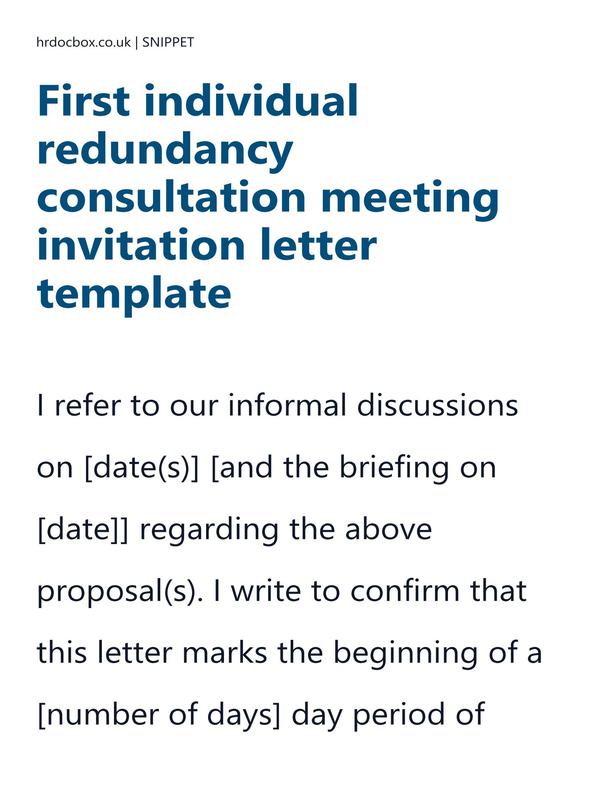
First individual redundancy consultation meeting invitation letter template preview
UK Specific
Instant Download
12 Months' Updates
Fully Editable
2026 Reviewed
Get the complete resource

Don't just buy one template — get the complete Redundancy process toolkit

<p>If you are managing a redundancy process, the toolkit brings together practical HR templates covering planning, consultation, selection, scoring, outcomes and termination.</p>

36 templates • £29.99 • 12 months' access & updates
View the process toolkit

What's included in this template?

This template brings together the key information, sections and considerations you need to create a clear, comprehensive and professional HR document. Preview the document below.

  • Formal invitation to the first individual redundancy consultation meeting.
  • Explanation of the proposed redundancy and the business rationale.
  • Confirmation that the employee's role is at risk and no final decision has been made.
  • Meeting details, including date, time, location or joining arrangements.
  • Guidance on discussing alternatives, suitable vacancies and employee suggestions.
  • Information about raising questions, requesting adjustments and preparing for the meeting.
Template

Download .doc

Copy [to paste]

Email

[Sender name]

[Sender address]

[date]

[Recipient name]

[Recipient address]


Dear [Recipient first name],

Invitation to First Individual Redundancy Consultation Meeting

I am writing to invite you to a first individual consultation meeting to discuss proposed organisational changes that may affect your role as [Job Title].

The business is currently reviewing [explain the business reason, such as a reduction in demand, a proposed restructuring, changes to working methods or the removal of a particular function]. As part of these proposals, your role has been identified as being at risk of redundancy.

I want to emphasise that no final decision has been made about your role or employment. The purpose of consultation is to

PREVIEW ENDS HERE

This is the end of the preview

You've seen 20% of how the First individual redundancy consultation meeting invitation letter template is structured. Get the complete editable template instantly and customise it for your organisation.

£12.99
Specifications
Access 12 months, with updates
Length 2 pages • 463 words
Jurisdiction England, Wales, Scotland
Based on UK law, ACAS guidance
Last update 10/10/2026
Update reason Enhanced legal support section.
Next review 10/04/2027
Delivery & Format Instant digital delivery, .doc · .txt · email

What is a first individual redundancy consultation meeting invitation letter?

First individual redundancy consultation meeting invitation letter template

Beginning an individual redundancy consultation process requires clear communication, sensitivity and a genuine willingness to consider alternatives. This letter provides a structured way for employers to invite an employee to their first consultation meeting after identifying that their role may be affected by a proposed redundancy.

Explaining the proposed redundancy

The invitation should explain, in understandable terms, why redundancies are being considered. This might involve a reduction in demand, organisational restructuring, changes to working methods or the removal of a particular role. The explanation should be accurate and specific enough to help the employee understand the proposal.

Making clear that the decision is not final

Being placed at risk of redundancy does not mean that dismissal has been decided. The letter should explicitly confirm that the employer has not reached a final decision and that the employee's views, questions and suggestions will be considered before any outcome is determined.

Preparing for meaningful consultation

The first meeting should provide an opportunity to explain the proposal, listen to the employee's concerns and explore possible alternatives. These may include suitable alternative employment, changes to working arrangements, redeployment, reduced costs or other practical ways of avoiding redundancy. The employer should be prepared to consider suggestions genuinely rather than treating consultation as a formality.

Providing clear meeting arrangements

The invitation should state the meeting date, time, location or online joining arrangements, and who will attend. Giving reasonable notice helps the employee prepare. The employer should also consider any reasonable adjustments needed to enable the employee to participate effectively.

Supporting a fair and documented process

Following the meeting, the employer should keep an accurate record of the discussion, questions raised, information requested and alternatives proposed. Consultation may require further meetings and consideration of additional information. The process should remain open until the employer has properly considered the employee's representations and any relevant alternatives.

Best in class example

A manufacturing business is reviewing its operating structure following a sustained reduction in orders. Management proposes to remove one administrative role as part of a wider restructuring. Before reaching a decision, the business identifies the employee whose role may be affected and confirms that individual consultation must begin.

The employee is informed that their role is at risk of redundancy and receives an invitation to a first individual consultation meeting. The letter explains the business rationale, confirms that no final decision has been made and provides the meeting details. It also encourages the employee to consider any questions or suggestions they would like to raise.

At the meeting, the employee explains that some of their duties could be redistributed and that a vacancy in another department may be suitable. The employer records these points and agrees to investigate the vacancy, review the proposed allocation of duties and provide further information at a subsequent meeting.

Following the meeting, the employer investigates the alternatives and arranges a follow-up discussion. The invitation has helped establish an open process in which the employee understands the proposal, can contribute ideas and has a genuine opportunity to influence the outcome before a decision is made.

The wider HR process

Related HR resources and workflow

Explore the HR resources that may be relevant before and / or after using the First individual redundancy consultation meeting invitation letter, helping you understand the wider process, maintain appropriate documentation and follow a consistent approach.

Previous
Forms
Redundancy selection criteria matrix form

A redundancy selection criteria matrix provides a structured and consistent way to assess employees against objective criteria when an employer needs to select roles for redundancy.

This
First individual redundancy consultation meeting invitation letter
Next
Scripts
First individual redundancy consultation meeting script

Our First Redundancy Consultation Meeting Script Template enables structured discussions, addressing employee concerns professionally at the start of the process.

Premium content

To continue reading, purchase this item or a parent toolkit, library or our full library.

Implementation guidance

Use these best practice actions, recommended timescales and process stages to understand when and how the First individual redundancy consultation meeting invitation letter should be used, helping ensure each step is handled consistently and appropriately documented.

Step Description Responsibility Timing
1 Review the proposal. Confirm the business rationale, the role or roles affected, the proposed changes and whether collective consultation obligations may apply. Check relevant policies, contracts and any collective agreements. Senior manager and HR Before notifying the employee that their role is at risk
2 Prepare the invitation. Explain the proposal accurately, confirm that no final decision has been made, identify the meeting attendees and prepare any relevant information to share. HR or responsible manager Within 2 working days of confirming the consultation arrangements
3 Send the invitation. Provide the employee with reasonable notice, clear joining arrangements and an opportunity to request adjustments or raise any practical concerns about attending. HR or line manager Aim for at least 5 working days before the meeting, where practicable
4 Hold the first consultation meeting. Explain the proposal, listen to the employee's views, answer questions where possible and explore ways of avoiding or reducing redundancy, including suitable alternative employment. Consultation manager, supported by HR On the scheduled date, allowing sufficient time for discussion
5 Record and follow up. Document the discussion, investigate suggestions, respond to outstanding questions and arrange further consultation where needed. Do not reach a final decision until consultation has been meaningful and relevant alternatives have been considered. HR and responsible manager Send any agreed follow-up information within 5 working days where practicable; continue consultation as necessary
Premium content

To continue reading, purchase this item or a parent toolkit, library or our full library.

Common mistakes

Understand the common mistakes to avoid when using this HR template, helping you reduce risk, prevent unnecessary costs and ensure the process is handled correctly.

  • Suggesting the outcome is already decided. Avoid wording that implies the employee will definitely be dismissed before consultation has concluded.
  • Giving an unclear business reason. Explain the actual proposal and why the change is being considered, rather than relying on vague references to cost savings or restructuring.
  • Treating the meeting as a formality. The employer must be willing to consider the employee's views and alternatives genuinely.
  • Failing to prepare. The manager should understand the proposal, the available information and which questions can be answered at the first meeting.
  • Ignoring alternatives. Consider practical ways to avoid or reduce redundancies and whether suitable alternative vacancies may be available.
  • Overlooking collective consultation. Individual meetings do not replace statutory collective consultation where the relevant thresholds are met.
Premium content

To continue reading, purchase this item or a parent toolkit, library or our full library.

HR considerations

UK employment law and best practice

This template is designed to support the process, but the document should be used alongside the relevant HR procedure and applied to the circumstances of the individual case.

Genuine and meaningful consultation

Employers should consult employees before making a final redundancy decision. Consultation should explain the proposed changes and the reasons for them, provide an opportunity to raise concerns and explore ways of avoiding or reducing redundancies. Suggestions should be considered seriously, even where they are not ultimately accepted.

ACAS guidance: https://www.acas.org.uk/manage-staff-redundancies/redundancy-consultations

Individual consultation

Where fewer than 20 redundancies are proposed, employers should consult individually with affected employees as part of a fair process. There is no fixed statutory duration for individual consultation, but it must be meaningful and take place before a final decision is made. Employment contracts, workplace policies or collective agreements may impose additional requirements.

GOV.UK guidance: https://www.gov.uk/redundancy-your-rights/consultation

Collective consultation obligations

Where an employer proposes to make 20 or more redundancies at one establishment within a 90-day period, statutory collective consultation requirements apply. Individual consultation should also take place as appropriate. Collective consultation has specific requirements concerning employee representatives, information and minimum consultation periods. Employers should obtain appropriate advice where the threshold may be reached.

GOV.UK guidance: https://www.gov.uk/staff-redundant/redundancy-consultations

Considering alternatives to redundancy

Consultation should explore whether redundancies can be avoided or reduced. Employers should consider employee suggestions and investigate relevant alternatives, including changes to working arrangements, redeployment and suitable alternative vacancies. Where a suitable alternative vacancy exists, specific legal obligations may apply, including priority protection for certain employees on maternity, adoption or shared parental leave.

ACAS guidance: https://www.acas.org.uk/your-rights-during-redundancy/taking-another-job-with-your-employer

Fair treatment and discrimination

Redundancy proposals and decisions must not discriminate unlawfully. Employers should check that the rationale, any selection arrangements and the consultation process do not disadvantage employees because of protected characteristics or other legally protected circumstances. Where employees are in a selection pool, the pool and any selection criteria should be fair and appropriate.

GOV.UK guidance: https://www.gov.uk/redundancy-your-rights/being-selected-for-redundancy

Meeting arrangements and accompaniment

ACAS recommends considering allowing employees to be accompanied at individual redundancy consultation meetings. There is not generally an automatic statutory right to accompaniment at an ordinary redundancy consultation meeting, but contractual terms, workplace policies or collective agreements may provide one. Employers should consider requests reasonably and make appropriate arrangements to support effective participation.

ACAS guidance: https://www.acas.org.uk/manage-staff-redundancies/redundancy-consultations

Keeping records

Employers should retain the invitation, information shared, meeting notes, questions raised, employee proposals and the steps taken to investigate alternatives. Records help demonstrate that consultation was genuine and that the employer considered the employee's representations before reaching a decision.

ACAS guidance: https://www.acas.org.uk/manage-staff-redundancies/redundancy-consultations

Important implementation note

This template is a starting point and should be adapted to the circumstances. Before issuing it, check whether collective consultation, contractual consultation requirements, recognised trade union arrangements or special redundancy protections apply. The suggested meeting notice period in this template is good practice rather than a statutory minimum for individual consultation.

You may also need these resources

FAQs

When should this letter be sent?

Send it once the employer has decided that a role may be at risk and is ready to begin consultation. The invitation should follow or accompany clear communication about the proposal. It should not be used to present a final redundancy decision as already made.

Does the employee have to be told why their role is at risk?

The employee should be given a clear explanation of the proposed changes and the business reasons behind them. They need sufficient information to understand the proposal, ask informed questions and suggest alternatives.

How much notice should be given for the first meeting?

There is no universal statutory notice period for an individual redundancy consultation meeting. As a practical starting point, aim to provide around five working days' notice where circumstances allow, and allow more time where the employee needs it to prepare or arrange support.

Can the employee bring someone to the meeting?

ACAS recommends considering allowing an employee to be accompanied at an individual redundancy consultation meeting. The employee should be able to request this, and the employer should check its policies, contractual terms and any collective agreement. The letter should explain the arrangements that apply.

What happens after the first consultation meeting?

The employer should record the discussion, investigate questions and suggestions, consider possible alternatives and provide any outstanding information. Further meetings may be necessary. Consultation should continue until the employer has genuinely considered the employee's representations and relevant alternatives before reaching a final decision.

Why use HRDocBox rather than asking AI?

HRDocBox provides practical, editable HR templates designed for UK employers, with supporting implementation guidance and compliance considerations. AI can help tailor wording, but its output may omit important procedural steps or legal nuances. Employers should still check that any template reflects their circumstances and current legal obligations.

How this content is developed and reviewed

The First individual redundancy consultation meeting invitation letter template is developed using a practical HR methodology that considers current UK employment legislation, ACAS guidance, CIPD good practice and the real-world HR process it supports. Templates and supporting information are regularly reviewed and updated, with additional reviews triggered by significant changes to legislation, guidance or established HR practice, helping ensure each document remains practical, relevant and suitable for UK employers.

About the author

Darryl Horn, Chartered HR Director

Darryl is a Chartered HR professional with over 25 years' experience in senior HR and employee relations roles.

He has extensive practical experience of managing redundancy HR processes and founded hrdocbox to provide businesses with practical, professionally developed HR resources grounded in UK employment law and best practice.

HRDocBox has been creating practical UK HR documents since 2009.

Executive recommendation

"Darryl provides support and advice with excellent judgement, and has a strong understanding of people, policies and UK employment legislation."

"He is someone I trust; consistent, dependable, and committed to doing things properly."

RB
Ruth Brock Chief Executive Officer The Hygiene Bank
Get started today

HR confidence starts here

Whether you employ 5 people or 50, hrdocbox gives you the structure, documents and expertise needed to manage employees professionally and legally.

Download your FREE UK employment contract template

Professionally written and fully compliant with UK employment law
Download FREE contract
Free UK employment contract template