Role no longer at risk of redundancy letter template

£12.99
Editable template
Instant download
UK-specific & legally compliant
12 months updates included
2026 Reviewed

Use this letter to formally confirm that an employee's role is no longer at risk of redundancy, explain the outcome of the review and provide reassurance about their continued employment.

Use this template to:
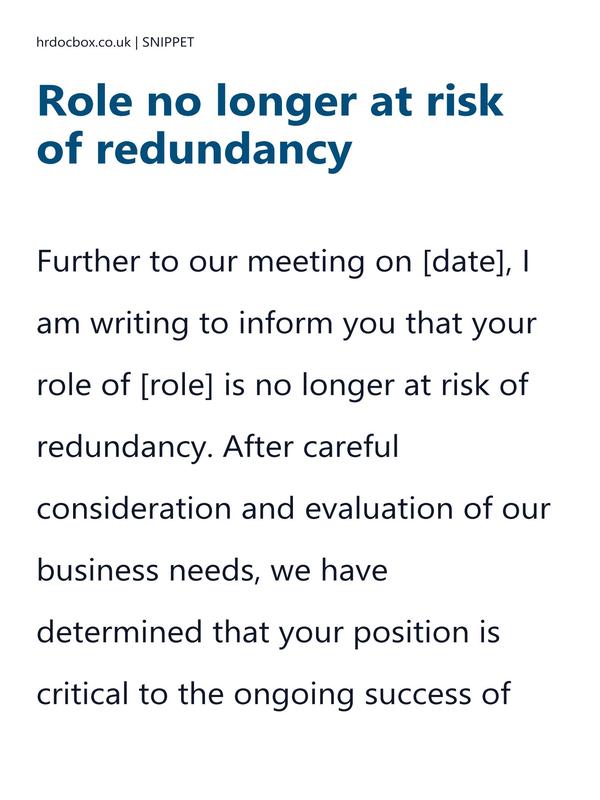
  • Confirm that the employee's role is no longer at risk of redundancy.
  • Explain the outcome of the redundancy review or consultation process.
  • Provide a clear reason for the decision, where appropriate.
  • Confirm whether the employee's role, terms and conditions remain unchanged.
  • Clarify whether any further meetings or actions are required.
  • Provide a written record of the decision and reassure the employee about the next steps.
Role no longer at risk of redundancy letter template preview

What you get with your purchase - much more than just a template!

Best practice example See what good looks like
Wider HR process Understand the bigger picture
Implementation guide Practical steps to follow
Common mistakes Know what to avoid
Get the complete resource

Don't just buy one template — get the complete Redundancy process toolkit

If you are managing a redundancy process, the toolkit brings together practical HR templates covering planning, consultation, selection, scoring, outcomes and termination.

36 templates • £29.99 • 12 months' access & updates
View the process toolkit

What's in this template?

  • Confirmation that the employee's role is no longer at risk of redundancy.
  • A summary of the decision following consultation or review.
  • An explanation of the reasons for the revised decision.
  • Confirmation of employment status and any unchanged contractual terms.
  • Clarification of any remaining organisational or consultation activity.
  • Contact details for questions or further clarification.
  • A professional closing that recognises the employee's cooperation.
Template

Download .doc

Copy [to paste]

Email

[Sender name]

[Sender address]

[date]

[Recipient name]

[Recipient address]


Dear [Recipient first name],

Confirmation That Your Role Is No Longer at Risk of Redundancy

Further to our recent discussions and the consultation process concerning the proposed organisational changes, I am writing to confirm the outcome of the review relating to your role as [Job Title].

Following consideration of the proposals, the information discussed during consultation and the options available to the business, we have decided that your role is no longer at risk of redundancy under the current proposals.

Reason for the decision

This decision has been made because [explain the

PREVIEW ENDS HERE

This is the end of the preview

You've seen 20% of how the Role no longer at risk of redundancy letter template is structured. Get the complete editable template instantly and customise it for your organisation.

£12.99
Specifications
Access 12 months, with updates
Length 2 pages • 383 words
Jurisdiction England, Wales, Scotland
Based on UK law, ACAS guidance
Last update 22/10/2026
Update reason Enhanced template wording and description.
Next review 22/04/2027
Delivery & Format Instant digital delivery, .doc · .txt · email

What is a role no longer at risk of redundancy letter?

Role no longer at risk of redundancy letter template

A role no longer at risk of redundancy letter provides formal written confirmation that an employer has decided not to proceed with the proposed redundancy of an employee's role. It is an important communication following a period of uncertainty, particularly where the employee has attended consultation meetings or been provisionally identified as potentially redundant.

Confirming the outcome clearly

The letter should state unambiguously that the employee's role is no longer at risk of redundancy under the proposals being considered. Where appropriate, it should explain whether the decision follows employee feedback, a change in business requirements, revised staffing plans, the availability of alternatives or another relevant development. The explanation should be accurate and consistent with the decision actually made.

Reassuring the employee

Being told that a role may be made redundant can cause considerable uncertainty. A clear outcome letter helps bring that uncertainty to an end and confirms what happens next. Where accurate, the employer can reassure the employee that their employment continues and that their job title, duties, pay, hours and other contractual terms remain unchanged.

Maintaining a fair and documented process

Employers should retain a record of the decision and the reasons for it, particularly where the outcome follows consultation or a review of proposed redundancies. If the organisation is continuing to restructure or other employees remain at risk, the letter should distinguish the employee's individual outcome from any wider proposals that remain unresolved.

Supporting a positive transition

The letter should be professional, straightforward and considerate. It should invite the employee to raise any questions and identify any further steps, such as a meeting to discuss revised team arrangements. A written confirmation provides clarity for the employee and a useful record for HR, while supporting trust and confidence following a period of uncertainty.

Best in class example

A business proposes a restructure that places several roles at risk of redundancy. One employee attends consultation meetings and provides suggestions for redistributing work and reducing costs. Management reviews the proposals and decides that the employee's role remains necessary under the revised structure.

HR confirms that the decision has been approved and that the employee is no longer at risk of redundancy under the proposals. The business continues to consult with other affected employees, but the employee's individual position has been resolved.

The employer sends a letter confirming the outcome, explaining that the role will be retained and stating that the employee's existing terms and conditions remain unchanged. The letter also explains that wider organisational changes may continue but do not currently place the employee's role at risk.

The employee now has a written record of the decision and can return their attention to their role. HR retains the letter and relevant consultation records, while the manager provides any necessary updates about team arrangements or responsibilities.

The wider HR process

Related HR resources and workflow

Explore the HR resources that may be relevant before and / or after using the Role no longer at risk of redundancy letter, helping you understand the wider process, maintain appropriate documentation and follow a consistent approach.

Previous
Letters
Final individual redundancy consultation meeting invitation letter

This Final Individual Redundancy Consultation Meeting Invitation Letter invites an employee to the final stage of an individual redundancy consultation process.

This
Role no longer at risk of redundancy letter
Premium content

To continue reading, purchase this item or a parent toolkit, library or our full library.

Implementation guidance

Use these best practice actions, recommended timescales and process stages to understand when and how the Role no longer at risk of redundancy letter should be used, helping ensure each step is handled consistently and appropriately documented.

Step Description Responsibility Timing (Days from Issue)
1 Review the consultation record, revised proposals and relevant management decisions to confirm that the employee's role is no longer at risk. HR / Decision-Making Manager Before issue
2 Confirm the reasons for the decision and whether the employee's role, duties and contractual terms remain unchanged. HR / Line Manager Before issue
3 Prepare and check the letter to ensure that the outcome is unambiguous and consistent with any wider restructuring or consultation activity. HR Before issue
4 Send the letter promptly, explain the outcome where appropriate and give the employee an opportunity to ask questions. HR / Line Manager As soon as practicable after the decision
5 Retain the letter and decision record, update relevant HR records and communicate any confirmed changes to team arrangements. HR / Line Manager Within 5 working days of issue
Premium content

To continue reading, purchase this item or a parent toolkit, library or our full library.

Common mistakes

Understand the common mistakes to avoid when using this HR template, helping you reduce risk, prevent unnecessary costs and ensure the process is handled correctly.

  • Using vague wording that leaves the employee uncertain about whether their role is still at risk.
  • Failing to explain the decision or provide a clear outcome following consultation.
  • Confirming that employment terms remain unchanged when other changes have also been proposed or agreed.
  • Implying that the wider redundancy process has ended when other roles remain under consultation.
  • Failing to retain a record of the decision, supporting rationale and consultation outcome.
  • Delaying the communication unnecessarily, leaving the employee exposed to avoidable uncertainty after the decision has been made.
Premium content

To continue reading, purchase this item or a parent toolkit, library or our full library.

HR considerations

UK employment law and best practice

This template is designed to support the process, but the document should be used alongside the relevant HR procedure and applied to the circumstances of the individual case.

A role no longer at risk of redundancy letter is generally a good-practice document rather than a statutory form. It records the employer's decision and helps ensure that the employee understands the outcome. The employer should confirm that the decision has been properly authorised and that the letter accurately reflects the position following consultation or review.

Genuine and meaningful consultation

Employers should consult affected employees before finalising redundancy decisions. Consultation should involve explaining the proposals, listening to suggestions and considering alternatives to redundancy. If the employee's role is no longer at risk, the letter should accurately confirm that outcome. The employer should retain appropriate records of the consultation and decision. https://www.acas.org.uk/manage-staff-redundancies/redundancy-consultations

Accuracy and clarity of the decision

Confirm whether the employee's role is no longer at risk under the specific proposals being considered, rather than using ambiguous wording such as "the redundancy process is on hold" if the intention is to remove the role from the proposals. If the employee's position remains subject to a different proposal or process, explain this clearly rather than implying that all uncertainty has ended.

Contractual terms and changes to the role

If the employee's role and contractual terms remain unchanged, the letter can confirm this. If the reorganisation also involves changes to duties, reporting lines, hours, pay, location or other contractual terms, these should be addressed separately through the appropriate process. Employers should not use a letter confirming that redundancy risk has ended to introduce unrelated changes without proper consideration and agreement where required. https://www.acas.org.uk/changing-an-employment-contract/employer-responsibilities

Fairness and discrimination

Ensure that the decision is based on legitimate business considerations and is not influenced by discrimination, retaliation for raising concerns or other unlawful factors. Where other employees remain at risk, continue to apply fair and consistent decision-making processes and maintain appropriate records.

Collective consultation and wider redundancy proposals

If the employer is proposing 20 or more redundancies at one establishment within a 90-day period, collective consultation requirements may apply. Confirming that one employee's role is no longer at risk does not automatically end wider consultation duties or remove the need to review the overall proposals. Employers should keep the number of proposed redundancies and any changes to the plans under review. https://www.acas.org.uk/manage-staff-redundancies/redundancy-consultations

Record keeping and employee communication

Keep a copy of the letter, the decision record and any relevant consultation notes in accordance with the organisation's retention arrangements. The employee should know whom to contact if they have questions. Managers should communicate any subsequent organisational changes accurately and avoid making assurances that go beyond the decision reached.

You may also need these resources

FAQs

When should a role no longer at risk of redundancy letter be issued?

Issue the letter once the employer has made and authorised a clear decision that the employee's role is no longer at risk under the proposals being considered. Communicate the outcome promptly so the employee is not left in unnecessary uncertainty.

Does the letter mean the entire redundancy process has ended?

No. It confirms the outcome for the individual employee or role covered by the letter. The employer may still be consulting with other employees or considering other organisational changes. The letter should distinguish the employee's individual outcome from any wider process that remains ongoing.

Should the employer explain why the role is no longer at risk?

Yes, where appropriate. A concise explanation might refer to revised business requirements, changes to the proposed structure, consultation feedback or an alternative solution. The explanation should be accurate, consistent with the decision and should not disclose confidential information about other employees.

Should the letter confirm that employment terms remain unchanged?

Yes, if that is correct. It can confirm that the employee's job title, duties, pay, working hours and other contractual terms remain unchanged. If separate changes are planned, explain that these will be addressed through the appropriate process rather than implying that everything remains the same.

Can the employee be placed at risk of redundancy again later?

A later, genuinely new business situation may lead an employer to consider redundancy proposals again, but the employer must assess the circumstances and follow the appropriate process. The original letter should accurately confirm the decision made at that time and should not include unnecessarily broad wording that undermines the reassurance being given.

Why use HRDocBox?

HRDocBox provides practical, customisable HR templates designed for UK employers, including small and medium-sized businesses. This letter gives HR teams a consistent way to communicate the outcome of a redundancy review, document the decision and reassure employees when their roles are no longer at risk.

Why use HRDocBox rather than asking AI?

AI can help draft correspondence, but a structured HRDocBox template provides a reusable starting point with the key communication points already organised. It helps maintain consistency across the redundancy process while allowing the employer to personalise the explanation and outcome. The completed letter should still be checked against the facts, consultation records and current legal requirements.

How this content is developed and reviewed

The Role no longer at risk of redundancy letter template is developed using a practical HR methodology that considers current UK employment legislation, ACAS guidance, CIPD good practice and the real-world HR process it supports. Templates and supporting information are regularly reviewed and updated, with additional reviews triggered by significant changes to legislation, guidance or established HR practice, helping ensure each document remains practical, relevant and suitable for UK employers.

About the author

Darryl Horn, Chartered HR Director

Darryl is a Chartered HR professional with over 25 years' experience in senior HR and employee relations roles.

He has extensive practical experience of managing redundancy HR processes and founded hrdocbox to provide businesses with practical, professionally developed HR resources grounded in UK employment law and best practice.

HRDocBox has been creating practical UK HR documents since 2009.

Executive recommendation

"Darryl provides support and advice with excellent judgement, and has a strong understanding of people, policies and UK employment legislation."

"He is someone I trust; consistent, dependable, and committed to doing things properly."

RB
Ruth Brock Chief Executive Officer The Hygiene Bank
Get started today

HR confidence starts here

Whether you employ 5 people or 50, hrdocbox gives you the structure, documents and expertise needed to manage employees professionally and legally.

Download your FREE UK employment contract template

Professionally written and fully compliant with UK employment law
Download FREE contract
Free UK employment contract template