Voluntary redundancy application form template

£14.99

UK-specific • Editable • Instant download • 12 months' updates

A voluntary redundancy application form for employees who wish to put themselves forward for redundancy during a proposed redundancy programme.

Use this template to:
  • Invite employees to formally apply for voluntary redundancy.
  • Capture the employee's personal and employment details.
  • Record their reasons for volunteering, where appropriate.
  • Confirm that an application does not guarantee acceptance.
  • Record the employee's understanding of the process and potential payments.
  • Provide a clear audit trail for voluntary redundancy decisions.
Voluntary redundancy application form template
2026 Reviewed

What's included in this template?

This template brings together the key information, sections and considerations you need to create a clear, comprehensive and professional HR document. Preview the document below.

  • Employee and employment details
  • Formal voluntary redundancy application
  • Reason for volunteering
  • Redundancy payment and benefits information
  • Notice and proposed leaving date
  • Employee declaration and signature
  • Employer decision and approval record
Specifications
Access 12 months (includes updates)
Length 2 pages • 740 words
Jurisdiction England, Wales and Scotland
Based on UK employment law, ACAS guidance
Last review 29/08/2026
Next review 28/02/2027
Delivery Instant download
Formats .doc · .xls · .txt · email

Download .doc

Edit .xls

Copy [to paste]

Email
Template

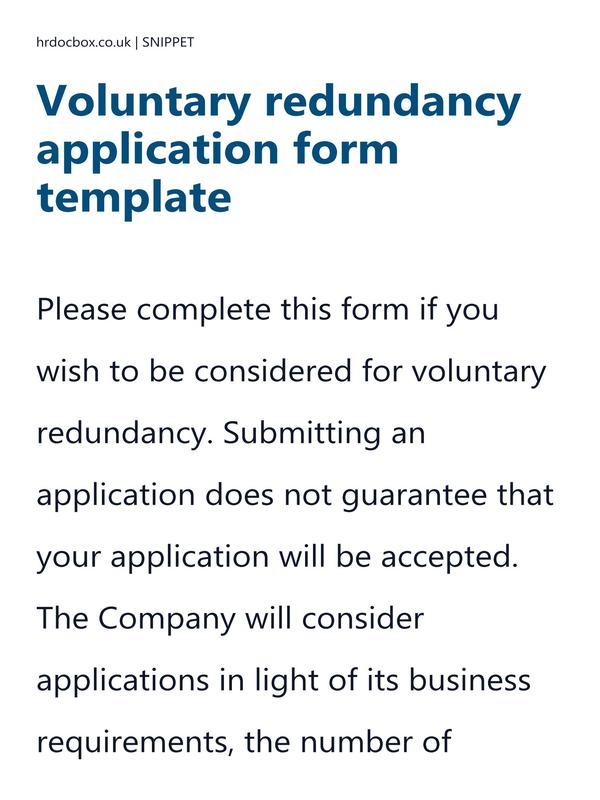
Voluntary redundancy application

Please complete this form if you wish to be considered for voluntary redundancy. Submitting an application does not guarantee that your application will be accepted. The Company will consider applications in light of its business requirements, the number of applications received and the roles, skills and experience it needs to retain.

1. Employee details

Employee name:  
Employee number:  
Job title:  
Department:  
Manager:  
Employment start date:  
Continuous service date:  
Current salary / hourly rate:  
Contractual notice period:  

2. Voluntary redundancy application

I wish to be considered for voluntary redundancy: Yes / No
Preferred leaving date:  
Reason for volunteering:  


Other information I would like the Company to consider:  


3. Redundancy payment information

Estimated statutory redundancy payment:  
Estimated enhanced redundancy payment:  
Other applicable payment:
PREVIEW ENDS HERE

This is the end of the preview

You've seen just 30% of how the Voluntary redundancy application form template is structured. Get the complete editable template instantly and customise it for your organisation.

£14.99

Need the complete Redundancy process?

Explore the Redundancy templates toolkit

What is a voluntary redundancy application form?

Voluntary redundancy application form template preview

A voluntary redundancy application form is used when an employer is considering redundancies and invites employees to put themselves forward for voluntary redundancy. It provides a structured way for employees to express their interest and gives the employer a consistent record of applications received.

What is a voluntary redundancy application form?

The form allows an employee to formally confirm that they wish to be considered for voluntary redundancy. It can be used alongside a voluntary redundancy scheme, consultation process or redundancy policy and provides a clear written record of the employee's request.

What does the form cover?

The template captures the employee's key details, their role and service information, their request to be considered for voluntary redundancy and any relevant information they wish the employer to take into account. It also provides space for the organisation to record its decision and any agreed arrangements.

Why use a formal application?

A consistent application process helps an employer manage voluntary redundancy requests fairly and transparently. It ensures that employees understand that putting themselves forward is an application rather than an automatic entitlement to leave, while giving the organisation a documented record of the decision-making process.

Does applying guarantee voluntary redundancy?

No. An employee can volunteer for redundancy, but the employer does not have to accept the application. The business may need to retain particular skills, experience or roles, or may receive more applications than it can accept. ACAS specifically recommends making clear to employees that volunteering does not guarantee that the employer will agree to make them redundant. http://www.acas.org.uk/your-rights-during-redundancy/voluntary-redundancy

What should employers consider before accepting an application?

The employer should consider the needs of the business, the proposed redundancy programme, the employee's role and any applicable selection or consultation arrangements before deciding whether to accept an application. The employer should also consider whether decisions could give rise to discrimination concerns or create inconsistency between employees.

Who is the form for?

The form is designed for employers and HR teams running a voluntary redundancy exercise. It is particularly useful where several employees are being invited to volunteer and the organisation wants a consistent process for receiving, reviewing and recording applications.

Example

A manufacturing business is proposing to reduce its workforce because of a sustained reduction in demand. As part of the redundancy process, the company invites employees in the affected areas to apply for voluntary redundancy.

Sarah, who has 14 years' continuous service, decides that she would like to leave the business and completes the voluntary redundancy application form before the deadline. She confirms that she understands that applying does not guarantee that her application will be accepted.

HR reviews the applications with the relevant managers. Although Sarah's application is attractive from a cost-reduction perspective, the business also considers the skills and experience it needs to retain. The company decides that Sarah's application can be accepted.

HR formally confirms the decision and then deals with Sarah's redundancy arrangements, including her notice, accrued holiday and applicable redundancy payment. The completed application form is retained as part of the redundancy records.

The wider HR process

Related HR resources and workflow

Explore the HR resources that may be relevant before and / or after using the Voluntary redundancy application form, helping you understand the wider process, maintain appropriate documentation and follow a consistent approach.

Previous
Letters
Invitation for voluntary redundancy applications letter

Our Invitation for Voluntary Redundancy Applications letter template encourages employees to apply for voluntary redundancy while maintaining a fair process.

This
Voluntary redundancy application form
Next
Letters
Invitation to discuss voluntary redundancy application letter

If you receive an application for voluntary redundancy, send this model letter to an employee as an invitation to a meeting to discuss it.

Premium content

To continue reading, purchase this item or a parent toolkit, library or our full library.

Implementation guidance

Use these best practice actions, recommended timescales and process stages to understand when and how the Voluntary redundancy application form should be used, helping ensure each step is handled consistently and appropriately documented.

Step Description Responsibility Timing
1 Define the voluntary redundancy scheme: Confirm why redundancies are being considered, which employees or roles are eligible to volunteer and any scheme terms or enhanced payments available. HR / Senior Management Before launch
2 Provide information: Explain the voluntary redundancy opportunity, process, relevant dates, potential payments and make clear that applications are subject to employer approval. HR Before applications open
3 Receive applications: Ask employees who wish to volunteer to complete and sign the application form by the stated deadline. HR During application period
4 Assess applications: Consider each application against the organisation's requirements, consultation arrangements and any relevant selection or eligibility criteria. Record the reasons for accepting or declining applications. HR / Management After deadline
5 Confirm the outcome: Notify employees of the decision and, where voluntary redundancy is accepted, proceed with the appropriate consultation, redundancy, notice and payment arrangements. HR / Management After assessment
Premium content

To continue reading, purchase this item or a parent toolkit, library or our full library.

Common mistakes

Understand the common mistakes to avoid when using this HR template, helping you reduce risk, prevent unnecessary costs and ensure the process is handled correctly.

  • Giving employees the impression that applying for voluntary redundancy automatically guarantees acceptance.
  • Failing to explain the eligibility criteria, scheme terms, deadlines or potential redundancy payments before applications are submitted.
  • Ignoring voluntary redundancies when calculating whether the 20-employee collective consultation threshold has been reached.
  • Accepting or rejecting applications inconsistently without considering the business reasons for the decision.
  • Failing to consider whether the voluntary redundancy process could disadvantage employees because of a protected characteristic.
  • Assuming that accepting voluntary redundancy removes the need to follow the appropriate redundancy, consultation, notice and payment processes.
Premium content

To continue reading, purchase this item or a parent toolkit, library or our full library.

HR considerations

UK employment law and best practice

This template is designed to support the process, but the document should be used alongside the relevant HR procedure and applied to the circumstances of the individual case.

Voluntary redundancy is a process through which employees put themselves forward for redundancy. An employee can volunteer for redundancy, but the employer does not have to accept the application. The decision should take account of the wider needs of the organisation and should be handled consistently and without unlawful discrimination. http://www.acas.org.uk/your-rights-during-redundancy/voluntary-redundancy

Redundancy consultation

Voluntary redundancy does not remove the employer's wider redundancy obligations. Employers should consult affected employees and genuinely consider ways of avoiding or reducing redundancies. Where fewer than 20 redundancies are proposed, individual consultation should normally take place; collective consultation is legally required where 20 or more redundancies are proposed at one establishment within a 90-day period. http://www.acas.org.uk/manage-staff-redundancies/redundancy-consultations

Voluntary redundancies must still be included when determining whether the threshold for collective consultation has been reached. http://www.acas.org.uk/collective-consultation-redundancy

Statutory redundancy pay eligibility

An employee will normally qualify for statutory redundancy pay if they are an employee with at least two years' continuous employment. Statutory redundancy pay is calculated by reference to age, weekly pay and completed years of continuous service, subject to the statutory limits. http://www.gov.uk/calculate-employee-redundancy-pay

The two-year qualifying period applies to statutory redundancy pay; an employer may nevertheless offer an enhanced contractual or discretionary redundancy payment under the terms of its voluntary redundancy scheme.

Redundancy payment calculations

Employers should calculate statutory redundancy pay using the applicable statutory rules and current limits. Where an enhanced voluntary redundancy package is offered, the terms should clearly explain what additional payment is available and how it interacts with statutory redundancy pay and other termination payments. http://www.gov.uk/calculate-employee-redundancy-pay

Discrimination and fair selection

Employers should take care that decisions about who can volunteer, whose application is accepted and how redundancy opportunities are offered do not discriminate unlawfully because of a protected characteristic. ACAS specifically highlights the potential for discrimination concerns where an employer offers voluntary redundancy selectively. http://www.acas.org.uk/your-rights-during-redundancy/voluntary-redundancy

Notice and final payments

Acceptance of voluntary redundancy will normally lead to termination by reason of redundancy, with the employee receiving the payments to which they are entitled under their contract and the applicable law. This can include notice pay, accrued holiday and statutory or enhanced redundancy pay, depending on the circumstances.

Collective consultation thresholds

If an employer proposes 20 or more redundancies at one establishment within a 90-day period, collective consultation obligations apply. The count includes employees who volunteer for redundancy, so voluntary applications cannot be excluded simply because employees have put themselves forward. From 6 April 2026, the maximum protective award for failure to comply with collective consultation requirements is up to 180 days' pay per affected employee. http://www.acas.org.uk/collective-consultation-redundancy

You may also need these resources

FAQs

Does an employee have a right to voluntary redundancy?

No. An employee can ask to be considered for voluntary redundancy, but the employer does not have to accept the application. The organisation may need to retain particular employees because of their skills, experience or business requirements. http://www.acas.org.uk/your-rights-during-redundancy/voluntary-redundancy

Does voluntary redundancy count towards the 20-person consultation threshold?

Yes. Voluntary redundancies count when determining whether an employer is proposing 20 or more redundancies at one establishment within a 90-day period. They cannot simply be excluded because employees volunteered. http://www.acas.org.uk/collective-consultation-redundancy

Does everyone who volunteers have to be treated the same?

Not necessarily. An employer may need to decide which applications it can accept based on the needs of the business. However, the process should be transparent and decisions should not be discriminatory or inconsistent without a legitimate reason.

Does voluntary redundancy qualify for statutory redundancy pay?

Voluntary redundancy is still redundancy. An employee who has at least two years' continuous employment will normally qualify for statutory redundancy pay, subject to the statutory rules and any applicable exclusions. An employer may also offer an enhanced voluntary redundancy payment. http://www.gov.uk/calculate-employee-redundancy-pay

Can an employee withdraw a voluntary redundancy application?

This depends on the employer's process and whether the application has already been formally accepted or an agreement has been reached. The application form should therefore make clear when an application becomes binding, if applicable, and employers should deal consistently with any requests to withdraw.

Why use HRDocBox rather than AI?

AI can produce a basic redundancy application form, but the difficult part is making sure the document fits into a proper UK redundancy process. Voluntary redundancy sits alongside consultation, selection, statutory redundancy pay, collective consultation thresholds and discrimination considerations.

HRDocBox combines the practical application form with the HR context around using it, helping employers create a clearer and more consistent voluntary redundancy process rather than simply generating a generic form.

How this content is developed and reviewed

The Voluntary redundancy application form template is developed using a practical HR methodology that considers current UK employment legislation, ACAS guidance, CIPD good practice and the real-world HR process it supports. Templates are regularly reviewed and updated, with additional reviews triggered by significant changes to legislation, guidance or established HR practice, helping ensure each document remains practical, relevant and suitable for UK employers.

About the author

Darryl Horn, Chartered HR Director

Darryl is a Chartered HR professional with over 25 years' experience in senior HR and employee relations roles.

He has extensive practical experience of managing redundancy processes and founded hrdocbox to provide businesses with practical, professionally developed HR resources grounded in UK employment law and best practice.

HRDocBox has been creating practical UK HR documents since 2009.

Executive recommendation

"Darryl provides support and advice with excellent judgement, and has a strong understanding of people, policies and UK employment legislation."

"He is someone I trust; consistent, dependable, and committed to doing things properly."

RB
Ruth Brock Chief Executive Officer The Hygiene Bank
The Voluntary redundancy application form template is also included in these bundles:

Redundancy toolkit Redundancy toolkit 36 templates
£34.90

Termination library Termination library 137 templates
£69.99

Full library Full library 776 templates
£99.99

Get started today

HR confidence starts here

Whether you employ 5 people or 50, hrdocbox gives you the structure, documents and expertise needed to manage employees professionally and legally.

Download your FREE UK employment contract template

Professionally written and fully compliant with UK employment law

Download FREE contract
Free UK employment contract template