Libraries
780+ HR templates
Everything your business needs to stay compliant
Policies, contracts, letters, guidance and HR support tools for UK employers.
View full libraryPolicies, contracts, letters, guidance and HR support tools for UK employers.
View full libraryThis Managers Guide to Maternity Leave helps UK line managers support pregnant employees and manage maternity leave from the initial notification through to the employee's return to work. It explains key responsibilities, important deadlines, health and safety considerations, communication expectations and when to involve HR or payroll.
Use this template to:
<p>If you are managing parental and family leave, the toolkit brings together practical HR templates covering notifications, eligibility, planning, leave and return to work.</p>
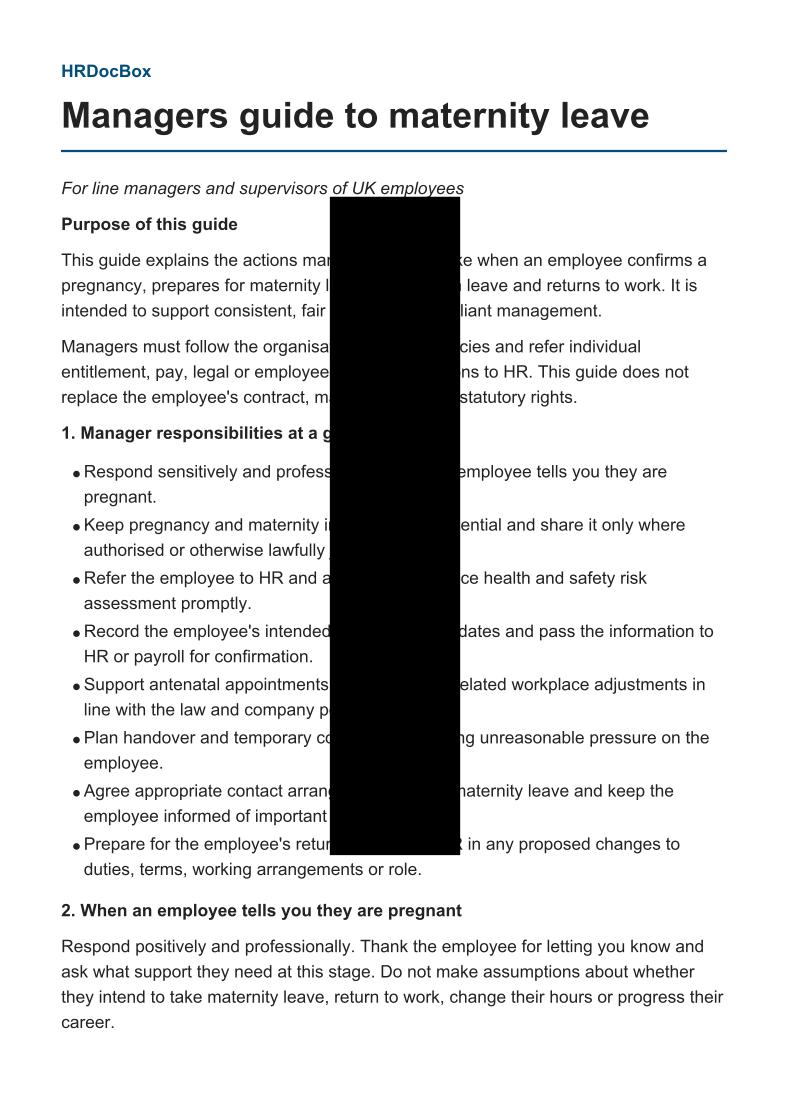
For line managers and supervisors of UK employees
Purpose of this guide
This guide explains the actions managers should take when an employee confirms a pregnancy, prepares for maternity leave, remains on leave and returns to work. It is intended to support consistent, fair and legally compliant management.
Managers must follow the organisation's current policies and refer individual entitlement, pay, legal or employee-relations questions to HR. This guide does not replace the employee's contract, maternity policy or statutory rights.
1. Manager responsibilities at a glance
2. When an employee tells you they are pregnant
Respond
You've seen 10% of how the Managers guide to maternity leave is structured. Get the complete editable template instantly and customise it for your organisation.

Managing maternity leave well requires more than recording an absence. Managers need to respond sensitively to pregnancy notifications, protect the employee from unfavourable treatment, address workplace health and safety risks and coordinate the practical arrangements for the employee's time away. They also need to maintain appropriate contact, plan cover fairly and prepare for a smooth return.
This guide gives managers a practical process to follow, while making clear when decisions should be referred to HR or payroll. It can be used by small businesses without a dedicated HR team as well as by larger employers with established maternity policies.
When an employee shares news of their pregnancy, managers should respond professionally, ask what support is needed and respect the employee's wishes about who can be told. Information must be handled confidentially. Managers should arrange a suitable health and safety risk assessment promptly, review working arrangements where necessary and make sure pregnancy-related sickness is recorded and handled appropriately.
Employees have rights relating to antenatal care and protection from pregnancy and maternity discrimination. Managers should not make assumptions about an employee's commitment, capacity, career plans or willingness to undertake particular work because they are pregnant.
Employees who qualify for Statutory Maternity Leave can take up to 52 weeks, regardless of length of service, provided the relevant conditions are met. Maternity leave and Statutory Maternity Pay are separate entitlements, so managers should not make promises about pay. HR or payroll should check the employee's circumstances, evidence and any enhanced company maternity pay scheme.
Managers should ensure that the intended leave dates are recorded and that the employee receives the required written confirmation. They should agree a proportionate handover and cover plan without placing unreasonable pressure on the employee to complete work before leave begins.
Before leave starts, agree how the employee would prefer to receive updates, who will contact them and what kind of information they would like to receive. Contact should be appropriate to the employee's circumstances and should not create pressure to work. Employees may work up to 10 keeping-in-touch (KIT) days during maternity leave by agreement, without ending their maternity leave. Working on a KIT day should be agreed in advance, including the work and pay arrangements.
Managers must keep employees informed of relevant opportunities and significant workplace changes, such as promotions, training, reorganisations or redundancies. Temporary maternity cover should be planned carefully, with the temporary arrangement explained to the person providing cover.
Managers should make contact at an agreed point before the expected return date, discuss practical arrangements and ensure that the employee is not disadvantaged for taking maternity leave. Statutory holiday continues to accrue during maternity leave. Any holiday arrangements, requests for flexible working and relevant health and safety considerations should be handled under the applicable policies and legal requirements.
The employee's right to return to the same job, or in certain circumstances a suitable alternative role, depends on the circumstances and the length of leave taken. Managers should involve HR before proposing changes to the employee's role, terms, working pattern or reporting line, and should seek advice promptly if a restructure or redundancy situation arises.
Related HR resources and workflow
Explore the HR resources that may be relevant before and / or after using the Managers guide to maternity leave, helping you understand the wider process, maintain appropriate documentation and follow a consistent approach.

Use this Pregnancy Notification Checklist to manage the key actions following an employee's pregnancy notification.
Use the following as a practical framework for assessing the situation, considering the available options and deciding on the appropriate course of action. Follow each step in sequence to support consistent, informed and appropriate decision-making.
Understand the common mistakes to avoid when using this HR template, helping you reduce risk, prevent unnecessary costs and ensure the process is handled correctly.
Eligible employees can take up to 52 weeks of Statutory Maternity Leave, normally split into 26 weeks of Ordinary Maternity Leave and 26 weeks of Additional Maternity Leave. The employee's right to leave is separate from eligibility for Statutory Maternity Pay.
Respond supportively, respect confidentiality, ask what information can be shared, refer the notification to HR and arrange a prompt health and safety risk assessment. Do not make assumptions about the employee's work, career plans or future availability.
Yes. The manager and employee should agree suitable contact arrangements, including how often to communicate and the preferred method. Employees must be kept informed of important workplace developments and opportunities. Any work during maternity leave, including a keeping-in-touch day, must be agreed rather than imposed.
Do not assume that this means they are not entitled to maternity leave. HR or payroll should assess SMP eligibility, explain the outcome, follow the applicable SMP1 process and signpost the employee to check whether they may qualify for Maternity Allowance. Check separately for any enhanced Company Maternity Pay entitlement.
HRDocBox provides practical, customisable HR resources designed to help UK employers and managers follow consistent processes, record key decisions and handle common people-management situations more confidently. Adapt this guide to your organisation's policies, contracts and management structure.
This guide provides a structured starting point tailored to the practical responsibilities of a UK line manager, with key stages, escalation points and official guidance references in one place. AI can help explain or adapt the content, but employers should still check the current law, their own policies and the employee's individual circumstances before making decisions.
How this content is developed and reviewed
The Managers guide to maternity leave is developed using a practical HR methodology that considers current UK employment legislation, ACAS guidance, CIPD good practice and the real-world HR process it supports. Templates and supporting information are regularly reviewed and updated, with additional reviews triggered by significant changes to legislation, guidance or established HR practice, helping ensure each document remains practical, relevant and suitable for UK employers.
Darryl Horn, Chartered HR Director
Darryl is a Chartered HR professional with over 25 years' experience in senior HR and employee relations roles.
He has extensive practical experience of managing parental and family HR processes and founded hrdocbox to provide businesses with practical, professionally developed HR resources grounded in UK employment law and best practice.
HRDocBox has been creating practical UK HR documents since 2009.
"Darryl provides support and advice with excellent judgement, and has a strong understanding of people, policies and UK employment legislation."
"He is someone I trust; consistent, dependable, and committed to doing things properly."




















Whether you employ 5 people or 50, hrdocbox gives you the structure, documents and expertise needed to manage employees professionally and legally.
Professionally written and fully compliant with UK employment law
Access a free contract template instantly - or save 10% on any document today.
Use this code at checkout for 10% off anything!
Includes instant download, updates, and full access to your HR templates.