Redundancy at risk meeting script template

£12.99
Editable template
Instant download
UK-specific & legally compliant
12 months updates included
2026 Reviewed

Use this redundancy at risk meeting script to guide managers through an initial conversation with an employee whose role may be affected by proposed redundancies. It provides a structured approach to explaining the business rationale, managing questions sensitively and beginning meaningful consultation without suggesting that the outcome has already been decided.

Use this script to:
  • Explain why the employee's role is at risk of redundancy.
  • Clarify the difference between being at risk and being made redundant.
  • Explain the proposed changes and the consultation process.
  • Encourage questions, feedback and suggestions for alternatives.
  • Discuss possible redeployment and suitable alternative employment.
  • Help managers conduct a sensitive, consistent and properly documented meeting.
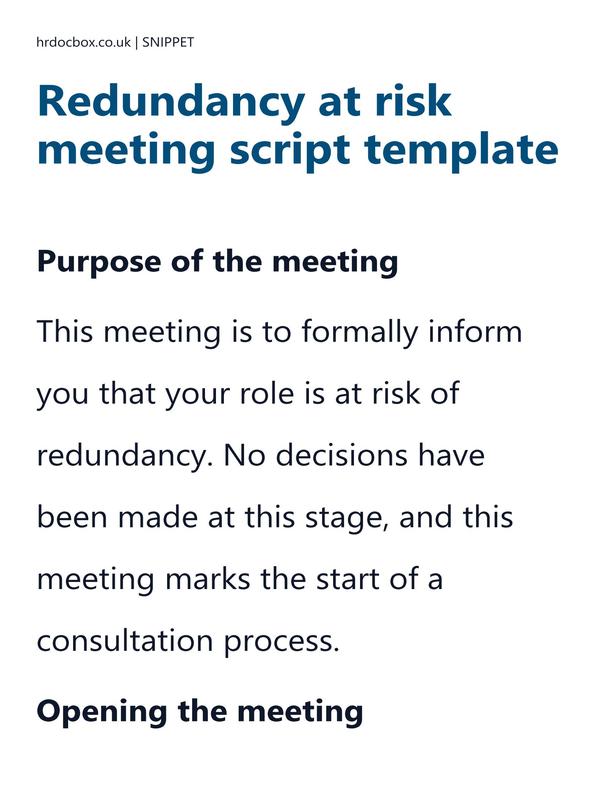
Redundancy at risk meeting script template preview

What you get with your purchase - much more than just a template!

Best practice example See what good looks like
Wider HR process Understand the bigger picture
Implementation guide Practical steps to follow
Common mistakes Know what to avoid
Get the complete resource

Don't just buy one template — get the complete Redundancy process toolkit

If you are managing a redundancy process, the toolkit brings together practical HR templates covering planning, consultation, selection, scoring, outcomes and termination.

36 templates • £29.99 • 12 months' access & updates
View the process toolkit

What's in this template?

  • Pre-meeting preparation checklist for the manager and HR.
  • Opening statement and explanation of the business rationale.
  • Suggested wording for explaining at-risk status and the consultation process.
  • Questions to explore alternatives, employee concerns and possible redeployment.
  • Guidance for handling difficult reactions and challenging questions.
  • Meeting notes, agreed actions and follow-up arrangements.
Template

Download .doc

Copy [to paste]

Email

Purpose

This script is intended to help a manager conduct an initial meeting with an employee whose role is at risk of redundancy. It should be adapted to the circumstances and delivered as a conversation, not read mechanically. The manager should allow time for questions and avoid implying that the outcome has already been decided.

Meeting details

Employee name [Employee Name]
Job title [Job Title]
Meeting date and time [Date and Time]
Meeting location [Location or Online Meeting Details]
Manager leading the meeting [Manager Name and Job Title]
HR representative / note-taker [Name and Job Title]
Employee companion, if applicable [Name and Role]

Before the meeting: manager preparation

Before meeting the employee, check that you can explain the following accurately:

  • The business reasons for the proposed changes.
  • How the proposal may affect the employee's role.
  • The number and types of roles potentially affected, where this information can be shared.
  • Any proposed selection pool or criteria, if applicable.
  • The consultation process and anticipated next steps.
  • Potential alternatives already considered and further options that could be explored.
  • Any information that needs to be provided after the meeting.

Check whether the employee has requested a companion or reasonable adjustments. Ensure that the meeting can take place privately and that sufficient time has been allowed.

Part 1: Opening the meeting

Suggested wording

“Thank you for meeting with us today. I appreciate that this may be a difficult conversation, and I want to explain the situation clearly and give you the opportunity to ask questions and share your views.

“The purpose of this meeting is to explain proposed changes within the business

PREVIEW ENDS HERE

This is the end of the preview

You've seen 20% of how the Redundancy at risk meeting script template is structured. Get the complete editable template instantly and customise it for your organisation.

£12.99
Specifications
Access 12 months, with updates
Length 4 pages • 1,493 words
Jurisdiction England, Wales, Scotland
Based on UK law, ACAS guidance
Last update 10/10/2026
Update reason Terminology update.
Next review 10/04/2027
Delivery & Format Instant digital delivery, .doc · .txt · email

What is a redundancy at risk meeting script?

Redundancy at risk meeting script template

Announcing that an employee's role is at risk of redundancy can be one of the most difficult conversations a manager has to conduct. A clear meeting structure helps ensure that the employee understands the proposal, has an opportunity to express their views and knows what will happen next.

Preparing for the meeting

Before the meeting, the manager should understand the business rationale, the proposed organisational changes, the roles affected and the anticipated timetable. They should also know what information can be shared, what remains under consideration and which questions may require follow-up. HR should brief the manager on the consultation process and any applicable company procedures.

Explaining the proposal clearly

The manager should explain the proposed changes in straightforward language, including why they are being considered and how they may affect the employee's role. Avoid vague statements or unsupported assurances. If the proposal involves a selection pool or proposed selection criteria, explain these clearly and give the employee an opportunity to comment where relevant.

Handling the conversation sensitively

Employees may respond with shock, frustration, anxiety or silence. Managers should allow time for the employee to process the information, acknowledge their concerns and avoid becoming defensive. It is acceptable to say that an answer needs to be checked rather than speculate or promise an outcome that cannot be guaranteed.

Exploring alternatives

The discussion should not be limited to explaining why redundancy is proposed. Managers should invite ideas for avoiding or reducing redundancies and consider alternatives such as redeployment, suitable vacancies, changes to duties or working arrangements and other realistic proposals. Any suggestion that cannot be resolved during the meeting should be recorded and investigated.

Recording the discussion and next steps

Accurate notes should capture the key information explained, questions raised, responses provided, suggestions made and agreed actions. The manager should confirm when the employee can expect an update and arrange further consultation where needed. The meeting record should demonstrate that the employer has listened and will genuinely consider the employee's representations before deciding the outcome.

Best in class example

A manufacturing business is considering restructuring its customer service function after a change in customer demand and the introduction of new systems. One existing role may no longer be required in its current form. Management has not reached a final decision and arranges an at-risk meeting with the employee concerned.

The manager begins by acknowledging that the discussion may be difficult and explains the proposed changes, the reasons behind them and the potential effect on the employee's role. The manager makes clear that the role is at risk, but that no final redundancy decision has been made.

The employee asks whether their duties could be combined with another position and whether there are vacancies elsewhere in the business. The manager listens, records the suggestions and explains that the business will review the proposed structure and investigate available roles before reaching a decision.

Following the meeting, HR checks current and anticipated vacancies, reviews the employee's suggestions with the relevant managers and provides the information that remains outstanding. A further consultation meeting is arranged to discuss the findings. The script has helped the manager explain the proposal consistently while leaving the process genuinely open to alternatives.

The wider HR process

Related HR resources and workflow

Explore the HR resources that may be relevant before and / or after using the Redundancy at risk meeting script, helping you understand the wider process, maintain appropriate documentation and follow a consistent approach.

Previous
Letters
Redundancy at risk letter

A redundancy at risk letter provides a clear and professional way to formally notify an employee that their role is potentially at risk of redundancy.

This
Redundancy at risk meeting script
Next
Letters
First individual redundancy consultation meeting invitation letter

Use this first individual redundancy consultation meeting invitation letter to formally invite an employee to discuss a proposed redundancy situation affecting their role.

Premium content

To continue reading, purchase this item or a parent toolkit, library or our full library.

Implementation guidance

Use these best practice actions, recommended timescales and process stages to understand when and how the Redundancy at risk meeting script should be used, helping ensure each step is handled consistently and appropriately documented.

Step Description Responsibility Timing
1 Prepare the business case. Confirm the reason for the proposed changes, the roles affected, any proposed selection arrangements and the alternatives already considered. Identify information that needs to be shared with the employee. Senior manager and HR Before the at-risk meeting is arranged
2 Brief the meeting manager. Review the script, agree who will lead and take notes, check the consultation timetable and prepare answers to likely questions. Confirm whether a companion or any reasonable adjustments are needed. HR and meeting manager At least 1–2 working days before the meeting
3 Conduct the meeting. Explain the proposal, confirm that no final decision has been made, invite questions and listen to the employee's views. Allow adequate time and avoid rushing the conversation. Meeting manager, supported by HR On the scheduled meeting date
4 Investigate the points raised. Review suggestions, check potential vacancies, answer outstanding questions and consider whether changes to the proposal could avoid or reduce redundancy. Record the reasons for any proposal that cannot be taken forward. HR and relevant managers Aim to provide updates within 5 working days, where practicable
5 Confirm actions and continue consultation. Complete the meeting record, provide agreed information, communicate next steps and arrange further meetings if needed. Do not finalise the outcome until consultation has been meaningful and relevant alternatives have been considered. HR and meeting manager Send a follow-up within 2–5 working days where practicable; continue consultation as required
Premium content

To continue reading, purchase this item or a parent toolkit, library or our full library.

Common mistakes

Understand the common mistakes to avoid when using this HR template, helping you reduce risk, prevent unnecessary costs and ensure the process is handled correctly.

  • Presenting redundancy as a certainty. Explain that the role is at risk and that no final decision has been made.
  • Using a script mechanically. Adapt the wording to the employee's circumstances and allow a genuine two-way conversation.
  • Giving vague explanations. Explain the actual business proposal and how it may affect the role.
  • Making promises. Do not guarantee redeployment, continued employment or a particular outcome unless it has been properly confirmed.
  • Failing to investigate suggestions. Record the employee's ideas and take reasonable steps to assess them after the meeting.
  • Confusing individual and collective consultation. Check whether statutory collective consultation duties apply in addition to individual discussions.
Premium content

To continue reading, purchase this item or a parent toolkit, library or our full library.

HR considerations

UK employment law and best practice

This template is designed to support the process, but the document should be used alongside the relevant HR procedure and applied to the circumstances of the individual case.

Meaningful redundancy consultation

Employers should consult employees before making a final redundancy decision. Consultation should explain the proposed changes and business reasons, provide an opportunity to ask questions and allow the employee's views and suggestions to be considered genuinely. Consultation does not have to result in agreement, but it must not be treated as a formality.

ACAS guidance: https://www.acas.org.uk/manage-staff-redundancies/redundancy-consultations

Informing employees that their roles are at risk

Employers should inform affected employees as soon as possible when redundancies are being considered. Employees should be told which roles are affected, why redundancies are proposed, how many redundancies are being considered and what happens next. Their at-risk status and the outline consultation arrangements should also be confirmed in writing.

ACAS guidance: https://www.acas.org.uk/manage-staff-redundancies/tell-employees

Collective consultation requirements

Where an employer proposes 20 or more redundancies at one establishment within a 90-day period, statutory collective consultation obligations apply. These include requirements concerning employee representatives, information and minimum consultation periods. Individual meetings do not replace collective consultation where required. Employers should check the applicable notification requirements and timetable before proceeding.

GOV.UK guidance: https://www.gov.uk/staff-redundant/redundancy-consultations

Selection pools and criteria

Where employees are being selected from a group of people carrying out the same or similar work, the employer should explain the proposed selection pool and criteria and give affected employees a meaningful opportunity to comment. Selection arrangements should be reasonable, evidence-based and applied fairly. Where a role is genuinely disappearing and there is no meaningful pool of comparable employees, the employer should still explain the rationale and consider any relevant representations.

GOV.UK guidance: https://www.gov.uk/redundancy-your-rights/being-selected-for-redundancy

Considering alternatives and suitable vacancies

Consultation should explore ways to avoid or reduce redundancy. Employers should investigate relevant suggestions and suitable alternative vacancies. Special statutory priority rules apply to certain employees on, or returning from, maternity leave and other protected family-related leave. Suitable alternative employment must be assessed in light of the role, terms, pay, hours, location and the employee's circumstances.

GOV.UK guidance: https://www.gov.uk/redundancy-your-rights/suitable-alternative-employment

Companions and reasonable adjustments

ACAS recommends considering allowing employees to be accompanied at individual redundancy consultation meetings. There is not generally an automatic statutory right to accompaniment at an ordinary redundancy consultation meeting, although contractual terms, workplace policies or collective agreements may provide one. Employers should also consider reasonable adjustments where required, including adjustments to meeting arrangements or the way information is provided.

ACAS guidance: https://www.acas.org.uk/manage-staff-redundancies/redundancy-consultations

Records and follow-up

Keep a record of the meeting, including the information explained, questions raised, employee suggestions, answers provided and follow-up actions. Document how proposals were considered and why any alternatives were not adopted. Records should be stored securely, shared only where appropriate and retained in accordance with the organisation's data protection and retention arrangements.

Using the script correctly

This script supports the conversation but does not replace a fair redundancy process, written confirmation of at-risk status or any required collective consultation. Adapt it to the facts, check contractual and workplace procedures, and seek appropriate advice where the situation involves complex selection arrangements, protected leave, a TUPE transfer or significant collective redundancies.

You may also need these resources

FAQs

Is an at-risk meeting the same as a redundancy consultation meeting?

An at-risk meeting is often the first meeting in the individual consultation process. It explains the proposal and its potential impact on the employee. It should also begin a genuine discussion about concerns, questions and alternatives. Further meetings may be required before a final decision can be made.

Can we tell the employee that their job is definitely going?

Not if the decision remains a proposal. Explain the business rationale and why the role is at risk, but make clear that no final decision has been made and that the employee's representations and potential alternatives will be considered. Avoid wording that suggests the consultation cannot influence the outcome.

What if the employee becomes upset or angry?

Remain calm, acknowledge the employee's reaction and allow them time to process the information. Offer a short break if appropriate and avoid arguing or becoming defensive. If the employee cannot continue, discuss rearranging the meeting where reasonable and record any outstanding matters that still need to be addressed.

What questions should managers ask during the meeting?

Managers should ask whether the employee understands the proposal, what concerns they have, whether they can suggest ways to avoid or reduce redundancy and whether there are roles or working arrangements they would like the business to consider. The questions should be open and appropriate to the circumstances, rather than designed to steer the employee towards accepting the proposal.

What should happen after the meeting?

Record the discussion, investigate the points raised, consider alternatives and provide outstanding information. Keep the employee updated and arrange further consultation where needed. The employer should only reach a final decision after it has genuinely considered the employee's representations and relevant alternatives.

Why use HRDocBox rather than asking AI?

HRDocBox provides practical, editable UK HR resources with structured scripts, implementation guidance and compliance considerations. AI can help adapt wording, but it may overlook procedural requirements or important legal distinctions. Employers should still tailor the resource to the facts and check that their process meets current legal obligations.

How this content is developed and reviewed

The Redundancy at risk meeting script template is developed using a practical HR methodology that considers current UK employment legislation, ACAS guidance, CIPD good practice and the real-world HR process it supports. Templates and supporting information are regularly reviewed and updated, with additional reviews triggered by significant changes to legislation, guidance or established HR practice, helping ensure each document remains practical, relevant and suitable for UK employers.

About the author

Darryl Horn, Chartered HR Director

Darryl is a Chartered HR professional with over 25 years' experience in senior HR and employee relations roles.

He has extensive practical experience of managing redundancy HR processes and founded hrdocbox to provide businesses with practical, professionally developed HR resources grounded in UK employment law and best practice.

HRDocBox has been creating practical UK HR documents since 2009.

Executive recommendation

"Darryl provides support and advice with excellent judgement, and has a strong understanding of people, policies and UK employment legislation."

"He is someone I trust; consistent, dependable, and committed to doing things properly."

RB
Ruth Brock Chief Executive Officer The Hygiene Bank
Get started today

HR confidence starts here

Whether you employ 5 people or 50, hrdocbox gives you the structure, documents and expertise needed to manage employees professionally and legally.

Download your FREE UK employment contract template

Professionally written and fully compliant with UK employment law
Download FREE contract
Free UK employment contract template