Redundancy at risk letter template

£9.99

UK-specific • Editable • Instant download • 12 months' updates

A redundancy at risk letter provides a clear and professional way to formally notify an employee that their role is potentially at risk of redundancy. It explains why redundancies are being considered, what this means for the employee and what will happen next, while making clear that no final decision has yet been made.

Use this template to:

  • Confirm that an employee is at risk of redundancy.
  • Explain the business reasons behind the proposed redundancies.
  • Set out the proposed consultation process and next steps.
  • Explain the employee's position within the proposed redundancy process.
  • Identify potential alternatives such as redeployment or voluntary redundancy.
  • Invite the employee to raise questions, suggestions or relevant information.
  • Create a clear written record of the initial notification.
Redundancy at risk letter template
2026 Reviewed

What's included in this template?

This template brings together the key information, sections and considerations you need to create a clear, comprehensive and professional HR document. Preview the document below.

  • Notification that the employee is at risk of redundancy
  • Business reasons for the proposed redundancy
  • Details of the affected role or selection pool
  • Confirmation that no final decision has been made
  • Outline of the consultation process
  • Potential alternatives to redundancy
  • Next steps and consultation meeting arrangements
  • Opportunity for questions and representations
  • HR contact and supporting information
Specifications
Access 12 months (includes updates)
Length 2 pages • 353 words
Jurisdiction England, Wales and Scotland
Based on UK employment law, ACAS guidance
Last review 23/08/2026
Next review 23/02/2027
Delivery Instant download
Formats .doc · .txt · email

Download .doc

Copy [to paste]

Email
Template

[Sender name]

[Sender address]

[date]

[Recipient name]

[Recipient address]


Dear [Recipient first name],

Notification that your role is at risk of redundancy

Private and Confidential

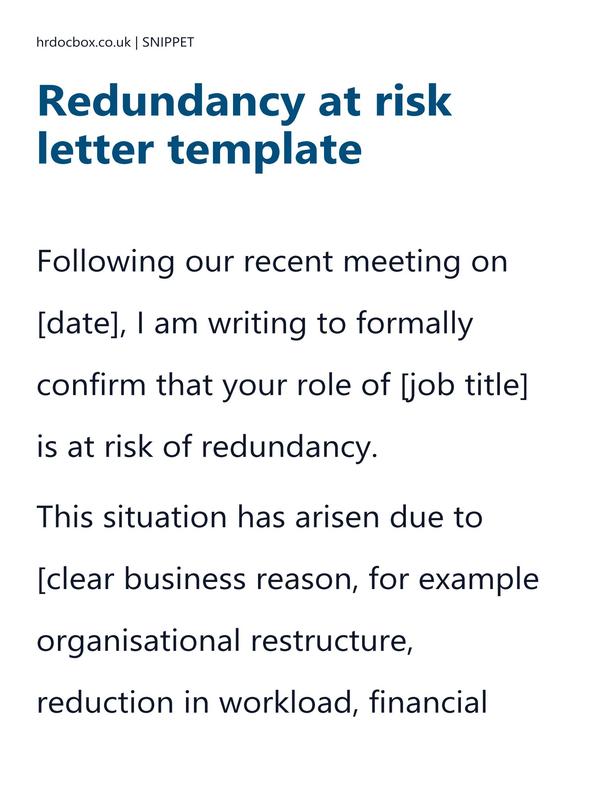
I am writing to confirm that, following a review of [the business / department / team], we are proposing changes which may result in redundancies. Unfortunately, this means that your role of [Job Title] is currently at risk of redundancy.

The reason for the proposed changes is [briefly explain the business reason, for example: a reduction in demand / financial pressures / restructuring / closure of a department / changes to the way work is organised].

At this stage, no final decision has been made about your employment. We are beginning a consultation process during which we will discuss the proposals with you

PREVIEW ENDS HERE

This is the end of the preview

You've seen just 30% of how the Redundancy at risk letter template is structured. Get the complete editable template instantly and customise it for your organisation.
£9.99

Need the complete Redundancy process?

Explore the Redundancy templates toolkit

What is a redundancy at risk letter?

Redundancy at risk letter template preview

A redundancy at risk letter is used to formally tell an employee that their role is potentially affected by a proposed redundancy exercise. It is normally issued at the beginning of the individual consultation process and explains the situation without presenting redundancy as a final decision.

The letter gives the employee a clear written explanation of why redundancies are being considered, what their current position is and what they can expect to happen next. It should be consistent with the information provided verbally when the employee is first told about the proposals.

What is it used for?

The letter provides an important starting point for consultation. It gives the employee enough information to understand why their role is at risk and provides a framework for the discussions that follow.

It can also help HR maintain a consistent approach where several employees are affected. While individual letters should be tailored to the employee and circumstances, the underlying explanation of the redundancy proposal and consultation process should be clear and consistent.

Who needs a redundancy at risk letter?

The template is designed for employers, HR professionals and managers who are beginning a redundancy process and need to formally notify an employee that their role is at risk.

It is particularly useful where employees are being placed into a selection pool and individual consultation will follow. The letter can also be adapted where a particular role is at risk without the need for a competitive selection exercise.

What should happen after the letter?

The letter should be followed by genuine consultation rather than treated as the notification of a decision that has already been made. The employer should listen to the employee's views, consider alternatives and review relevant information raised during the process.

The exact process will depend on the circumstances, including the number of proposed redundancies, whether collective consultation applies and whether there are existing policies or agreements that affect the process.

Example

A business has experienced a sustained reduction in orders and is reviewing the structure of one of its operational teams. It has identified that two roles may no longer be required, but several employees carry out similar work and a selection process is therefore necessary.

HR agrees the proposed selection pool and criteria with management before any individual employee is selected. The employees are then informed that their roles are at risk and are given written confirmation of the proposal.

The letter explains the commercial reason for the proposed redundancies, confirms that no final decision has been made and sets out how consultation will work. It also explains that the business will consider alternatives, including redeployment and suggestions from employees that could avoid or reduce redundancies.

During consultation, one employee identifies a potential vacancy in another part of the business and suggests that some of the affected work could be reorganised. HR investigates the proposal and considers whether it could reduce the number of redundancies required.

The at risk letter has therefore served as the starting point for a genuine consultation process rather than simply being used to tell the employee that they are losing their job.

The wider HR process

Related HR resources and workflow

Explore the HR resources that may be relevant before and / or after using the Redundancy at risk letter, helping you understand the wider process, maintain appropriate documentation and follow a consistent approach.

Previous
Guides
Managers guide to redundancy

If you are managing a redundancy process, this model guide provides effective support for you meet your obligations and help employees understand the process.

This
Redundancy at risk letter
Next
Letters
Final individual redundancy consultation meeting invitation letter

If you need to conclude consultation with a provisionally selected employee, send this model redundancy consultation final meeting invitation letter template.

Premium content

To continue reading, purchase this item or a parent toolkit, library or our full library.

Implementation guidance

Use these best practice actions, recommended timescales and process stages to understand when and how the Redundancy at risk letter should be used, helping ensure each step is handled consistently and appropriately documented.

Step Description Responsibility Timing (Days from Issue)
1 Prepare the Proposal: Confirm the business rationale, affected roles, selection pool and proposed consultation approach before notifying employees. HR / Management Day -14 to Day -1
2 Notify the Employee: Meet with the employee and explain that their role is at risk before providing the written confirmation. HR / Manager Day 0
3 Begin Consultation: Discuss the proposals, reasons for redundancy, selection arrangements and possible alternatives. HR / Manager / Employee Day 1 onwards
4 Consider Representations: Review questions, suggestions, alternative proposals and any information that could affect the proposed process or outcome. HR / Management Throughout consultation
5 Reach an Outcome: Once meaningful consultation is complete, confirm the outcome and, where redundancy remains necessary, proceed to the appropriate next stage. HR / Management Following consultation
Premium content

To continue reading, purchase this item or a parent toolkit, library or our full library.

Common mistakes

Understand the common mistakes to avoid when using this HR template, helping you reduce risk, prevent unnecessary costs and ensure the process is handled correctly.

  • Writing the letter as though the employee has already been made redundant.
  • Giving too little information about why the employee's role is at risk or what happens next.
  • Failing to explain that consultation is an opportunity to consider alternatives and employee suggestions.
  • Starting individual selection or consultation before the wider redundancy process has been properly established.
  • Using inconsistent explanations or processes for employees in the same redundancy exercise.
  • Failing to consider whether collective consultation obligations apply to the wider redundancy exercise.
Premium content

To continue reading, purchase this item or a parent toolkit, library or our full library.

HR considerations

UK employment law and best practice

This template is designed to support the process, but the document should be used alongside the relevant HR procedure and applied to the circumstances of the individual case.

An at risk letter forms part of the wider redundancy process and should support genuine consultation rather than present a final decision. Acas guidance states that employers should tell affected employees as soon as possible when redundancies are being considered and, for employees at risk, confirm in writing that they are at risk, explain possible alternatives and outline the consultation plans. :contentReference[oaicite:1]{index=1}

Make clear that redundancy is only proposed

The wording of an at risk letter matters. At this stage, the employee should understand that their role is potentially at risk and that consultation is taking place. Describing the employee as redundant or confirming their dismissal before consultation has taken place can undermine the credibility of the process.

Acas advises that employers should consult before making a final decision about redundancies. Consultation should involve listening to employees and genuinely considering their suggestions, including proposals that could avoid or reduce redundancies. :contentReference[oaicite:2]{index=2}

Explain the reason for the proposed redundancy

Employees should be given enough information to understand why their role is at risk. This might include reduced demand, financial pressures, restructuring, closure or changes to the way work is organised.

The explanation does not need to predict the final outcome, but it should provide a meaningful basis for consultation. Acas recommends discussing the proposed changes, why they are needed and ways of avoiding or reducing redundancies. :contentReference[oaicite:3]{index=3}

Explain what happens next

A good at risk letter should give the employee a clear understanding of the next stage, including how and when consultation will take place. This helps prevent uncertainty and gives the employee a reasonable opportunity to prepare questions and suggestions.

Where selection criteria or a selection pool are relevant, these should be addressed as part of the consultation process. Acas recommends that selection criteria are as objective and measurable as possible and are applied consistently across the selection pool. :contentReference[oaicite:4]{index=4}

Consider alternatives

Redundancy should not be treated as the only possible outcome. Employers should consider whether redundancies can be avoided or reduced, including through measures such as voluntary redundancy, changes to working arrangements or suitable alternative employment where appropriate.

Acas specifically recommends discussing alternatives and ways of avoiding or reducing redundancies during consultation. The at risk letter therefore works best when it opens the door to those discussions rather than simply announcing a predetermined outcome. :contentReference[oaicite:5]{index=5}

Individual and collective consultation

Where fewer than 20 redundancies are proposed, there are no specific statutory minimum consultation periods for individual consultation, but employers should still carry out genuine and meaningful consultation. GOV.UK states that failing to consult properly can result in an unfair dismissal claim. :contentReference[oaicite:6]{index=6}

Where 20 or more redundancies are proposed at one establishment within a 90-day period, the collective redundancy consultation rules under the Trade Union and Labour Relations (Consolidation) Act 1992 may apply. Employers must also consider the separate notification requirements that apply to collective redundancies. :contentReference[oaicite:7]{index=7}

Good HR practice

The letter should be consistent with what has been communicated verbally and with the wider redundancy documentation. HR should avoid unnecessarily alarming language, provide enough information to allow meaningful discussion and ensure managers understand that being "at risk" is not the same as having been selected for redundancy.

It is also good practice to maintain a clear record of the consultation process, including the information provided to employees, questions raised, alternatives considered and any changes made as a result. This creates a more transparent process and provides useful evidence of how decisions were reached.

You may also need these resources

FAQs

Does an at risk letter mean I have been made redundant?

No. It confirms that your role is potentially at risk and that consultation is taking place. It should not be used to communicate a final redundancy decision.

What should an employer include in an at risk letter?

Acas recommends confirming the risk of redundancy, explaining why redundancies are being considered, outlining the consultation process and identifying possible alternatives such as voluntary redundancy or redeployment. :contentReference[oaicite:8]{index=8}

Does an employee have to be consulted before redundancy?

Yes. Employers should carry out genuine and meaningful consultation before finalising redundancy decisions. For 20 or more proposed redundancies at one establishment within 90 days, specific collective consultation rules apply. :contentReference[oaicite:9]{index=9}

Can an employee challenge being placed at risk?

They can raise concerns, provide information and suggest alternatives during consultation. Employers should genuinely consider relevant points rather than treating the initial at risk decision as final. :contentReference[oaicite:10]{index=10}

Why use an HRDocBox redundancy at risk letter?

It provides a structured starting point informed by ACAS guidance, UK employment law and practical HR experience, helping employers communicate a difficult situation clearly while keeping the wider consultation process in view.

Why use HRDocBox rather than asking AI to write an at risk letter?

AI can produce a plausible letter, but effective redundancy documentation needs to fit the wider HR process. HRDocBox draws on deep HR knowledge, practical application and years of experience to consider what the document needs to achieve, not simply how the wording should sound.

How this content is developed and reviewed

The Redundancy at risk letter template is developed using a practical HR methodology that considers current UK employment legislation, ACAS guidance, CIPD good practice and the real-world HR process it supports. Templates are regularly reviewed and updated, with additional reviews triggered by significant changes to legislation, guidance or established HR practice, helping ensure each document remains practical, relevant and suitable for UK employers.

About the author

Darryl Horn, Chartered HR Director

Darryl is a Chartered HR professional with over 25 years' experience in senior HR and employee relations roles.

He has extensive practical experience of managing redundancy processes and founded hrdocbox to provide businesses with practical, professionally developed HR resources grounded in UK employment law and best practice.

HRDocBox has been creating practical UK HR documents since 2009.

Executive recommendation

"Darryl provides support and advice with excellent judgement, and has a strong understanding of people, policies and UK employment legislation."

"He is someone I trust; consistent, dependable, and committed to doing things properly."
RB
Ruth Brock Chief Executive Officer The Hygiene Bank
Get started today

HR confidence starts here

Whether you employ 5 people or 50, hrdocbox gives you the structure, documents and expertise needed to manage employees professionally and legally.

Download your FREE UK employment contract template

Professionally written and fully compliant with UK employment law
Download FREE contract
Free UK employment contract template