Disciplinary appeal hearing script template

£14.99

UK-specific • Editable • Instant download • 12 months' updates

The Disciplinary Appeal Hearing Script provides a structured framework for managers and HR professionals to conduct a disciplinary appeal fairly, consistently and professionally. It guides the appeal chair through opening the hearing, confirming the grounds of appeal, reviewing the evidence, questioning the parties and reaching a reasoned outcome.

Use this template to:

  • Structure a disciplinary appeal hearing.
  • Confirm and explore the employee's grounds of appeal.
  • Ensure the employee has a fair opportunity to present their case.
  • Guide questioning and discussion during the hearing.
  • Keep the appeal focused on the relevant issues.
  • Provide a consistent framework for reaching an appeal decision.
Disciplinary appeal hearing script template
2026 Reviewed

What's included in this template?

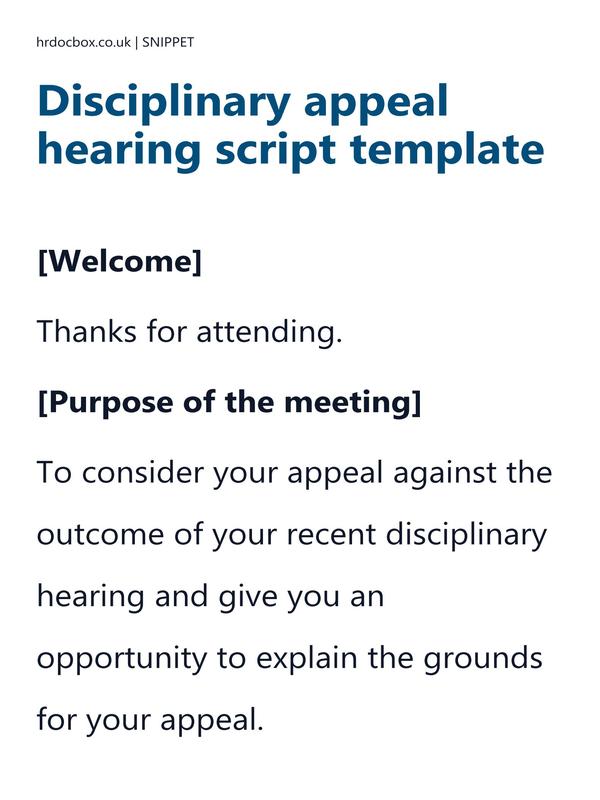
This template brings together the key information, sections and considerations you need to create a clear, comprehensive and professional HR document. Preview the document below.

  • Opening and introductions
  • Confirmation of the appeal grounds
  • Review of the disciplinary process
  • Questions and evidence
  • Employee and management submissions
  • Closing and outcome arrangements
Specifications
Access 12 months (includes updates)
Length 2 pages • 715 words
Jurisdiction England, Wales and Scotland
Based on UK employment law, ACAS guidance
Last review 24/08/2026
Next review 24/02/2027
Delivery Instant download
Formats .doc · .txt · email

Download .doc

Copy [to paste]

Email
Template

1   Before the hearing

1.1   Ensure that the appeal manager has received the relevant disciplinary documentation, including the original allegation(s), investigation evidence, disciplinary hearing notes, outcome letter, grounds of appeal and any supporting information submitted by the employee.

1.2   The appeal manager should be appropriately impartial and, where practicable, should not have been involved in the original disciplinary decision.

2   Opening the hearing

2.1   Good [morning / afternoon]. My name is [Name] and I will be chairing today's disciplinary appeal hearing.

2.2   Also present are [HR representative / note-taker / other attendees].

2.3   [Employee Name], can I confirm that you are [employee's name and job title]?

2.4   You have appealed against the disciplinary decision communicated to you on [date]. Before we begin, I would like to confirm that you understand the purpose of today's hearing and the grounds on which your appeal is being considered.

3   Confirming the appeal

3.1   Your appeal was submitted on [date] and sets out the following grounds:

3.2   [Summarise the employee's grounds of appeal accurately and neutrally.]

3.3   Can you confirm that these are the grounds you wish to pursue today?

3.4   Is there anything you would like to add or clarify before we begin?

4   Explain the appeal process

4.1   The purpose of today's hearing is to consider your appeal fairly and to review the grounds you have raised against the original disciplinary decision.

I

PREVIEW ENDS HERE

This is the end of the preview

You've seen just 30% of how the Disciplinary appeal hearing script template is structured. Get the complete editable template instantly and customise it for your organisation.
£14.99

Need the complete Disciplinary process?

Explore the Disciplinary templates toolkit

What is a disciplinary appeal hearing script?

Disciplinary appeal hearing script template preview

A Disciplinary Appeal Hearing Script provides a structured framework for conducting an appeal against a disciplinary decision. It helps the person chairing the appeal cover the important stages of the meeting while allowing the employee a genuine opportunity to explain why they believe the original decision should be reconsidered.

It can be adapted to the particular grounds of appeal and the organisation's disciplinary and appeal procedures.

What is it used for?

The script helps keep an appeal hearing focused and orderly. It provides prompts for confirming the grounds of appeal, reviewing relevant evidence, asking clarification questions, considering the original process and giving the employee an opportunity to make final comments.

It also helps the appeal chair distinguish between reviewing the original decision and simply repeating the disciplinary hearing.

Who should use it?

The resource is suitable for HR professionals, managers and senior employees who are responsible for chairing or supporting disciplinary appeal hearings.

It is particularly useful for organisations where managers may occasionally chair an appeal but do not conduct disciplinary appeals regularly.

How should it be used?

The script should be prepared alongside the employee's grounds of appeal and the documents from the original disciplinary process. It should be used as a guide rather than read word-for-word, allowing the appeal chair to ask appropriate questions and explore relevant issues.

The appeal chair should remain impartial, give appropriate consideration to the employee's points and document the reasons for the final decision.

Example

An employee receives a final written warning following a disciplinary hearing for alleged misconduct. The employee appeals, arguing that important evidence was not properly considered and that the sanction was disproportionate.

An independent manager is appointed to hear the appeal. Before the meeting, they review the original investigation, disciplinary hearing notes, evidence, outcome letter and the employee's grounds of appeal.

During the appeal hearing, the employee is given an opportunity to explain their concerns. The appeal chair asks questions about the evidence and invites the original decision-maker to respond to the points raised.

The appeal chair then considers the information presented and decides that some of the employee's concerns are justified. The original sanction is reviewed and the appeal is partially upheld. The decision and reasons are confirmed to the employee in writing.

The wider HR process

Related HR resources and workflow

Explore the HR resources that may be relevant before and / or after using the Disciplinary appeal hearing script, helping you understand the wider process, maintain appropriate documentation and follow a consistent approach.

Previous
Letters
Disciplinary decision appeal letter

Our Disciplinary Decision Appeal Letter Template supports fair processes, providing a platform for employees to address concerns and seek resolution.

This
Disciplinary appeal hearing script
Next
Letters
Disciplinary appeal hearing outcome confirmation letter

Our Disciplinary Appeal Hearing Outcome Confirmation Letter Template ensures clear communication of the final decision, promoting fairness and transparency.

Premium content

To continue reading, purchase this item or a parent toolkit, library or our full library.

Implementation guidance

Use these best practice actions, recommended timescales and process stages to understand when and how the Disciplinary appeal hearing script should be used, helping ensure each step is handled consistently and appropriately documented.

Step Description Responsibility Timing (Days from Issue)
1 Review the Appeal: Read the employee's grounds of appeal and identify the specific issues that need to be considered before arranging the hearing. Appeal Manager / HR Day -14 to Day -7
2 Prepare the Evidence: Review the original investigation, disciplinary hearing notes, outcome letter and relevant evidence, and identify any additional information requiring consideration. Appeal Manager / HR Day -7 to Day -3
3 Conduct the Appeal Hearing: Use the script to structure the hearing, allow the employee to present their grounds of appeal and ask appropriate questions to clarify the issues. Appeal Manager / HR Day 0
4 Consider the Appeal: Review the employee's arguments, evidence, original decision and any relevant procedural or mitigating factors before reaching a reasoned decision. Appeal Manager Day 1 to Day 5
5 Communicate the Outcome: Confirm the appeal decision in writing, explain the reasons for the outcome and record any further action required. Appeal Manager / HR Day 5 to Day 7
Premium content

To continue reading, purchase this item or a parent toolkit, library or our full library.

Common mistakes

Understand the common mistakes to avoid when using this HR template, helping you reduce risk, prevent unnecessary costs and ensure the process is handled correctly.

  • Allowing the person who made the original disciplinary decision to decide the appeal.
  • Treating the appeal as a simple repeat of the original disciplinary hearing.
  • Failing to properly consider the employee's specific grounds of appeal.
  • Dismissing new evidence without considering whether it could affect the original decision.
  • Reaching an outcome before all relevant evidence and representations have been considered.
  • Failing to explain the reasons for the appeal decision clearly.
Premium content

To continue reading, purchase this item or a parent toolkit, library or our full library.

HR considerations

UK employment law and best practice

This template is designed to support the process, but the document should be used alongside the relevant HR procedure and applied to the circumstances of the individual case.

A disciplinary appeal is an important part of a fair disciplinary process. The ACAS Code of Practice on disciplinary and grievance procedures recommends that employers give employees the right to appeal a formal disciplinary decision and deal with appeals promptly and fairly. (https://www.acas.org.uk/acas-code-of-practice-on-disciplinary-and-grievance-procedures)

Right to appeal

ACAS recommends that employers allow employees to appeal a disciplinary decision where they believe the decision was wrong or unfair, or where they have new evidence to present. The appeal procedure should normally be explained to the employee as part of the disciplinary outcome.

An appeal is therefore more than an opportunity for an employee to express dissatisfaction. It should provide a genuine opportunity to challenge the decision or process.

Impartiality

Where possible, the appeal should be dealt with by someone who was not involved in the original disciplinary decision. ACAS recommends that an appeal is handled impartially and, where practicable, by someone more senior who has not previously been involved. (https://www.acas.org.uk/disciplinary-procedure-step-by-step)

The size and structure of an organisation may affect who can reasonably hear an appeal, particularly in a small business, but employers should still take reasonable steps to ensure the process is fair.

Grounds of appeal

The appeal should address the employee's stated grounds rather than simply repeat the original disciplinary hearing. Grounds might include new evidence, procedural concerns, disagreement with the findings, inconsistency of treatment or the severity of the sanction.

The appeal chair should consider whether the original decision was reasonable in light of the evidence and whether anything raised during the appeal changes the position.

New evidence

Where an employee presents relevant new evidence, the appeal chair should consider it properly rather than dismissing it simply because it was not raised earlier. Depending on its significance, further investigation may be appropriate.

The employee should be given a reasonable opportunity to explain their evidence and respond to relevant points raised during the appeal.

Companion at the appeal

Employees have a statutory right to be accompanied at a disciplinary or grievance hearing by a trade union representative or workplace colleague where the relevant statutory conditions apply. The ACAS Code also recommends that employers allow employees to be accompanied at appeal hearings. (https://www.acas.org.uk/acas-code-of-practice-on-disciplinary-and-grievance-procedures)

The employer should therefore confirm the applicable right to accompaniment and follow its own disciplinary procedure consistently.

Outcome and reasons

The appeal decision should be communicated clearly and should explain the outcome and, where appropriate, the reasons for the decision. ACAS recommends confirming the appeal outcome in writing as soon as possible. (https://www.acas.org.uk/disciplinary-procedure-step-by-step)

A well-recorded decision helps demonstrate that the appeal was genuinely considered and provides clarity about what happens next.

You may also need these resources

FAQs

What should happen at a disciplinary appeal hearing?

The employee should be given an opportunity to explain their grounds of appeal, present relevant evidence and respond to relevant points. The appeal manager should review the original decision and consider whether the appeal provides grounds to uphold, overturn or amend it. ACAS recommends that appeals are dealt with fairly and impartially. (https://www.acas.org.uk/disciplinary-procedure-step-by-step)

Who should hear a disciplinary appeal?

Where practicable, the appeal should be heard by someone who was not involved in the original disciplinary decision and who is sufficiently senior or independent to review it objectively. The ACAS Code encourages employers to arrange appeals impartially. (https://www.acas.org.uk/acas-code-of-practice-on-disciplinary-and-grievance-procedures)

Can an appeal introduce new evidence?

Yes. New evidence can be relevant to an appeal, particularly where it could have affected the original decision. The appeal chair should consider the evidence properly and may need to carry out further investigation where appropriate.

Why use HRDocBox for a Disciplinary Appeal Hearing Script?

HRDocBox combines deep HR knowledge, practical application and years of experience with real disciplinary and employee relations situations. The script provides a structured framework while leaving room for the appeal chair to explore the specific grounds and evidence in each case.

Why use HRDocBox rather than asking AI to create the script?

AI can generate a generic meeting script, but a disciplinary appeal needs to reflect the ACAS process, the employee's grounds of appeal, procedural fairness, evidence and the distinction between an appeal and a repeat disciplinary hearing. HRDocBox combines UK employment-law knowledge with practical HR experience and purpose-built documentation.

How much detail should a disciplinary appeal script contain?

The script should provide enough structure to ensure the important stages are covered without forcing the appeal chair into a rigid question-and-answer format. The grounds of appeal and evidence will determine how much questioning and discussion is appropriate in each case.

How this content is developed and reviewed

The Disciplinary appeal hearing script template is developed using a practical HR methodology that considers current UK employment legislation, ACAS guidance, CIPD good practice and the real-world HR process it supports. Templates are regularly reviewed and updated, with additional reviews triggered by significant changes to legislation, guidance or established HR practice, helping ensure each document remains practical, relevant and suitable for UK employers.

About the author

Darryl Horn, Chartered HR Director

Darryl is a Chartered HR professional with over 25 years' experience in senior HR and employee relations roles.

He has extensive practical experience of managing disciplinary processes and founded hrdocbox to provide businesses with practical, professionally developed HR resources grounded in UK employment law and best practice.

HRDocBox has been creating practical UK HR documents since 2009.

Executive recommendation

"Darryl provides support and advice with excellent judgement, and has a strong understanding of people, policies and UK employment legislation."

"He is someone I trust; consistent, dependable, and committed to doing things properly."

RB
Ruth Brock Chief Executive Officer The Hygiene Bank
The Disciplinary appeal hearing script template is also included in these bundles:

Disciplinary toolkit Disciplinary toolkit 50 templates
£34.90

Management library Management library 468 templates
£79.99

Full library Full library 776 templates
£99.99

Get started today

HR confidence starts here

Whether you employ 5 people or 50, hrdocbox gives you the structure, documents and expertise needed to manage employees professionally and legally.

Download your FREE UK employment contract template

Professionally written and fully compliant with UK employment law

Download FREE contract
Free UK employment contract template