Libraries
780+ HR templates
Everything your business needs to stay compliant
Policies, contracts, letters, guidance and HR support tools for UK employers.
View full libraryPolicies, contracts, letters, guidance and HR support tools for UK employers.
View full libraryA practical manager's guide to deciding when an employee should be suspended following an allegation of misconduct. It helps managers assess the risks, understand when suspension may be appropriate, consider alternatives and work with HR to manage the situation fairly while an investigation takes place.
Use this guide to:

If you are managing a disciplinary process, the toolkit brings together practical HR templates covering investigations, hearings, warnings, appeals and outcomes.
This guide brings together the key information, considerations and practical guidance you need to understand the subject, make informed decisions and take an appropriate and consistent approach. Preview the document below.
Who is this guide for?
This guide is for managers dealing with an allegation of misconduct. It explains when suspension may be appropriate, when it may be possible to manage the situation without suspension, and what managers should do before taking action.
Need advice?
Managers should involve the HR or People team at an early stage, particularly where an allegation could potentially result in formal disciplinary action. HR can advise and support managers with assessing whether suspension or an alternative approach is appropriate.
1. What is suspension?
Suspension is a temporary instruction for an employee not to attend work or undertake their normal duties while an investigation is carried out.
Suspension is not a disciplinary sanction and does not mean the employee is guilty. It should only be used where there is a genuine reason why allowing the employee to remain at work could create a significant risk.
Suspension should be kept under review and brought to an end as soon as it is no longer necessary.
2. The first question: do we actually need to suspend?
Do not automatically suspend someone simply because an allegation is serious or could potentially amount to gross misconduct.
Instead, ask:
"What risk would keeping this employee at work create while we investigate?"
Consider whether the employee could:
If there is no significant ongoing risk, suspension may not be necessary.
3. When might
You've seen 20% of how the Managers guide to employee suspensions is structured. Get the complete editable template instantly and customise it for your organisation.
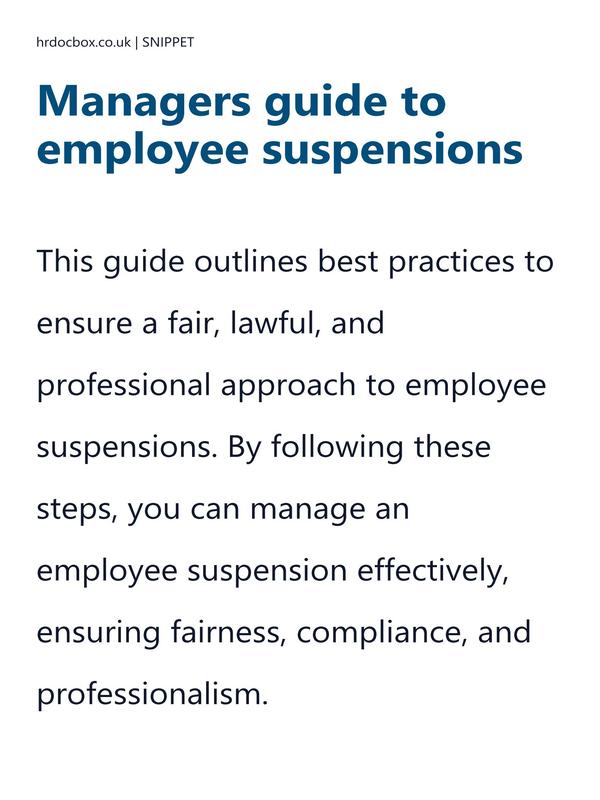
Suspension can be an important risk-management measure when dealing with an allegation of serious misconduct, but it should not be an automatic response or used as a punishment. This guide gives managers a straightforward framework for deciding whether suspension is genuinely necessary and what other options may be available.
The starting point is to consider what could happen if the employee remains at work while the facts are established. This could include interference with evidence, influencing witnesses, further misconduct, retaliation, health and safety concerns or inappropriate access to systems, records or information.
Where the risk can reasonably be controlled without removing the employee from work, alternatives should be considered. Depending on the circumstances, this could include changing duties, shifts or location, restricting contact, removing access to systems or stock, or temporarily assigning alternative work.
Managers should involve the HR or People team at an early stage, particularly where an allegation could potentially result in formal disciplinary action. HR can help assess the risks, consider alternatives and agree an appropriate investigation process, while the manager provides important knowledge about the workplace and operational circumstances.
A decision not to suspend does not mean that suspension can never be considered later. Equally, where an employee is suspended, the position should be reviewed regularly. The aim is to protect the integrity of the investigation while treating the employee and everyone involved fairly.
Related HR resources and workflow
Explore the HR resources that may be relevant before and / or after using the Managers guide to employee suspensions, helping you understand the wider process, maintain appropriate documentation and follow a consistent approach.

A suspension policy setting out when an employee may be suspended from work, the alternatives that should be considered, and how suspension should be authorised, communicated, reviewed and managed during an investigation or formal process.

Our Notice of Suspension Letter Template ensures a formal and clear communication during employee suspension, preserving procedural fairness.
Use the following as a practical framework for assessing the situation, considering the available options and deciding on the appropriate course of action. Follow each step in sequence to support consistent, informed and appropriate decision-making.
Understand the common mistakes to avoid when using this HR template, helping you reduce risk, prevent unnecessary costs and ensure the process is handled correctly.
No. Even an allegation that could potentially amount to gross misconduct does not automatically justify suspension. The manager should consider the actual risks created by keeping the employee at work and whether those risks can be managed in another way.
Consider whether the employee could interfere with evidence, influence or intimidate witnesses, repeat the alleged behaviour, retaliate against someone involved, create a health and safety risk or access relevant systems, records or information. The HR/People team can help assess these risks.
Depending on the circumstances, alternatives could include changing duties, shifts or location, restricting contact with particular people, removing access to systems or stock, working from home or temporarily assigning different work.
Yes. A decision not to suspend initially does not prevent the employer reconsidering the position if new information creates a genuine risk that cannot reasonably be managed another way.
Managers should establish enough information to understand the immediate situation and risks, but should avoid conducting a wide informal investigation themselves. The HR/People team can help determine how the investigation should be handled and who should carry it out.
AI can generate general suggestions, but HRDocBox provides structured, UK-focused resources designed around practical workplace situations. This guide gives managers a consistent framework for assessing suspension, considering alternatives and escalating appropriately to HR, helping organisations avoid relying on a different AI-generated approach every time a misconduct issue arises.
How this content is developed and reviewed
The Managers guide to employee suspensions is developed using a practical HR methodology that considers current UK employment legislation, ACAS guidance, CIPD good practice and the real-world HR process it supports. Templates and supporting information are regularly reviewed and updated, with additional reviews triggered by significant changes to legislation, guidance or established HR practice, helping ensure each document remains practical, relevant and suitable for UK employers.
Darryl Horn, Chartered HR Director
Darryl is a Chartered HR professional with over 25 years' experience in senior HR and employee relations roles.
He has extensive practical experience of managing disciplinary HR processes and founded hrdocbox to provide businesses with practical, professionally developed HR resources grounded in UK employment law and best practice.
HRDocBox has been creating practical UK HR documents since 2009.
"Darryl provides support and advice with excellent judgement, and has a strong understanding of people, policies and UK employment legislation."
"He is someone I trust; consistent, dependable, and committed to doing things properly."
















Whether you employ 5 people or 50, hrdocbox gives you the structure, documents and expertise needed to manage employees professionally and legally.
Professionally written and fully compliant with UK employment law
Access a free contract template instantly - or save 10% on any document today.
Use this code at checkout for 10% off anything!
Includes instant download, updates, and full access to your HR templates.