Libraries
780+ HR templates
Everything your business needs to stay compliant
Policies, contracts, letters, guidance and HR support tools for UK employers.
View full libraryPolicies, contracts, letters, guidance and HR support tools for UK employers.
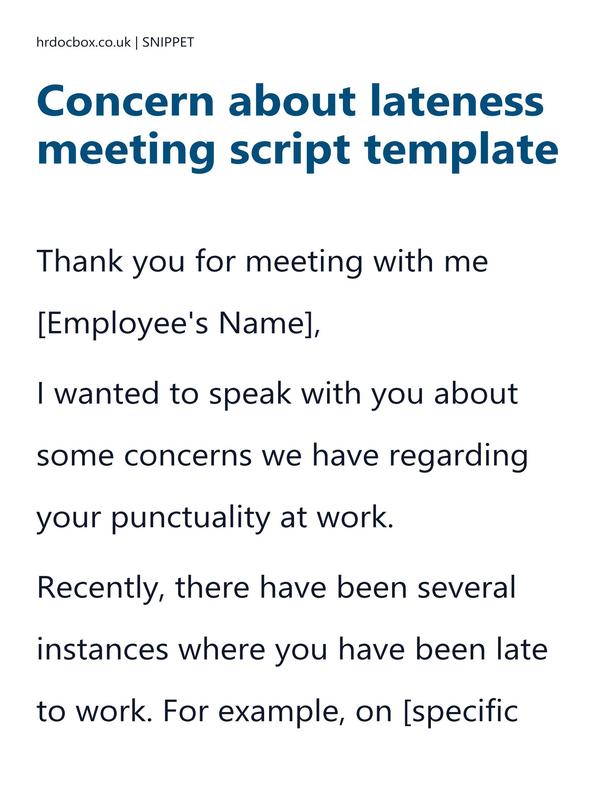
View full libraryThis Concern About Lateness or Timekeeping Meeting Script provides a structured way for managers to discuss repeated or significant lateness with an employee. It helps managers explain the concern, understand the reasons for lateness, consider any relevant support and agree clear expectations for improvement.
Use this script to:
<p>If you are managing a disciplinary process, the toolkit brings together practical HR templates covering investigations, hearings, warnings, appeals and outcomes.</p>
Opening the meeting
Thank you for meeting with me. I wanted to have a conversation with you about your recent timekeeping and, in particular, the occasions when you have arrived after your expected start time.
The purpose of today's meeting is to understand what has been happening, give you an opportunity to explain any reasons for the lateness and discuss what may need to happen going forward.
This is intended to be a constructive conversation, and I would like to hear your perspective before we agree any next steps.
Explaining the concern
Looking
You've seen 20% of how the Concern about lateness or timekeeping meeting script template is structured. Get the complete editable template instantly and customise it for your organisation.

This meeting script helps managers hold a structured conversation when an employee has been arriving late for work. It provides a practical framework for raising the concern without making assumptions and gives the employee an opportunity to explain what is happening.
The meeting should clearly explain the attendance concern, including the relevant pattern or examples of lateness. Managers should focus on the facts and explain the impact that repeated lateness may have on the employee's role, colleagues, customers or the operation.
The employee should be given a reasonable opportunity to explain the reasons for their lateness. There may be practical, personal, health-related or work-related circumstances that need to be understood before deciding what action is appropriate.
Where the discussion identifies an underlying issue, the manager should consider whether any appropriate support, reasonable adjustment or other practical measure may be relevant. Any action should reflect the circumstances and the organisation's normal policies and procedures.
The manager should make clear what attendance and timekeeping standards are expected and agree any practical steps the employee needs to take. Where appropriate, the discussion can also confirm how and when progress will be reviewed.
A follow-up conversation can establish whether punctuality has improved and whether the agreed arrangements are working. If lateness continues, the manager should consider whether further action is appropriate under the organisation's attendance, capability or disciplinary procedures.
Use these best practice actions, recommended timescales and process stages to understand when and how the Concern about lateness or timekeeping meeting script should be used, helping ensure each step is handled consistently and appropriately documented.
Understand the common mistakes to avoid when using this HR template, helping you reduce risk, prevent unnecessary costs and ensure the process is handled correctly.
A meeting may be appropriate where lateness has become a recurring concern, is having a significant impact on the workplace or does not improve following an earlier informal discussion. The manager should consider the circumstances and relevant attendance information before arranging the meeting.
The manager should explain the concern using factual examples, describe any relevant impact and give the employee an opportunity to respond. The conversation should focus on understanding the situation and agreeing what needs to happen next.
Yes. Understanding the reason for lateness can help the manager determine whether there is a practical solution or whether additional support may be appropriate. The manager should listen to the explanation before deciding what action to take.
If the employee indicates that a health condition or disability may be contributing to their lateness, the manager should consider whether further information, support or reasonable adjustments may be appropriate and seek HR advice where necessary.
It can, depending on the circumstances, the employee's contract, the organisation's policies and the nature of the attendance concern. If formal action is considered, the employer should follow an appropriate and fair process.
AI can produce a generic lateness meeting script, but HRDocBox provides structured, UK-focused HR documentation designed around practical workplace processes. This script gives managers a consistent framework for raising concerns, understanding the employee's circumstances and agreeing appropriate next steps.
How this content is developed and reviewed
The Concern about lateness or timekeeping meeting script template is developed using a practical HR methodology that considers current UK employment legislation, ACAS guidance, CIPD good practice and the real-world HR process it supports. Templates and supporting information are regularly reviewed and updated, with additional reviews triggered by significant changes to legislation, guidance or established HR practice, helping ensure each document remains practical, relevant and suitable for UK employers.
Darryl Horn, Chartered HR Director
Darryl is a Chartered HR professional with over 25 years' experience in senior HR and employee relations roles.
He has extensive practical experience of managing disciplinary HR processes and founded hrdocbox to provide businesses with practical, professionally developed HR resources grounded in UK employment law and best practice.
HRDocBox has been creating practical UK HR documents since 2009.
"Darryl provides support and advice with excellent judgement, and has a strong understanding of people, policies and UK employment legislation."
"He is someone I trust; consistent, dependable, and committed to doing things properly."




















Whether you employ 5 people or 50, hrdocbox gives you the structure, documents and expertise needed to manage employees professionally and legally.
Professionally written and fully compliant with UK employment law
Access a free contract template instantly - or save 10% on any document today.
Use this code at checkout for 10% off anything!
Includes instant download, updates, and full access to your HR templates.