Concern about lateness letter template

£9.99
5.0
Customer reviews 1 review
UK-specific Editable Instant download 12 months' updates

A concern about lateness letter for raising repeated or unacceptable lateness with an employee and making clear the expected standard of attendance and punctuality.

Use this template to:

  • Raise concerns about repeated lateness or poor punctuality
  • Set out the dates and pattern of lateness clearly
  • Remind the employee of the expected start time
  • Give the employee an opportunity to explain any underlying reasons
  • Agree practical steps for improving punctuality
  • Create an appropriate informal record before considering further action
Concern about lateness letter template
2026 Reviewed
Get the complete resource

Don't just buy one template — get the complete Disciplinary templates toolkit

If you are managing a disciplinary process, the toolkit brings together practical HR templates covering investigations, hearings, warnings, appeals and outcomes.

50 templates • £24.99 • 12 months' access & updates
View the complete toolkit

What's included in this template?

This template brings together the key information, sections and considerations you need to create a clear, comprehensive and professional HR document. Preview the document below.

  • Details of the lateness concern
  • Record of affected dates
  • Expected working hours
  • Opportunity to explain the circumstances
  • Improvement expectations
  • Follow-up arrangements
Template

Download .doc

Copy [to paste]

Email

[Sender name]

[Sender address]

[date]

[Recipient name]

[Recipient address]


Dear [Recipient first name],

Concern about lateness

I am writing following our recent discussion about your attendance and, in particular, concerns regarding your punctuality.

Your normal working hours are [start time] to [finish time], and you are expected to be ready to start work at [start time] each working day.

We have noted the following occasions when you arrived after your scheduled start time:

Date Expected start time Actual arrival time Minutes late


We discussed the reasons

PREVIEW ENDS HERE

This is the end of the preview

You've seen 30% of how the Concern about lateness letter template is structured. Get the complete editable template instantly and customise it for your organisation.
£9.99
Specifications
Access 12 months, with updates
Length 2 pages • 371 words
Jurisdiction England, Wales, Scotland
Based on UK law, ACAS guidance
Last update 08/09/2026
Reason Annual template review.
Next review 08/03/2027
Delivery & Format Instant digital delivery, .doc · .txt · email

What is a concern about lateness letter?

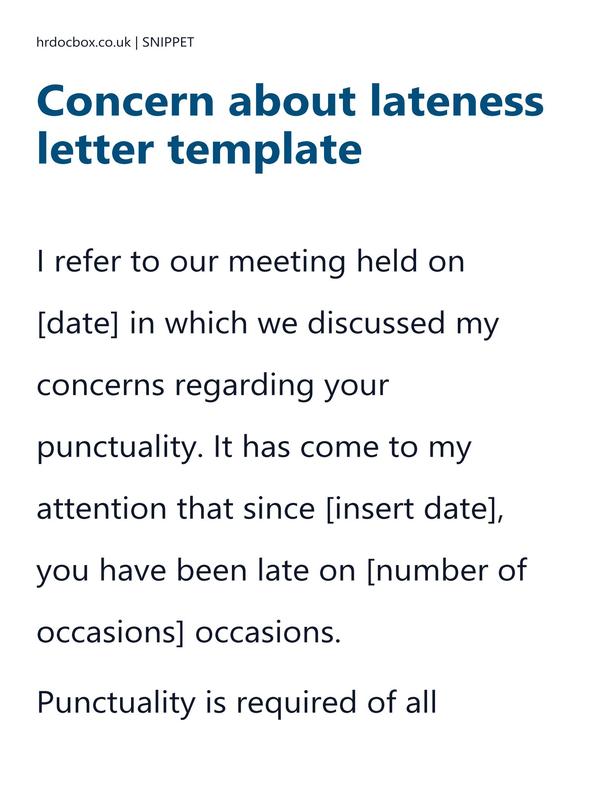
Concern about lateness letter template preview

Occasional lateness may happen for genuine and unavoidable reasons, but a repeated pattern can affect colleagues, customers and the operation of a business. This letter provides a professional way to raise concerns at an early stage and make clear what improvement is expected without unnecessarily moving straight to formal disciplinary action.

Addressing the pattern of lateness

The letter allows the employer to identify the dates and frequency of lateness and explain why punctuality is important. Keeping the discussion factual helps avoid the employee feeling that the concern is based on assumptions or isolated incidents.

Giving the employee an opportunity to explain

Lateness can sometimes be connected to transport difficulties, caring responsibilities, health issues, disability or another underlying circumstance. The employee should be given an opportunity to explain what is happening before conclusions are reached about their conduct or performance.

Setting clear expectations for improvement

The letter confirms the employee's expected start time and sets out what needs to change. Where appropriate, it can also identify practical measures, such as allowing the employee to raise difficulties with their manager or agreeing a review period.

Providing an informal step before formal action

Where the concern is relatively minor or the employer is seeking to address the issue informally, this letter can provide a useful written record. If lateness continues, the employer can then consider whether further action under its attendance, capability or disciplinary procedures is appropriate.

Example

An employee is contracted to start work at 8:00am but has arrived after the scheduled start time on six occasions during the previous month. The delays range from five to 25 minutes and are beginning to affect the opening of the department and the workload of colleagues who have to cover until the employee arrives.

The manager reviews the attendance records and meets with the employee to discuss the pattern. The employee explains that they have recently been experiencing problems with their usual transport arrangements but accepts that they need to make alternative arrangements to arrive on time.

Following the discussion, the manager sends a concern about lateness letter confirming the dates discussed, the required 8:00am start time and the expectation that the employee will be ready to begin work at that time. The letter also confirms that the employee should speak to the manager if there is an ongoing difficulty that could affect their attendance.

The employee's punctuality is reviewed over the following month. Their attendance improves significantly and there are no further concerns, so no formal action is required. The letter remains as a record of the informal management intervention.

The wider HR process

Related HR resources and workflow

Explore the HR resources that may be relevant before and / or after using the Concern about lateness letter, helping you understand the wider process, maintain appropriate documentation and follow a consistent approach.

Previous
Guides
Managers guide to timekeeping

Our Guide to Timekeeping for Managers helps leaders improve punctuality, manage attendance issues effectively, and maintain team productivity with confidence.

This
Concern about lateness letter
Next
Policies
Timekeeping policy

Our Timekeeping Policy Template promotes punctuality, accountability, and efficient workflow management for a more productive work environment.

Premium content

To continue reading, purchase this item or a parent toolkit, library or our full library.

Implementation guidance

Use these best practice actions, recommended timescales and process stages to understand when and how the Concern about lateness letter should be used, helping ensure each step is handled consistently and appropriately documented.

Step Description Responsibility Timing
1 Review attendance records and establish the dates, frequency and duration of the lateness concern. Manager / HR Before discussion
2 Meet with the employee to explain the concern and give them an opportunity to provide an explanation or identify any underlying issues. Manager As soon as practical
3 Consider whether any personal, health, disability or other circumstances require further investigation or support before deciding what action is appropriate. Manager / HR During review
4 Issue the letter confirming the concern, required standard and agreed actions for improving punctuality. Manager / HR Following discussion
5 Monitor attendance over the agreed review period and decide whether the matter has been resolved or requires further action. Manager / HR During review period
Premium content

To continue reading, purchase this item or a parent toolkit, library or our full library.

Common mistakes

Understand the common mistakes to avoid when using this HR template, helping you reduce risk, prevent unnecessary costs and ensure the process is handled correctly.

  • Raising concerns without checking the employee's actual attendance record.
  • Focusing only on the lateness without giving the employee an opportunity to explain.
  • Ignoring possible health, disability or other underlying circumstances.
  • Using unnecessarily accusatory or disciplinary language for an informal concern.
  • Failing to explain clearly what improvement is expected.
  • Allowing repeated lateness to continue without reviewing whether further action is required.
Premium content

To continue reading, purchase this item or a parent toolkit, library or our full library.

HR considerations

UK employment law and best practice

This template is designed to support the process, but the document should be used alongside the relevant HR procedure and applied to the circumstances of the individual case.

Attendance and punctuality

Employers can set reasonable working hours and attendance expectations and can address persistent lateness where an employee does not meet those requirements. The employer should apply its policies and contractual arrangements consistently.

Informal management

Where lateness is relatively minor or appears capable of being resolved through discussion, an informal conversation and written confirmation can be an appropriate first step. If the issue is serious or persistent, the employer should consider its formal disciplinary or attendance procedure.

Right to be accompanied

An informal meeting about lateness does not normally carry the statutory right to be accompanied. If the matter progresses to a formal disciplinary hearing, the statutory right to be accompanied may apply. https://www.acas.org.uk/disciplinary-procedure-step-by-step/step-4-the-disciplinary-meeting

Disability and reasonable adjustments

If lateness may be connected to a disability, employers should consider whether reasonable adjustments are appropriate before taking action. This may include adjustments to working arrangements or start times where reasonable and appropriate. https://www.acas.org.uk/reasonable-adjustments

Discrimination

Employers should take care not to treat employees less favourably because of a protected characteristic and should consider whether an attendance requirement could disadvantage a particular employee in circumstances where a reasonable adjustment or other approach may be appropriate. https://www.legislation.gov.uk/ukpga/2010/15/contents

Fair and consistent treatment

Similar cases should normally be handled consistently, while recognising that relevant individual circumstances may justify a different approach. Employers should retain sufficient records to explain how attendance concerns have been addressed.

Disciplinary procedure

Persistent lateness may potentially become a disciplinary matter where it amounts to misconduct or breaches contractual attendance requirements. Formal disciplinary action should follow a fair procedure and take account of the Acas Code where applicable. https://www.acas.org.uk/acas-code-of-practice-on-disciplinary-and-grievance-procedures

Best practice

The purpose of an informal concern letter should be to address the issue early, make expectations clear and give the employee a reasonable opportunity to improve. It should not be presented as a formal warning unless the employer is actually commencing a formal disciplinary process.

You may also need these resources

FAQs

Is repeated lateness a disciplinary matter?

It can be, particularly where lateness is persistent, unexplained and contrary to the employee's contractual working arrangements. However, an employer may choose to address a minor or emerging concern informally before considering formal disciplinary action.

Should I speak to the employee before sending a lateness letter?

Yes, wherever practical. Discussing the concern first gives the employee an opportunity to explain the circumstances and allows the employer to identify whether there is an underlying issue that needs to be considered.

What if the employee has a genuine reason for being late?

The employer should consider the explanation carefully. A genuine occasional difficulty may not require further action, while an ongoing issue may require an agreed solution. If the reason could relate to a disability or another protected circumstance, further consideration may be necessary.

Can I deduct pay for lateness?

Employers should check the employee's contract and pay arrangements before making deductions. A deduction should not be used automatically as a disciplinary measure, and any deduction must comply with the rules governing deductions from wages. https://www.acas.org.uk/deductions-from-pay-and-wages

Does this letter count as a formal warning?

Not necessarily. This template is designed for raising an informal concern and setting expectations. If the employer intends to issue a formal warning, it should normally follow the organisation's disciplinary procedure and the principles of the Acas Code.

Why use HRDocBox rather than AI?

AI can generate a basic letter about lateness, but it may blur the distinction between an informal management conversation and formal disciplinary action or overlook issues such as reasonable adjustments and consistent treatment. HRDocBox templates are built around practical UK HR processes and provide structured wording that managers can adapt and use as part of a defensible attendance process.

Customer reviews

What people are saying

Back to product

We got good use from Concern about lateness letter

Matthew Lee • 18 Apr 2025

The manager could use it without needing a long explanation first. The finished letter looked professional without sounding overly corporate. The document fitted neatly into the steps we were already following.

How this content is developed and reviewed

The Concern about lateness letter template is developed using a practical HR methodology that considers current UK employment legislation, ACAS guidance, CIPD good practice and the real-world HR process it supports. Templates and supporting information are regularly reviewed and updated, with additional reviews triggered by significant changes to legislation, guidance or established HR practice, helping ensure each document remains practical, relevant and suitable for UK employers.

About the author

Darryl Horn, Chartered HR Director

Darryl is a Chartered HR professional with over 25 years' experience in senior HR and employee relations roles.

He has extensive practical experience of managing disciplinary HR processes and founded hrdocbox to provide businesses with practical, professionally developed HR resources grounded in UK employment law and best practice.

HRDocBox has been creating practical UK HR documents since 2009.

Executive recommendation

"Darryl provides support and advice with excellent judgement, and has a strong understanding of people, policies and UK employment legislation."

"He is someone I trust; consistent, dependable, and committed to doing things properly."

RB
Ruth Brock Chief Executive Officer The Hygiene Bank
Get started today

HR confidence starts here

Whether you employ 5 people or 50, hrdocbox gives you the structure, documents and expertise needed to manage employees professionally and legally.

Download your FREE UK employment contract template

Professionally written and fully compliant with UK employment law
Download FREE contract
Free UK employment contract template