Libraries
780+ HR templates
Everything your business needs to stay compliant
Policies, contracts, letters, guidance and HR support tools for UK employers.
View full libraryPolicies, contracts, letters, guidance and HR support tools for UK employers.
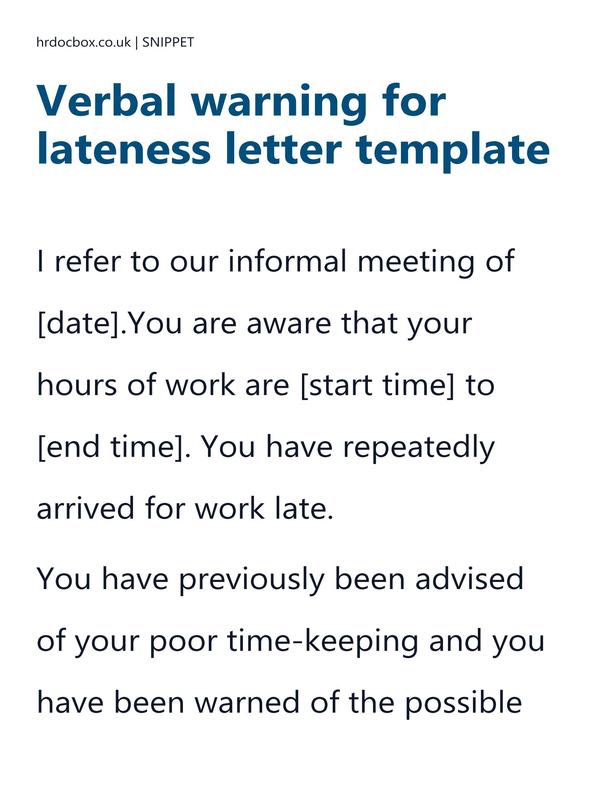
View full libraryUse this Verbal Warning for Lateness Letter to document a verbal warning where an employee has been arriving late for work. It helps managers explain the concern, set clear attendance expectations and record the improvement required in line with the organisation's disciplinary policy.
Use this template to:

<p>If you are managing a disciplinary process, the toolkit brings together practical HR templates covering investigations, hearings, warnings, appeals and outcomes.</p>
This template brings together the key information, sections and considerations you need to create a clear, comprehensive and professional HR document. Preview the document below.
[Sender name]
[Sender address]
[date]
[Recipient name]
[Recipient address]
Dear [Recipient first name],
Verbal Warning for Lateness
Further to our discussion on [Date of Discussion], I am writing to confirm the verbal warning issued in relation to your lateness.
Reason for the warning
We discussed concerns regarding your punctuality, including the following instances:
| Date | Required start time | Actual arrival time | Minutes late |
Reliable timekeeping is important to the effective operation of the business and to ensure that work is
You've seen 20% of how the Verbal warning for lateness letter template is structured. Get the complete editable template instantly and customise it for your organisation.
Repeated lateness can disrupt operations, affect colleagues and create difficulties with customer service or production planning. A verbal warning can help address the issue by making expectations clear and giving the employee an opportunity to improve.
This letter template allows employers to document a verbal warning for lateness, including the concerns discussed, the employee's explanation, the punctuality standard required and the consequences of further lateness. It should be adapted to the organisation's disciplinary policy and the circumstances of the case.
Before issuing a warning, establish the relevant dates and times, check the applicable working hours and consider the employee's explanation. Repeated lateness without a valid reason may justify disciplinary action, but managers should consider relevant circumstances, including disability-related issues, reasonable adjustment requests, caring emergencies or transport disruption where relevant.
Explain the required start time, any clocking-in or reporting requirements and the standard expected going forward. Where appropriate, agree a monitoring period and identify any support or adjustments needed. The employee should understand what must change and how improvement will be assessed.
Confirm what was discussed, the warning's status and how long it will remain active if the organisation's policy specifies a period. Explain that further lateness may lead to additional disciplinary action in line with the policy. Keep the record confidential and ensure the warning is consistent with how comparable cases are handled.
Check whether the warning is informal or a formal disciplinary sanction. An informal verbal warning should not be treated later as a formal warning. If a formal warning is being considered, follow the organisation's disciplinary procedure, including the formal meeting and right to be accompanied where applicable. A written letter confirming a verbal warning does not remove those procedural requirements.
Related HR resources and workflow
Explore the HR resources that may be relevant before and / or after using the Verbal warning for lateness letter, helping you understand the wider process, maintain appropriate documentation and follow a consistent approach.

Our Guide to Timekeeping for Managers helps leaders improve punctuality, manage attendance issues effectively, and maintain team productivity with confidence.

This First Written Warning for Lateness Letter provides a formal disciplinary outcome where an employee has been found to have failed to meet the organisation’s required standards for punctuality.
Use these best practice actions, recommended timescales and process stages to understand when and how the Verbal warning for lateness letter should be used, helping ensure each step is handled consistently and appropriately documented.
Understand the common mistakes to avoid when using this HR template, helping you reduce risk, prevent unnecessary costs and ensure the process is handled correctly.
Yes, where appropriate under your organisation's policy. For minor or initial concerns, an informal conversation or verbal warning may be sufficient. Repeated lateness without a valid reason may justify formal disciplinary action. Check your policy and consider the employee's explanation before deciding what response is proportionate.
It is good practice to keep a confidential written record of an informal or verbal warning. The letter should make clear whether the warning is informal or a formal disciplinary sanction, what improvement is required and what may happen if lateness continues. Do not describe an informal warning in a way that suggests a formal disciplinary process has taken place when it has not.
There is generally no statutory right to be accompanied at an informal conversation that cannot result in formal disciplinary action. However, a statutory right to be accompanied applies at a formal disciplinary hearing that could result in a formal warning or other disciplinary action, where the employee makes a reasonable request. Your policy may provide additional rights.
Follow your organisation's disciplinary policy. If it specifies a period, confirm that period in the letter. For an informal warning, make clear how long it will be considered when reviewing the issue, if applicable. Apply the policy consistently and avoid keeping warning records longer than necessary under the organisation's retention arrangements.
HRDocBox provides practical HR templates to help managers address workplace issues consistently. This letter gives you a clear way to document lateness concerns, set expectations, record the improvement required and explain the next steps, while allowing you to adapt the wording to your disciplinary policy.
AI can help draft a letter, but it may blur the distinction between an informal warning and a formal disciplinary sanction or overlook your organisation's procedure. This template provides a reusable structure for recording the issue and required improvement. Check the facts, policy and applicable ACAS guidance before issuing it.
How this content is developed and reviewed
The Verbal warning for lateness letter template is developed using a practical HR methodology that considers current UK employment legislation, ACAS guidance, CIPD good practice and the real-world HR process it supports. Templates and supporting information are regularly reviewed and updated, with additional reviews triggered by significant changes to legislation, guidance or established HR practice, helping ensure each document remains practical, relevant and suitable for UK employers.
Darryl Horn, Chartered HR Director
Darryl is a Chartered HR professional with over 25 years' experience in senior HR and employee relations roles.
He has extensive practical experience of managing disciplinary HR processes and founded hrdocbox to provide businesses with practical, professionally developed HR resources grounded in UK employment law and best practice.
HRDocBox has been creating practical UK HR documents since 2009.
"Darryl provides support and advice with excellent judgement, and has a strong understanding of people, policies and UK employment legislation."
"He is someone I trust; consistent, dependable, and committed to doing things properly."



















Whether you employ 5 people or 50, hrdocbox gives you the structure, documents and expertise needed to manage employees professionally and legally.
Professionally written and fully compliant with UK employment law
Access a free contract template instantly - or save 10% on any document today.
Use this code at checkout for 10% off anything!
Includes instant download, updates, and full access to your HR templates.