Libraries
780+ HR templates
Everything your business needs to stay compliant
Policies, contracts, letters, guidance and HR support tools for UK employers.
View full libraryPolicies, contracts, letters, guidance and HR support tools for UK employers.
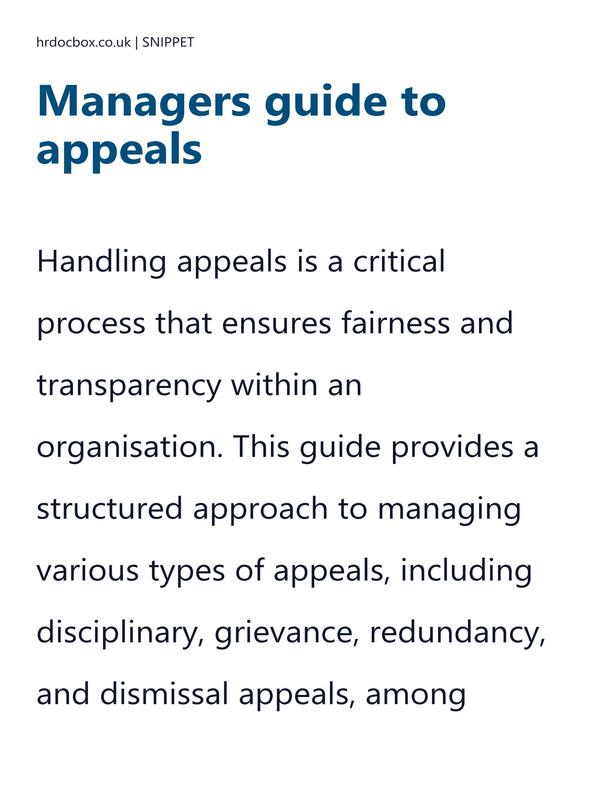
View full libraryA practical manager's guide to handling workplace appeals, helping managers understand when an appeal may arise, how to respond fairly, and how to support a consistent, impartial and well-documented appeal process.
Use this guide to:
<p>If you are managing a disciplinary process, the toolkit brings together practical HR templates covering investigations, hearings, warnings, appeals and outcomes.</p>
This guide brings together the key information, considerations and practical guidance you need to understand the subject, make informed decisions and take an appropriate and consistent approach. Preview the document below.
Overview
An appeal gives an employee an opportunity to challenge a workplace decision they believe was wrong, unfair or reached through an inappropriate process.
Managers should approach appeals objectively and avoid treating them as a formality. The purpose is to establish whether the original decision should be upheld, varied or overturned.
1. Understand the grounds of appeal
Start by identifying exactly what the employee is challenging.
Common grounds may include:
Do not assume that an appeal simply means the employee disagrees with the original decision. Understand what they are asking the organisation to reconsider.
2. Appoint an appropriate appeal manager
Where practicable, the appeal should be heard by someone who was not involved in making the original decision.
The appeal manager should have sufficient authority to make an appropriate decision and should be able to approach the case impartially.
HR should be
You've seen 20% of how the Managers guide to appeals is structured. Get the complete editable template instantly and customise it for your organisation.

An appeal gives an employee an opportunity to challenge a workplace decision they believe was wrong, unfair or reached through an inappropriate process. Managers have an important role in ensuring appeals are handled consistently, objectively and without unnecessary delay.
An appeal should be considered carefully rather than treated as an opportunity to simply repeat the original process. Managers should understand the employee's grounds of appeal and establish what decision or aspect of the process is being challenged.
The appeal should normally be considered by someone who was not involved in making the original decision and who has appropriate authority. The relevant documents and evidence should be reviewed before the appeal meeting.
The appeal meeting should give the employee a reasonable opportunity to explain why they believe the original decision should be reconsidered. Managers should listen objectively, ask appropriate questions and avoid reaching a conclusion before all relevant information has been considered.
The appeal outcome should be based on the information considered during the appeal and should be communicated clearly. Depending on the circumstances, the original decision may be upheld, varied or overturned. The outcome and any resulting actions should be recorded appropriately.
Use the following as a practical framework for assessing the situation, considering the available options and deciding on the appropriate course of action. Follow each step in sequence to support consistent, informed and appropriate decision-making.
Understand the common mistakes to avoid when using this HR template, helping you reduce risk, prevent unnecessary costs and ensure the process is handled correctly.
An appeal is an opportunity for an employee to ask an employer to reconsider a decision. The employee should normally explain why they believe the original decision or process was wrong, unfair or otherwise requires reconsideration.
Where practicable, the appeal should be heard by someone who was not involved in the original decision and who has sufficient authority to make an appropriate decision.
Common grounds can include a procedural error, relevant evidence not being considered, new evidence becoming available, the decision being unreasonable or the sanction being disproportionate. The organisation should consider the specific grounds raised.
This depends on the circumstances and the organisation's procedure. Managers should take HR advice before increasing a sanction or otherwise making an outcome less favourable on appeal, particularly where this was not anticipated by the employee.
Not necessarily. The organisation should consider what its procedure provides and what is appropriate in the circumstances. An appeal may involve a review of the original decision and process, or a rehearing where appropriate.
For disciplinary and grievance appeals covered by the statutory rules, eligible workers generally have a statutory right to be accompanied at a disciplinary or grievance hearing. The organisation should confirm the applicable arrangements before the meeting.
The outcome should be communicated clearly and any actions arising from the decision should be implemented. The outcome should also be recorded appropriately.
AI can provide general suggestions, but HRDocBox provides structured, UK-focused HR guidance designed around practical workplace situations. This guide gives managers a clear framework for handling appeals consistently while helping them understand when HR support and a formal process may be required.
How this content is developed and reviewed
The Managers guide to appeals is developed using a practical HR methodology that considers current UK employment legislation, ACAS guidance, CIPD good practice and the real-world HR process it supports. Templates and supporting information are regularly reviewed and updated, with additional reviews triggered by significant changes to legislation, guidance or established HR practice, helping ensure each document remains practical, relevant and suitable for UK employers.
Darryl Horn, Chartered HR Director
Darryl is a Chartered HR professional with over 25 years' experience in senior HR and employee relations roles.
He has extensive practical experience of managing disciplinary HR processes and founded hrdocbox to provide businesses with practical, professionally developed HR resources grounded in UK employment law and best practice.
HRDocBox has been creating practical UK HR documents since 2009.
"Darryl provides support and advice with excellent judgement, and has a strong understanding of people, policies and UK employment legislation."
"He is someone I trust; consistent, dependable, and committed to doing things properly."




















Whether you employ 5 people or 50, hrdocbox gives you the structure, documents and expertise needed to manage employees professionally and legally.
Professionally written and fully compliant with UK employment law

Access a free contract template instantly - or save 10% on any document today.
Use this code at checkout for 10% off anything!
Includes instant download, updates, and full access to your HR templates.