Libraries
780+ HR templates
Everything your business needs to stay compliant
Policies, contracts, letters, guidance and HR support tools for UK employers.
View full libraryPolicies, contracts, letters, guidance and HR support tools for UK employers.
View full libraryUse this restrictive covenant enforcement letter to address a suspected breach of post-termination contractual restrictions, protect legitimate business interests and formally request appropriate corrective action.
Use this template to:
If you are managing workplace confidentiality, the toolkit brings together practical HR templates covering confidentiality requirements, communication, controls, monitoring and exit arrangements.
[Sender name]
[Sender address]
[date]
[Recipient name]
[Recipient address]
Dear [Recipient first name],
Restrictive Covenants — Request for Compliance
PRIVATE AND CONFIDENTIAL
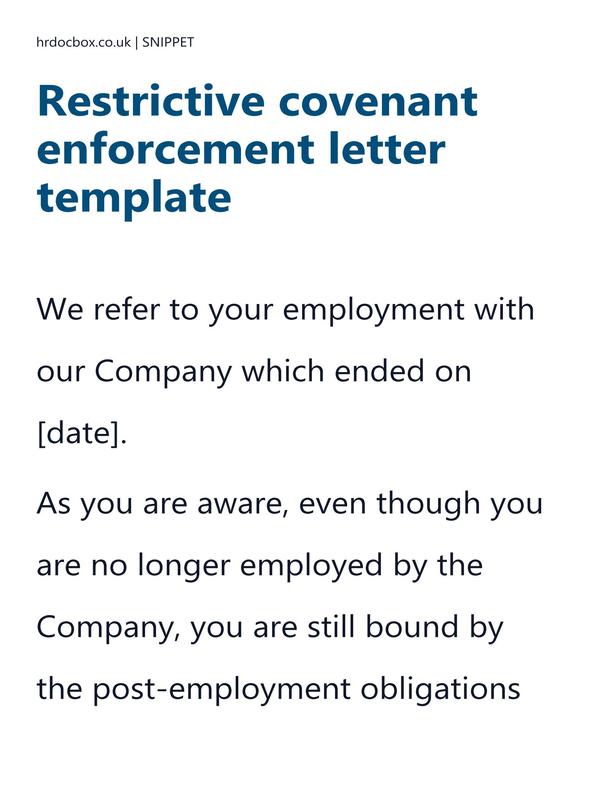
We are writing on behalf of [Company Name] concerning the restrictive covenants and related contractual obligations contained in your [employment contract / other relevant agreement] dated [Date].
This letter sets out our concerns regarding conduct that we believe may be inconsistent with those obligations. We ask that you consider the matters below carefully and provide a written response by the deadline specified.
Relevant contractual provisions
Clause [Clause Number] of your [employment contract / agreement] provides that:
[Insert the relevant contractual wording accurately, or identify the relevant provision and attach a copy where appropriate.]
The restriction applies for [Duration] from [Relevant Start Date or Trigger Event] and concerns [Specify the restricted activities, customers, employees, territory or other relevant scope].
Nature of
You've seen 20% of how the Restrictive covenant enforcement letter template is structured. Get the complete editable template instantly and customise it for your organisation.

A restrictive covenant enforcement letter is a formal communication used when an employer believes a current or former employee has acted, or is about to act, in breach of a contractual restriction. Common examples include alleged solicitation of former customers, dealing with restricted clients, poaching colleagues, misuse of confidential information or competing activities covered by a valid post-termination restriction.
The letter should identify the relevant contract, clause, restriction period and conduct giving rise to the concern. It should distinguish established facts from allegations or suspicions and avoid making claims that cannot be supported by available evidence. The employer should verify that the clause applies to the individual and remains in force before demanding compliance.
Restrictive covenants may protect interests such as confidential information, customer connections, trade secrets or workforce stability. The employer should identify the specific interest at risk and explain how the alleged conduct relates to it. A general desire to prevent competition or make it difficult for a former employee to find work is not, by itself, sufficient justification for a post-termination restriction.
The letter should state what the recipient is being asked to do, such as ceasing a specified activity, refraining from contacting particular customers or confirming that confidential information has not been used or disclosed. Any request should be proportionate to the restriction and the evidence available. A reasonable response deadline should be set, taking account of the urgency and seriousness of the issue.
Where the alleged breach is serious, ongoing or likely to cause immediate harm, an employer may need urgent legal advice about an injunction or other remedies. The letter should not overstate the employer's legal position or imply that a court has already determined the matter. A solicitor should review the evidence, the enforceability of the covenant and the proposed demands before the letter is sent, particularly where proceedings may be contemplated.
Related HR resources and workflow
Explore the HR resources that may be relevant before and / or after using the Restrictive covenant enforcement letter, helping you understand the wider process, maintain appropriate documentation and follow a consistent approach.

Use this model non-solicitation agreement to ensure that an employee does not solicit after leaving the Company.
Use these best practice actions, recommended timescales and process stages to understand when and how the Restrictive covenant enforcement letter should be used, helping ensure each step is handled consistently and appropriately documented.
Understand the common mistakes to avoid when using this HR template, helping you reduce risk, prevent unnecessary costs and ensure the process is handled correctly.
An employer may send one when it has credible information suggesting that a current or former employee is breaching a contractual restriction. The employer should first review the relevant contract, assess the evidence and obtain legal advice on enforceability and the appropriate response. If urgent harm is likely, do not allow routine correspondence to delay urgent legal advice.
Not automatically. A non-compete clause may be enforceable in appropriate circumstances, but the employer must establish that it protects a legitimate business interest and is no wider than reasonably necessary. A restriction on soliciting particular customers or misusing confidential information is different from a blanket prohibition on working for a competitor.
Relevant evidence may include the signed contract, the precise covenant, a chronology of events, reliable records of the alleged conduct and information showing the potential business impact. Evidence should be obtained and retained lawfully. The letter should distinguish what is known from what is suspected and give the recipient an appropriate opportunity to respond.
The request should match the alleged breach and the contractual restriction. Depending on the circumstances, it may ask the recipient to cease a specified activity, confirm compliance with a particular obligation, preserve relevant information or provide written assurances. Any request for an undertaking should be reviewed by a solicitor and should not extend beyond what the employer has a proper legal basis to seek.
The letter may reserve the employer's right to consider appropriate legal remedies, including an injunction or damages where legally available. It should not suggest that a remedy is guaranteed. The strength of the covenant, evidence, urgency and proportionality of the proposed action should be assessed with a solicitor before proceedings are contemplated.
HRDocBox provides practical, customisable HR templates designed for UK employers, including small and medium-sized businesses. This letter gives HR teams a structured starting point for documenting a suspected breach, identifying the required action and setting out the employer's position clearly. Because restrictive covenant disputes are fact-sensitive, the completed letter should be reviewed by an employment solicitor before use.
AI can help organise facts and draft correspondence, but it cannot establish that a particular covenant is enforceable simply from a description of the dispute. An HRDocBox template provides a consistent structure and prompts the employer to identify the clause, evidence, requested action and response deadline. It should be used alongside the actual contract, current legal guidance and case-specific legal advice.
How this content is developed and reviewed
The Restrictive covenant enforcement letter template is developed using a practical HR methodology that considers current UK employment legislation, ACAS guidance, CIPD good practice and the real-world HR process it supports. Templates and supporting information are regularly reviewed and updated, with additional reviews triggered by significant changes to legislation, guidance or established HR practice, helping ensure each document remains practical, relevant and suitable for UK employers.
Darryl Horn, Chartered HR Director
Darryl is a Chartered HR professional with over 25 years' experience in senior HR and employee relations roles.
He has extensive practical experience of managing confidentiality HR processes and founded hrdocbox to provide businesses with practical, professionally developed HR resources grounded in UK employment law and best practice.
HRDocBox has been creating practical UK HR documents since 2009.
"Darryl provides support and advice with excellent judgement, and has a strong understanding of people, policies and UK employment legislation."
"He is someone I trust; consistent, dependable, and committed to doing things properly."




















Whether you employ 5 people or 50, hrdocbox gives you the structure, documents and expertise needed to manage employees professionally and legally.
Professionally written and fully compliant with UK employment law

Access a free contract template instantly - or save 10% on any document today.
Use this code at checkout for 10% off anything!
Includes instant download, updates, and full access to your HR templates.